
Between April and June, the Museu de Arte Moderna in Rio de Janeiro presented the exhibition titled The End of Matter by Mexican artist Damián Ortega. I was able to enjoy two very different moments these works specially created for the museum. The first moment occurred when I saw the project—still under development—for the first time on the eve of the opening while visiting other exhibitions in the same museum. The other moment—a completely different experience—was when I returned to space the last week before the project was completed and saw all the changes that had been done to the work since its initial state.
One of the central elements of that early version of Ortega’s exhibition not yet open to the public was greater than any attempt of contention or blockade through the artifice that any exhibition mounting could ever hope to devise: a large white cube made with extruded polystyrene foam (XPS). As I spent some time looking at the monumentality of the piece—the object was almost twice my height—it became clear that its geometric shape was not made of a single unit, but rather of several sections of extruded polystyrene foam. It was as if this white cube was in line with one of the largest claims in the history of modern art museums in the western world: the exhibition space as an ideal place for the enjoyment of the different geometries of modernity. The second time around, the work took me back in time as it reminded me of one of the essential paradigms in the history of sculpture: the challenge of carving from a single block of marble. Based on the iconic character of this mountain of material—made even bigger by being in one of the temples of modern art in Brazil—Ortega appeared to be interested in questioning some of the central points in the history of art and images.
A second element next to the cube was essential for the completion of this project: a workshop-like section equipped with tables, measuring instruments as well as cutting and carving tools. It was manned by a group of men who were there to direct the action; artists who usually work just a few miles from the MAM-RJ, also in downtown Rio de Janeiro, and who are the protagonists of another visual form of expression that is part of the city’s cultural DNA: the Carnival.
The so-called “contemporary artist” produces—as is the case here with Damián Ortega—exhibition proposals to be visited for weeks or even months, presenting works that may eventually become part of collections and be appreciated until the end of their material life. On the other hand, the often referred to as “artist of the Carnival” works tirelessly to create sculptural pieces that will be admired for only about an hour and a half during the Samba Parade held in the same area of Rio de Janeiro. Once the ephemeral event has occurred—the winning samba school does get to participate in the parade a second time around during carnival week—all that is left behind are the visual records captured in photographs and the oral stories of the glory and opulence of a day fueled with the sweat of Samba that will never again be repeated.
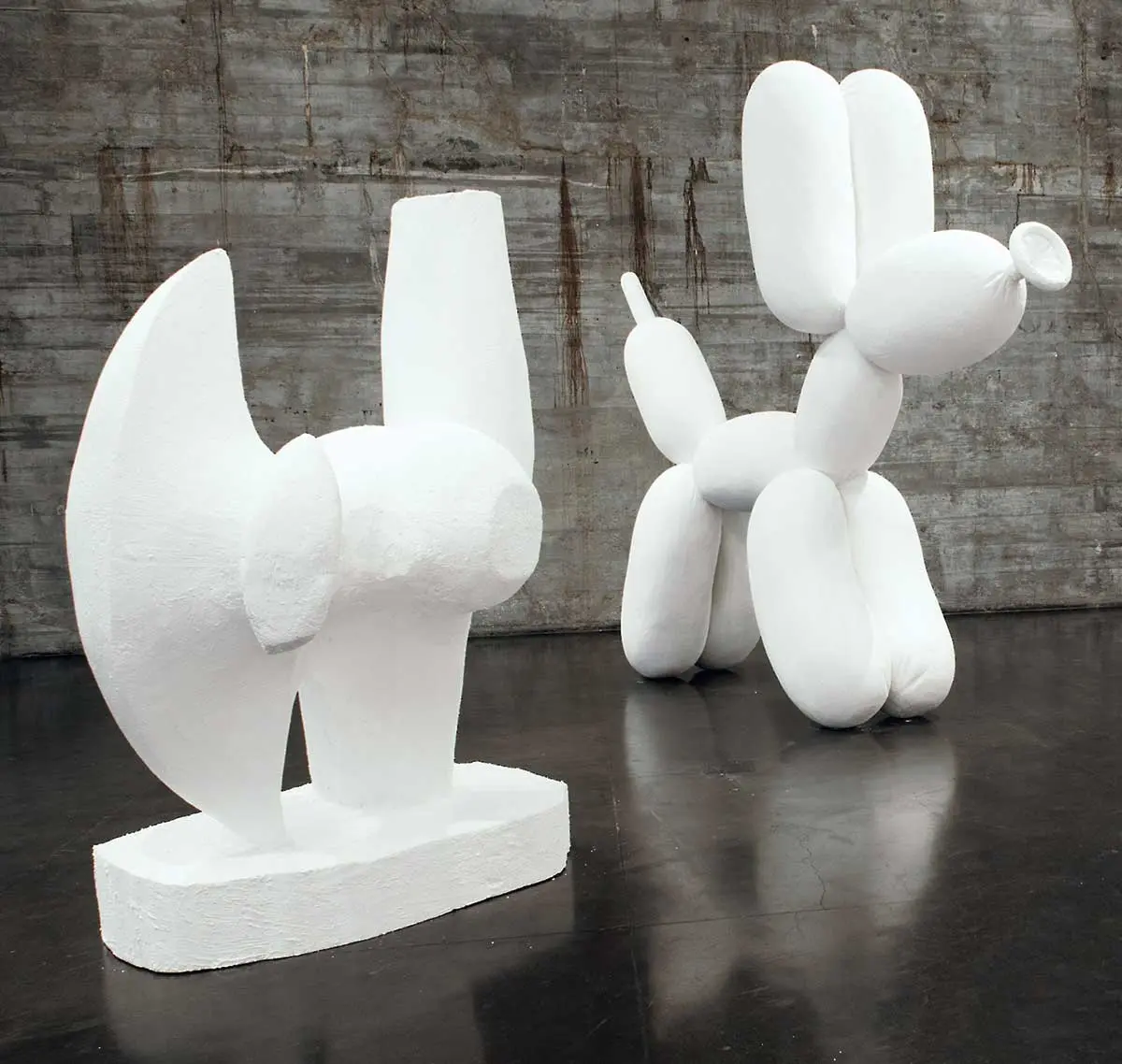
That initial moment of my encounter with Ortega’s proposal culminated with various elements that the public was also able to observe during the closing week of the exhibition. Many famous works from the history of art have been represented through sculpture by artists entrusted with the grandeur of the floats that participate in the carnival parades of the samba schools. On this occasion, Ortega proposed a temporary museum in which works by artists like Jeff Koons, Alberto Giacometti, Henry Moore, and Joseph Beuys were represented using extruded polystyrene foam. Additionally, the collection of sculptures envisioned by Ortega and produced by the local artists in the provisional workshop allowed space and dialogue between Western and non-Western art through the inclusion of, for instance, an Olmec sculpture, a totem produced in a region between the United States and Canada, along with several divinities from eastern regions. Ortega left it up to the public to access their own baggage to establish their own connections with the different cultures, geographies, and even more interesting, with the different ways of worshiping the images. While there is a loyal following of Jeff Koons’s works, motivated by their exorbitant price or by his reiterations that kitsch can be art, the monumental figure of a sleeping Buddha—that references an emblematic sculpture from Mainland China—displayed in such a way that it breaks the continuity of the space, is also a reminder that the adoration of images, including those that are part of the Carnival, is an inherent part of our human condition.
The End of Matter also makes us reflect on the classification of images. What makes this exhibition be regarded as something that belongs to the highbrow world of “fine art” or “high culture,” while, on the other hand, the enjoyment of the sculptures in the carnival is something considered part of a “popular festival”? To what extent are these classifications still relevant in contemporary culture? At any rate, it is a discussion that the Carnival has already articulated in many occasions—suffice to remember the 2010 samba school Unidos da Tijuca participation in the parade with a float that referenced the Laocoon in its structure.
Ortega said in an interview that the project was also conceived to continue the conversation started in 1965 between Hélio Oiticica and the Mangueira samba school—although referenced by Oiticica, the school was not allowed inside the museum that today houses Ortega’s proposal. Fifty years later, more than confirming the existence of a dialogue between “contemporary art” and the samba schools, the exhibition by this Mexican artist reminds us that the visual proposals in Rio’s Carnival are as complex as any artistic image.
This was the question that stayed with me after leaving the exhibition of extruded polystyrene foam replicas: When will the complexity of the floats and ephemeral sculptures in the carnival be considered beyond the realm of “popular” culture and studied with the same respect granted to works of art? What are the possible readings of the Laocoon and Michelangelo after being referenced using extruded polystyrene foam? There is a lot of material to sculpt with and things to be written about when it comes to the subject.
RAPHAEL FONSECA