In June and July of this year, the Zipper Galeria in São Paulo presented a retrospective exhibition of the work of Philip Morozini titled Two under the curatorship of Nazareno Rodrigues and Thais Gouveia.
The exhibition reveals the process of an artist who mainly combines photography and audiovisuals to establish a constant dialogue from the windows of his apartment located in a privileged spot from which to observe the urban chaos of the São Paulo metropolis: Minhocão.
The curators selected two video installations, seven photographs mounted on lightboxes and twelve photographs on methacrylate. These works were produced during the course of more than ten years of research and artistic production, in a relentless pursuit of meaning through images and scenes that insist on occurring before Morozini’s eyes. Felipe Morozini is not only an observer but a poet of images based on events that are offered to him. He weaves a poetic that is very much his own, reinterprets the situations that unfold outside his windows, dialoguing with them and getting in the eye of the storm as he conveys the issues offered to his senses. The exhibition reflects human nature in contrast to the city.
The context of his proposals is the environment created by Minhocão, a causeway built in 1970 that is part of the east-west arterial roads of São Paulo. It begins in the Perdizes neighborhood, on the east side of the city, and reaches Plaza Roosevelt Square in the downtown area, crossing Amaral Gurgel Street and São João Avenue. This urban project caused the rapid degradation of the whole area; the hostile environment created by the deteriorated urban context is transformed in the hands of Morozini into a fantastic space in which discomfort, the enormously loud sound, and visual pollution, and degenerated signs of the city are turned into pure poetry. To accomplish this, the artist allows himself to be affected by the events around him. Through the windows of the apartment that he inherited from his great-grandmother—located on São João Avenue, across from the elevated road— Morozini finds generosity in the multiple dialogues that he witnesses: like the couple on top of a building that performs in the nude a great daily ritual at dawn, a sort of dance/yoga that pays tribute to nature. Those two delicate bodies, full of nobility and simplicity, stand out amid the gray scenery of graffiti-covered concrete plagued by disturbing elements. This dancing ritual appears to occur in a sort of suspended time.
From his window Morozini witnesses life, love, cooperation, and the relationships that he has established with the couple without them knowing about it, or about the camera, the instrument that he uses to tell his stories. The daily exercise of looking, searching for images, enables the construction of multiple narratives in which Morozini and the characters in his environment develop an intimacy that he can only share with them eventually through the resulting work, as the subjects are not aware of their participation in the creative experience.
The scale between people and the buildings is an important and powerful element in the work of Felipe Morozini. The severity of this urban chaos is ordered by the artist as he underscores the lightness and humanity of the people portrayed, and even of the buildings, which are also regarded as characters. Morozini installed a search lamp on the ledge outside his apartment located on the top floor of a building that shows signs of having been elegant at one point, before Minhocão. The searchlight scans the city and its buildings, it even gives some humanity to the urban construct as it highlights people’s homes, but also the contrast between the modern and the old, the imposing and ever-expanding city; the intense movement of cars along Minhocão to go across the city, just a few meters away from the apartments.
This light that illuminates one of the most troubled and polluted areas of the city is the sign of a connection, a way to embrace the city, a caress, a display of love that also reveals details to an artist who steals images and stories lived among the chaos.
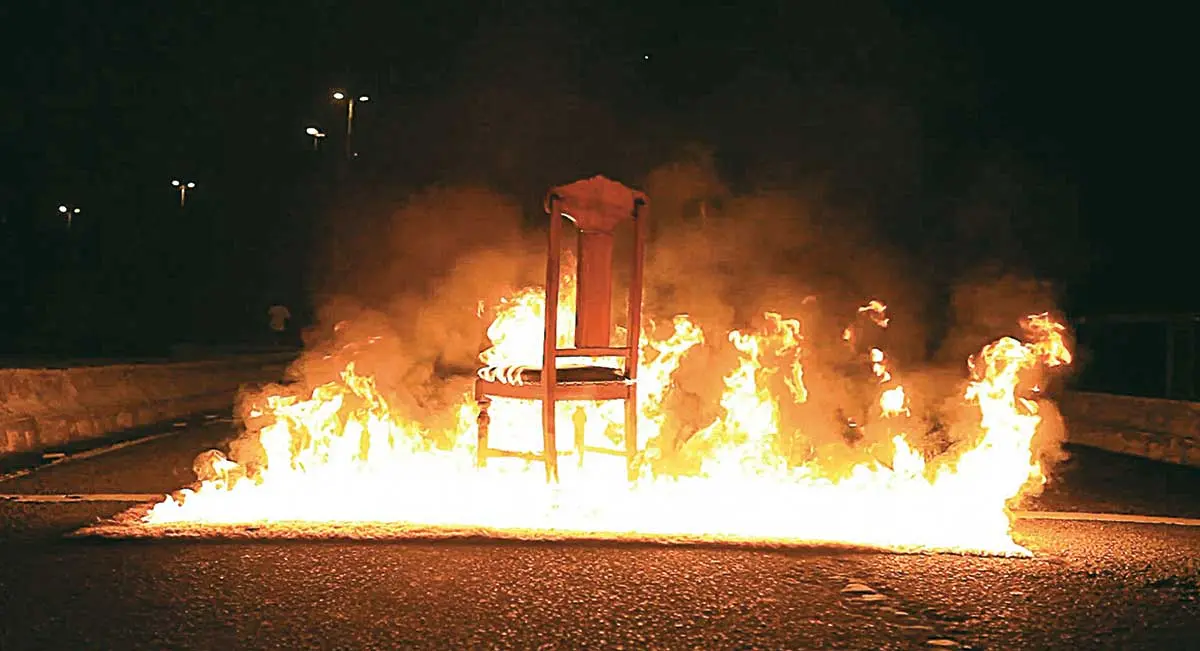
The video installations presented in the exhibition at the Zipper Galeria show Minhocão at night, as it is occupied by old furniture that belonged to Morozini and has been set on fire. It is another ritual, now performed by the artist, as he attempts at any cost to reconfigure the meanings of that landscape and of Minhocão. By burning old objects, Morozini opens a space for new relationships and new meanings, in an attempt to burn the chaos and look into a future of new poetic paths for his narratives.
HÉLCIO MAGALHÃES