
A strange feeling takes hold of you upon entering the exhibition rooms of the Lowe Art Museum and, at first glance, perceiving that they are empty. There is nothing on the floor and on the walls except for a few lines with small bumps that, upon closer inspection, we discover are drawings.
The exhibition Emptiness by Glexis Novoa (Havana, 1964) includes more than ten site-specific works specially created for the event. They are drawings with Neo-figurative tendencies rendered on the walls of the Lowe Art Museum. All of the works are articulated around a horizontal line that incorporates the walls from a curious perspective that is half pictorial and half photographic. It is an approach that produces a dichotomous effect between idea—the narrative effect of being before monumental buildings and constructions—and concentration—the implosive effect employed to represent these images in tiny forms within vast white planes. While initially confronted with works with expanded visual fields, viewers will eventually gather enough visual information to complete a proper reading of the works. Therefore, the perception of the background-figure relationship must be performed in two separate moments and from two different perspectives. The result is an unusual way of rendering the landscape based on panoramic planes, shapes, and objects that construct images in which, although never explicitly, human presence is suggested.
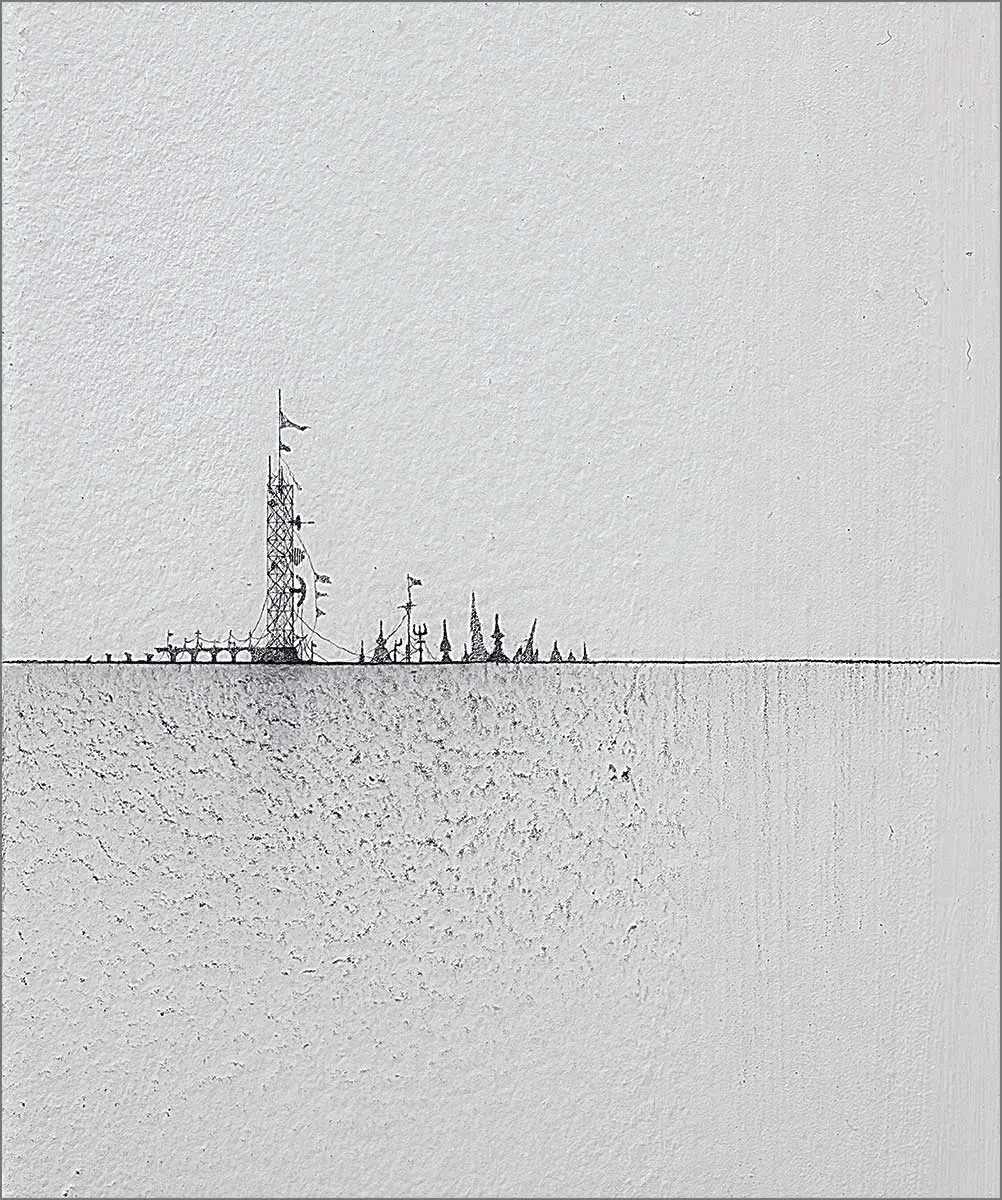
Emptiness immerses us in a world of utopic buildings and cities. Urban landscapes that are half amusement parks, half Tower of Babel, airports, and ports, or Libraries of Alexandria; places in which iconographic towers abound. Some are reminiscent of the constructivist monuments like the Tatlin’s Tower (the communist Monument to the Third International), while others are more similar to the Eiffel Tower or to oil platforms. There are also statues, billboards with phrases that invite to reflect on the context that contains them; bridges, piers, or dirigibles.
It is a strange cityscape, halfway between reality and fiction, “inhabited” and yet desolate, full and empty, concentrated but also expanded. A landscape whose physiognomy refers to a threshold with metaphorical references to pre-modern imaginary cities with fantastic and heroic haloes, as well as to postmodern megalopolis marked by idleness, addictive consumption, and endless entertainment.
Novoa has developed the practice of reflecting on ideologies and their implementation in historical forms of communication. He demystifies the aura that hovers over ideas that have been transformed into objects of consumption and are used for the mass indoctrination of society. Let us consider the works of his well-known Practical Period from the late eighties. Most of them are large installations in which phrases acquire a visuality of a pictorial nature that reference the visual explorations of both Russian constructivism and pop art. They also incorporate, in a parodic tone, a wide repertoire of heraldry on heroes and events that have been used to elevate the history of the Cuban revolution. A heraldic used to educate and worship the moral and ideological values under which the utopia of the communist social project initiated by the Cuban Revolution was to be built. The parody is theatrically conveyed, somewhat in the style of socialist realism, in a staging that turns the attempts to transmit highly intellectual ideas and convictions to the strata of popular culture into overblown and even kitsch occurrences. And this was actually one of the most important aesthetic assets of socialist realism because, as recognized by Boris Groys in Gesamtkunstwerk Stalin, “[...] it bridged the gap between elitism and visual kitsch by making visual kitsch the vehicle of elitist ideas [...] “.
On the other hand, Emptiness also reveals an author dedicated to imaging and representing possible cities. Cities that are not archetypal of those projected by different styles and that marked the architectural thinking of modernity. These miniaturized “cities” by Glexis Novoa do not favor, for example, the impeccably outlined rationalist architecture of Le Corbusier’s Villa Savoye. Novoa also does not favor in his cityscapes the utilitarian Constructivism of the Rusakov Worker’s Club of Konstantin Melnikov and its combination of planes and volumes; nor does he favor the elements of an architecture that applies the style of the Bauhaus, where, according to the idea of Walter Gropius, “form follows function.” Instead, Emptiness approaches the urban landscape through the combination of those architectural philosophies. Thus, the strange urban calligraphies in which shapes, stripped of their common use, recover a kind of spirit of primary significance to talk about the memories found in the unconscious of modern culture.
DENNYS MATOS