The transition from the modern to the contemporary in art corresponds to a paradigm shift from the relationship of art with itself to its relationship with reality. The work by Gustavo Speridião expresses this change in a relevant way, as revealed by the exhibition titled Canvas through eighteen large paintings never before exhibited that the artist created specifically for this recent solo exhibition at the Anita Schwartz Galeria de Arte in Rio de Janeiro.
The title of the exhibition comes from the support used for the works: cotton canvas. The paintings were exhibited without stretcher frames, directly displayed on the wall in what Speridião has called “a simple mounting.” Fourteen paintings, each measuring 2 × 7 meters, were exhibited in the large exhibition room on the gallery’s first floor, while another four paintings were displayed on the terrace, each measuring either 5.9 × 2 meters or 1.8 × 1 meters.
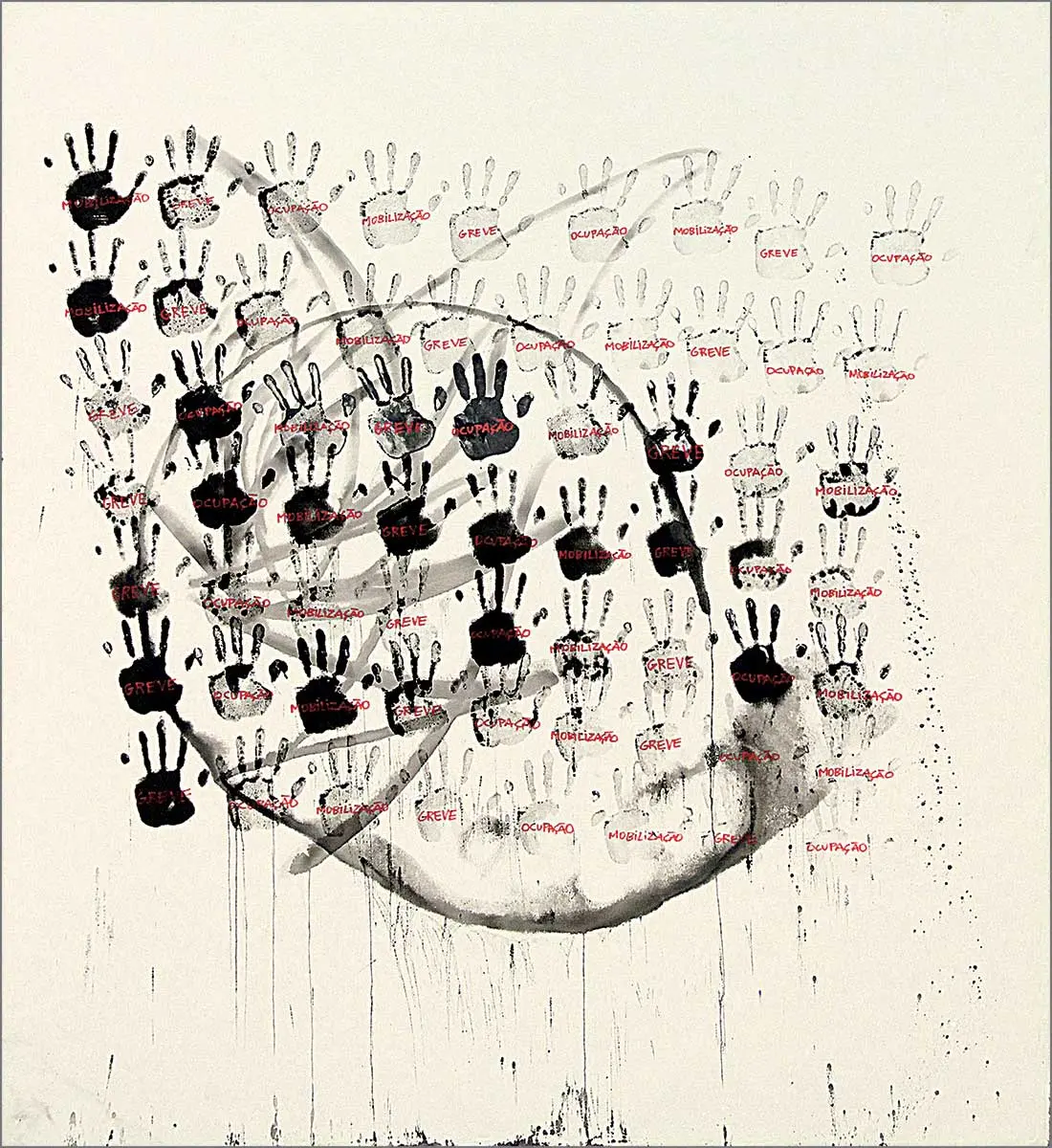
This series of canvases reflect a development in Gustavo Speridião’s oeuvre. It is the result of an exploration of the relationship between art and politics. According to Speridião, with this work, he aims at “exploring the picture plane and political affairs, using ink, charcoal, and collage (words, abstractions, and posters).” Thematically focusing on the close relationship between ethics and aesthetics, his work uses materials and languages from urban culture, as he reinforces the hypothesis that it is possible to conceptualize urban art as a phenomenon that is intrinsic to the contemporary art project.
Speridião made a collage on canvas using visual material that he collected between 2007 and 2014 in several countries, including Brazil, Bolivia, Portugal, Spain, Mexico, France, Greece, Russia, and Turkey. “They are street posters covering subjects that range from politics to social movements. It is material that illustrates the beginning of the global economic crisis of 2008 and its political ramifications,” said the artist. Therefore, there is a coherent connection between his work and the origins of the graffiti language, a visual manifestation that began in Paris with imagery created at universities in 1968, which was often transgressive, ephemeral, non-institutionalized, anonymous and clandestine1.
The work in the exhibition Canvas includes phrases like “Do not fear the world. Change it!” and “Damn middle-class!” which directly reference historical passages like the famous expression “forbidden to forbid,” an anthological street graffiti from the movement of May 1968. Another reference is the video titled Moviment, with images taken between 2007 and 2014 in different countries that highlight that international social movement. “Some of the works I presented center on the international revolutionary process, and others that, without directly addressing such themes, are nonetheless deeply influenced and colored by it. I use the same plane to render apparently different fields; pamphleteering abstractions, written paintings, and abstract pamphlets,” said Speridião.
Speridião’s work refers to the use of words as a distinctive sign in graffiti, and even as a characteristic that punctuates the entire course of art history at various times. It especially emphasizes the symbolic characteristics of words, as it has occurred over time, from the Renaissance through the posters of Toulouse-Lautrec, the avant-garde movement (Cubist collages, paintings by René Magritte and Fernand Léger), after the post-war era (1959 work Trophy 1 by Robert Rauschenberg, for instance), or even in the conceptual works of Lawrence Weiner from 1970, like Earth to Earth and Ashes to Ashes Dust to Dust, and so on.
In saying that words can be interpreted as images, researcher Simon Morley affirmed in his book titled Writing on the Wall: Word and Image in Modern Art (University of California Press) that this is an offensive operation against all forms of fundamentalist thought, given that the relationship between image and word promotes ambiguity and indeterminacy against code patterns, causing a semiotic that presses the placid surface of language.
Born in 1978 in Rio de Janeiro, Speridião is a prominent member of his generation. He has participated in several exhibitions in Brazil and abroad, including Parasophia 2015, curated by Shinji Kohmoto in Kyoto (Japan); Here There (Huna Hunak), curated by Gunnar B. Kvaran, Thierry Raspail, and Hans Ulrich Obrist, at the Museum of Art Park in Doha (Qatar); Imagine Brazil also curated by the same three curators, in Lyon (France) and at the Instituto Tomie Othake in São Paulo; and the personal exhibition Géometrie. Montage. Équilibrage. Photos et Videos, curated by Jean-Luc Monterosso at the Maison Européenne de la Photographie in Paris in 2013. The work of Gustavo Speridião is part of major collections like the Gilberto Chateaubriand/Museu de Arte Moderna, Rio de Janeiro, Museu de Arte Contemporânea in Niterói (MAC) and the Museu de Arte do Rio (MAR), in Rio de Janeiro.
Speridião’s work reveals how contemporary art expands the political potential of the artist. As critic Miguel Chaia writes in the book titled Arte y Política: Situaciones (Art and Politics: Situations, Azougue Editorial), the role of art is to be “[...] a possible site of resistance and change in society and, especially, a dense remnant of humanity.” And the work by Speridião does justice to this premise.
NOTE
1. N.T. It is worth remembering here that the graffiti existed for at least 300 years BC in the Greco-Roman world.
ALESSANDRA SIMÕES