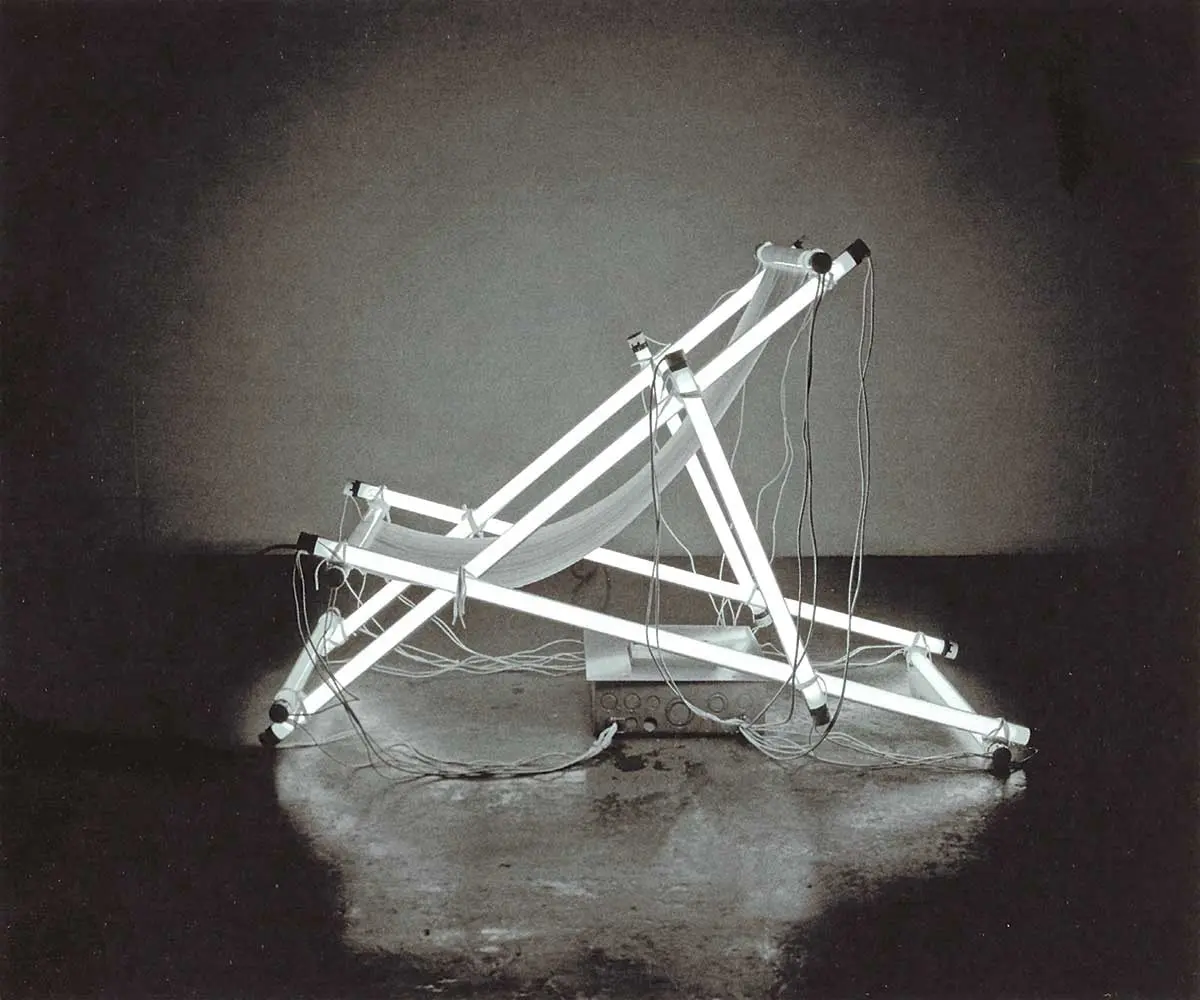
Iván Navarro was born in Santiago in 1972. At the time, Chile was living through a period of intense political instability, which came to a brutal denouement with the 1973 coup de état. Thus began an era of dictatorship, blackouts that darkened the streets across the country (and the electrical systems in torture centers), and ceaseless military surveillance that silenced an entire nation. But, did that silence, those interruptions, and those machinations end after seventeen years of self-censorship and repression? Confronted with this question, Navarro, who began his visual arts studies during the first year of transition in 1990, noticed the body and its sustained dichotomy between fragility and danger. He graduated in 1995 with a project that already connected electrical systems to the idea of survival.1 For the past twenty years (he moved to New York City in 1997), Navarro’s work has reflected pointedly on electricity and artificial light, exploring not only a notion of control during the state of siege in Chile but also its shadow, or better yet, its shadows: what remains after the action of light, at once violent and seductive, is used in various instances of abuse of power, in different geographic and cultural contexts. Thus, as more than one critic has noted, Navarro’s work has not been circumscribed to passports and local politics—the atrocities of the dictatorship and its sequels, as he previously did in Chile in 2007 with ¿Dónde están?—but has been able to engage, opportunely and shrewdly, local and global issues at least since 2001, when his Te sientas te mueres included the names of American citizens killed in the electric chair since the device’s introduction in the late Nineteenth Century.
Celebrating its first anniversary after hosting exhibitions by such artists as Miró and Yayoi Kusama, the CorpArtes Foundation’s Centro de las Artes 660 presents Navarro’s first mid-career retrospective from August 7th through October 18th. Curated by Manuel Cirauqui, currently, assistant curator at the Dia Foundation, this very thoughtful (in visual and theoretical terms) exhibition brings together twenty-three works created by Navarro between the mid-1990s and today, including now-canonical items such as Homeless Lamp, the Juice Sucker (2004-05), on parallel exhibit at the Guggenheim Museum in New York, and lesser-known work such as those for Hueso Records, a music production company established by the artist in 2005. In fact, the inclusion of Hueso Records productions in a specially conditioned room, in collaboration with Courtney Smith, signals Navarro’s decisive relationship with music, a subject that dialogs with recent works like a large cylindrical sculpture resembling a bass drum. The Spanish word for this musical instrument, bombo, brings to mind the word bomba—Navarro’s art is populated with wordplay—the object produces a strange warlike sound, always silent.
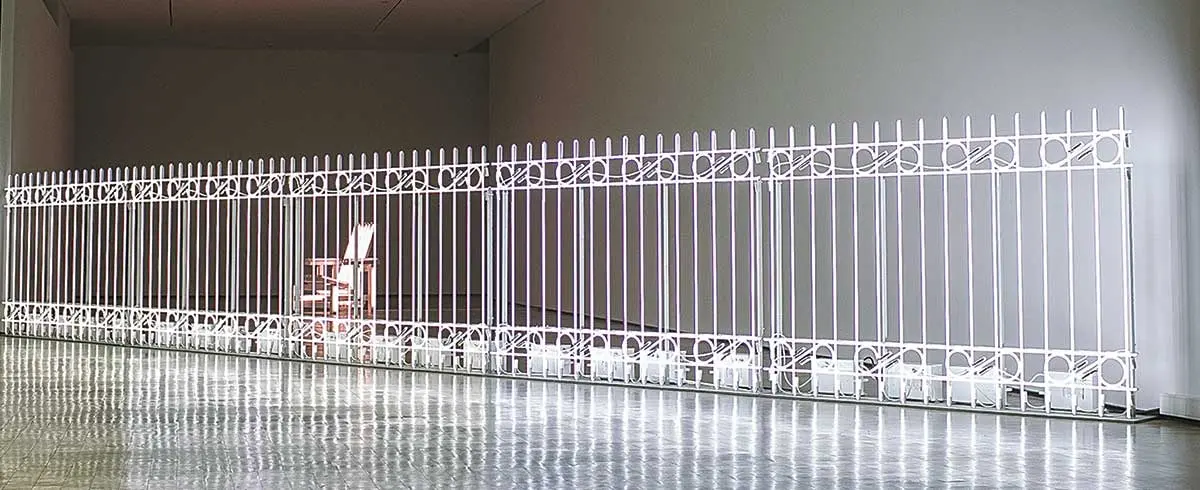
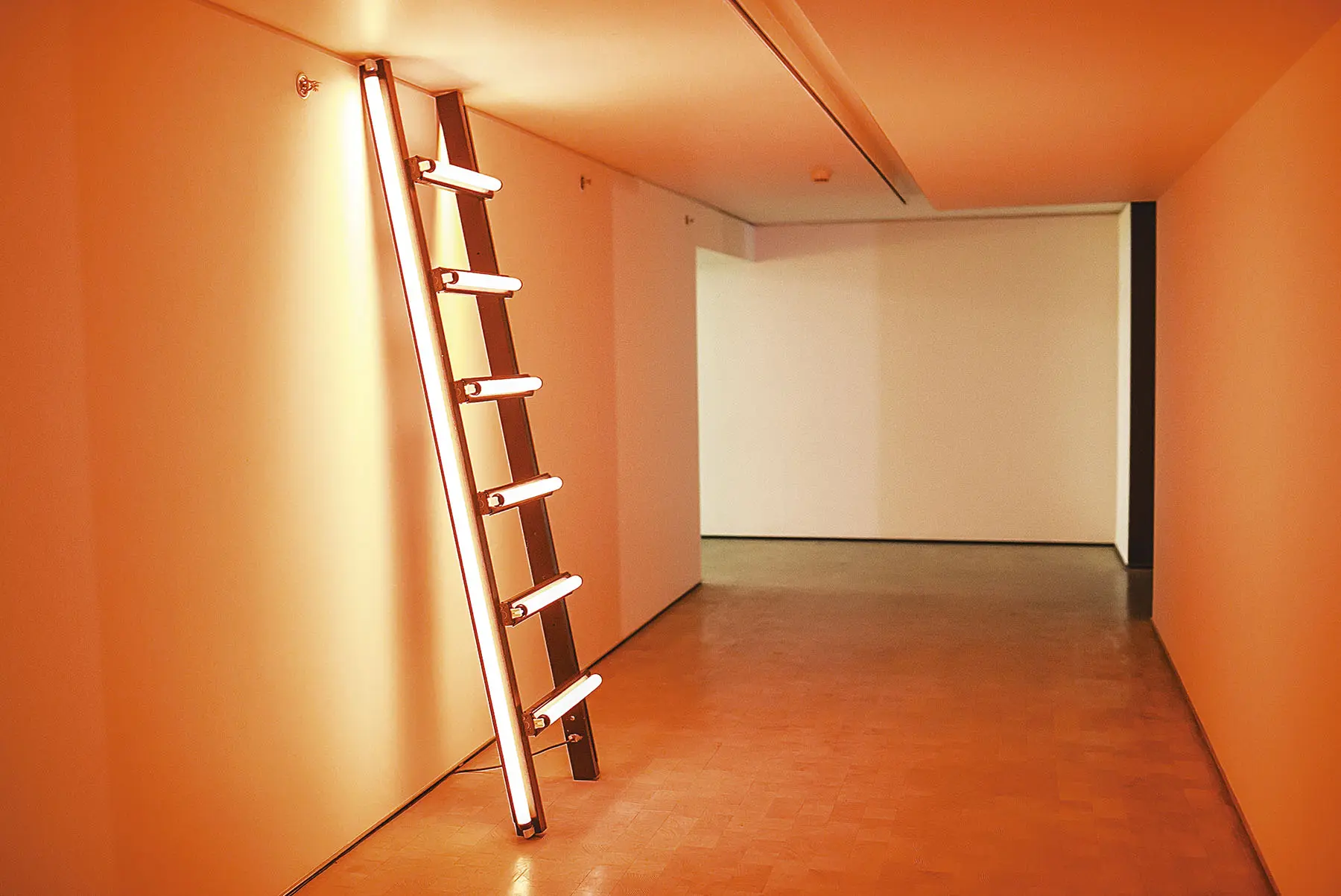
As they are installed in Centro de las Artes 660’s ample, well-equipped galleries, Navarro’s works prevent any chronological narrative, presenting, in turn, new associations around the concept of machine in order to connect subjects like industrial design and post-minimalism, present in his oeuvre. In the first gallery, the well-known associations and alterations that connect Death Row (2006-9) with Ellsworth Kelly’s Spectrum V (1969) again insist on the decisive presence of the viewer’s body, which approaches the thirteen doors in Navarro’s installation—aluminum, mirror, neon, and electricity—like a desiring machine. The body is invited by light to see its own reflection in the mirror, it's double, but soon this narcissistic pleasure becomes absence, a vacuum that seems eternal but is at the same time a false abyss, like a silent and impossible war. In 2009, for the catalog of his participation in the Venice Biennale, Navarro says that Death Row “is an attempt to temporarily intervene an impenetrable space (…) representing a silent and impossible war.”2 Six years later, Cirauqui has taken Navarro’s own words for the title of this retrospective, insisting on the poetics of negation as the starting point for an understanding of his work as a whole. Interaction and immobility: the sensorial experience in the viewer’s body is contradictory and different in each work, not entirely unconnected to Mona Hatoum’s post-minimalistic installations, where the body confronted with visual discourses that involve different kinds of abuses of power swerves between disillusionment and desire, never settling for disaffection. In this way, a version for CorpArtes of the cage presented by the artist for the 2011 Armory show, which criticized the typical art fair booth, now contains Pink Electric Chair (2006), initially preventing our access to its jail-like enclosure. However, after coursing through the exhibition, viewers are allowed to enter the cage and approach Pink Electric Chair, although sitting on it is impossible since the body might not be able to withstand the electricity. The same occurs with ironically functional works like Red Ladder (Backstage) and Joy Division I & II (2003), also on exhibit here. All in all, for Chilean audiences who have only had a chance to see ¿Dónde están?, this exhibition provides not only a notable selection of works by the artist beyond the local situation, but also an opportunity to pose interesting questions about the figure of the Latin American artist today, and their exhibition spaces and contexts.
NOTES
1. For more information, see http://www.artishock.cl/2015/04/13/el-mercado-del-arte-mitos-fantasias-realidades-videos-de-feria-ch-aco-2014/
2. Iván Navarro, in conversation with Justo Pastor Mellado: Iván Navarro, “Políticas de abastecimiento,” In Iván Navarro, The Threshold (Milan: Charta, 2009), p. 59.
FLORENCIA SAN MARTÍN
Ph.D. candidate in Art History, Rutgers University. Art critic and curator.