Between the months of May and June, the Galería Beatriz Gil in Caracas presented an interesting exhibition of sculptures under the title Spaces and Circles. The show consisted of a group of sixteen works by Venezuelan sculptor José Jesús Moros (aka J.J. Moros), an artist with an important trajectory and renowned visual sensitivity.
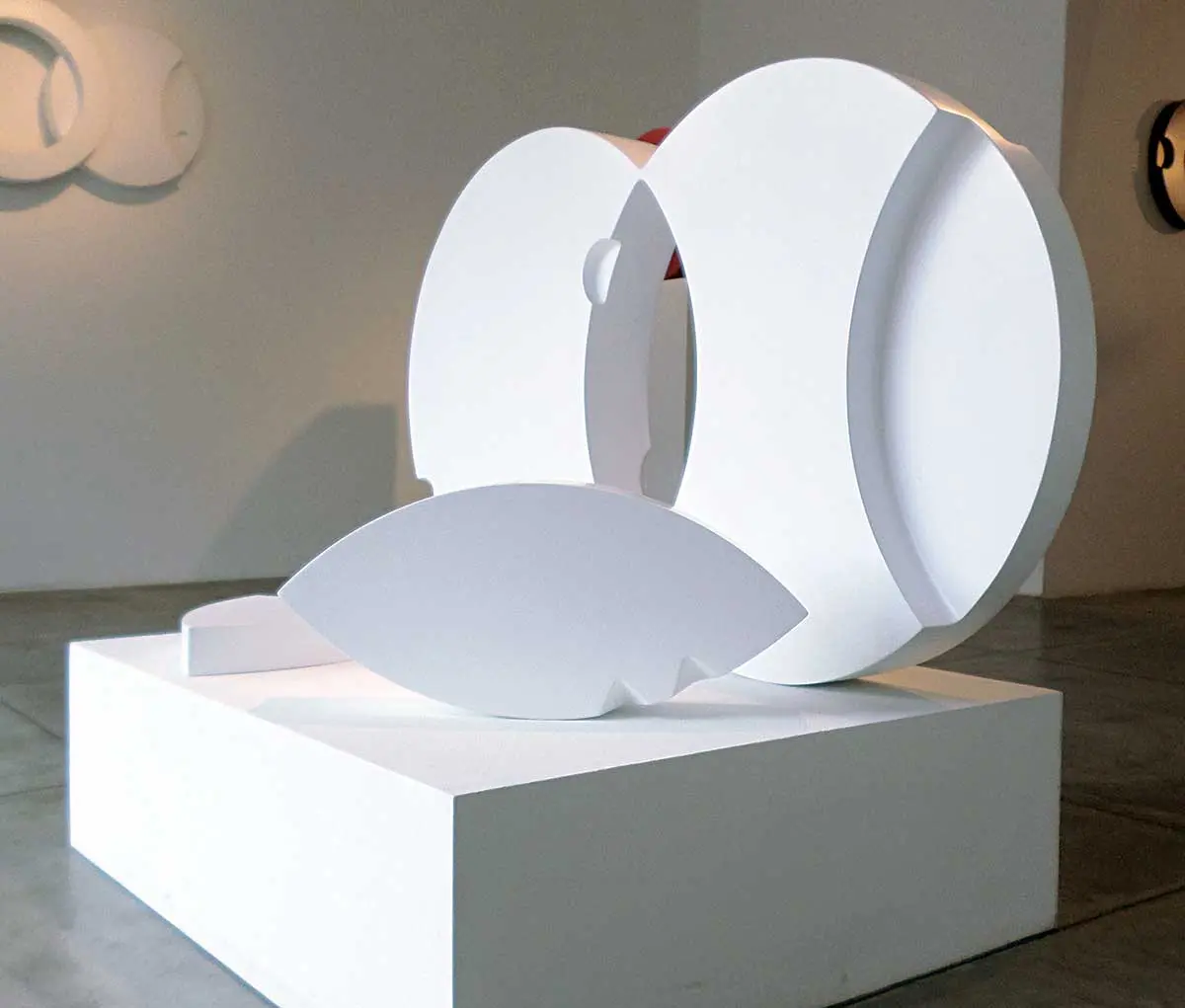
Most of the pieces in the group of works included in the exhibition can be formally defined based on the circle, one of the essential components in universal geometric language and particularly in art. This ancient form—but novel in Moros’s aesthetic language—acquire new “formalities” through his continued and consistent practice, while also proposing renewed perceptions. Thus, the circle is changed, transformed, it acquires original—or perhaps unknown—presences that make it different without losing its original condition.
The ability to modify a known form into a reinvented one—the result of a precise, thoughtful, consistent and serene practice—is an important quality in Moros’s creative process. His work with three-dimensional pieces began in the 1980s and continues to this day. Throughout this period of time, his sculptures have remained true to the constructivist language. Initially, there were the carvings on wood; a noble, unconditionally loyal material and a media that has been used since ancient times in the world of sculpture. The sculptures produced during this period constitute an important group of works that have earned Moros a place in the national art scene and that have made him a referent of Venezuelan art internationally. During this process of consolidating his discourse and innovating the aesthetic vision of his rationalist and structured three-dimensional proposals, he also began to incorporate metal, particularly steel. This material will allow him to assess the important role of technique, of flawless execution driven by aesthetic pursuits. His exploration will lead him to the creation of rigorously orthogonal volumes characterized by certain unmistakable signs of his creative practice: cuts, cracks, and the alteration of a severe geometry in favor of enhancing the value of the “emotional.” It is in this manner that Moros is able to reach a favorable balance between structurality, formal constructive values, and the sensitive form.
The exhibition at the Beatriz Gil Galería presents a total of sixteen pieces, most of them in steel. This small but significant group stands out for the special treatment given to the chrome work; however, the form of the circle becomes the connecting thread of the exhibition, the core aspect around which the show is built. J.J. Moros gives the circular shape a leading role. While the exhibition also includes some earlier works, it focuses for the most part on the emotional constancy of the circle and on the symbolic aspects associated with this ancestral form. A notable aspect of the works is the contrast between orthogonality and the search for the unlimited amplitude suggested by the continuity of the circular shape. Additionally, it points to the notion of totality, even infinity; in that sense, the shows opposed the orderly and systematic nature of orthogonality, in a contrast that somehow allows an assessment of Moros’s work a broader perspective.
From a distance, the works presented in the exhibition suggests a formal unit; however, closer and careful observation, reveals many interesting aspects, formal components that enrich the show’s significance. In Círculo Beta (Beta Circle), a piece rendered in black that was intervened by forms associated with the work itself; small circles or circular components used to create reliefs and variations; antagonisms organized within the piece—with the intention of stimulating the perception of the object—that contrast and balance the strength of the work as a whole. The work Dúo-Sustracción (Duo-Subtraction) follows that same idea. It is a sculptural piece that, again, is the symbolic consequence of the intersection of two circles in which the overlapping sections created by the encounter result in emptiness. This outcome has visual consequences that are immediately defined by contrasts, while the evidence of any connections becomes a reflective experience.
For its part, in the work Caligrafía V (Calligraphy V), four black circles propose elements that are similar to the piece Círculo Beta. However, this group reveals more complex relationships, such as compositional and dimensional variations, and, most importantly, those variations of a symbolic nature that exist between the components. Finally, the work has been designated as the most important piece in the exhibition, Rueda Rueda (Circle Circle) combines emotional and symbolic elements. Formally, it does not offer any major compositional variations in relation to other pieces of the group, being rather closely related to the work Círculo Beta. But the variations in this final piece occur through color: the red wheel. However, everything counts in these highly emotional times.
FREDDY CARREÑO