Beauty is truth as Keats put it — but the truth is often ugly. In an arena where aesthetics and morality actually align, the artwork created provides a diacritical form of resistance.
Jorge Tacla’s recent paintings investigate the intersections of communal history and personal memory. Deep hues of charcoal and blue allude to the colors of the official story; newspapers, photographs, and the small televisions of the artist’s childhood in a tumultuous Chile.
In Tacla’s second show at Cristin Tierney Gallery, he continued with his sublime scenes of destruction. In pursuing ruptured landscapes, he investigates an entropic space that is social as well as physical.
In two large paintings in the front, Tacla depicted a bombed-out armaments factory from post Civil War Spain. Beginning with photos of the devastated remains, he translated the architecture and mechanical parts into a lyric vocabulary. Compositionally, the horizontals, verticals, and diagonals set up a dynamic dialogue that’s apparent throughout the show.
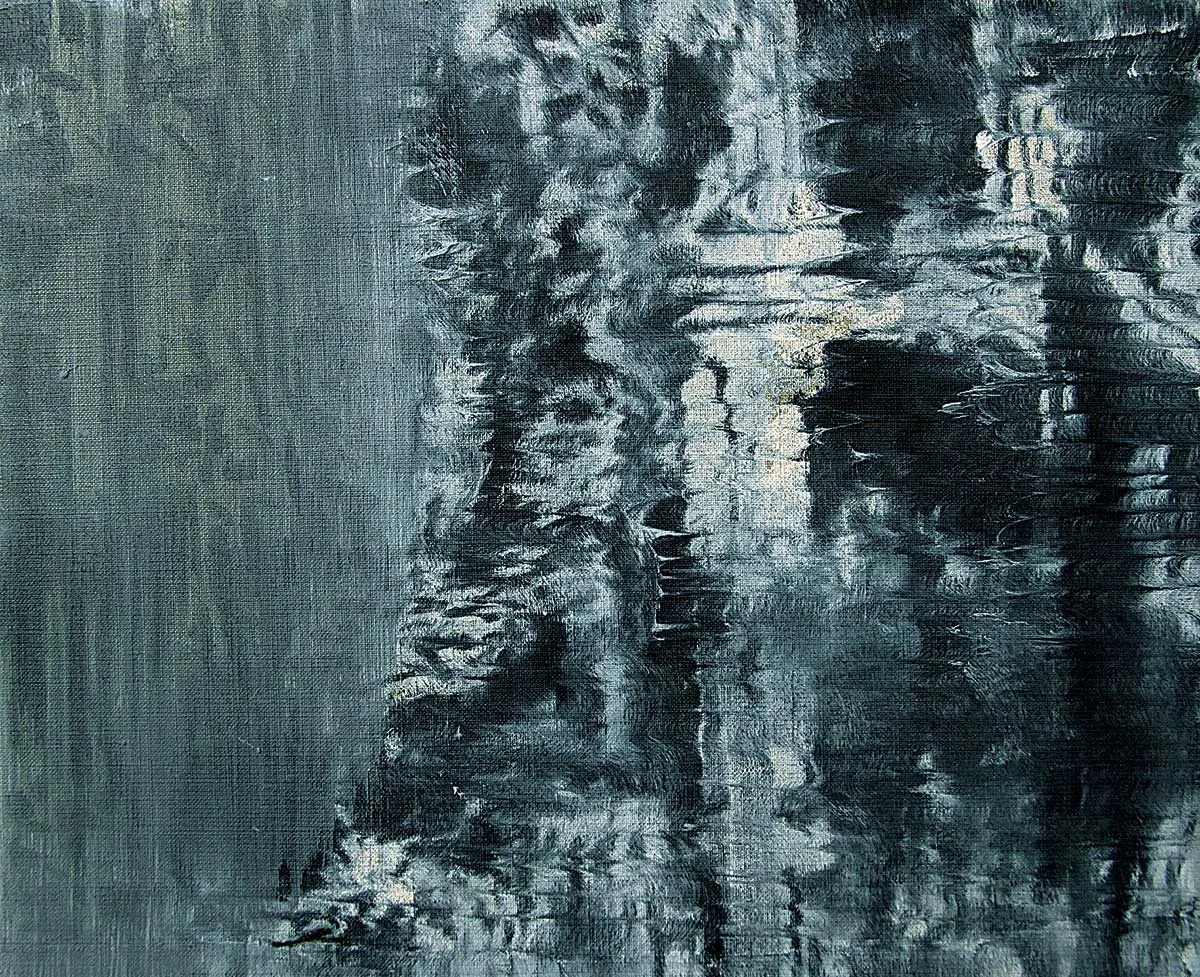
Done in nearly monochromatic palettes of navy and slate, Tacla added cold wax to the canvases. This slight skin is mixed with pigment and is smeared and scumbled into ragged, flickering rhythms, destabilizing the images.
In the foreground of Identidad Oculta 111, soldiers survey what appears to be an imposing cannon barrel. Tacla is known for repetitive mark-making and in this painting he left a couple of strips uncovered by later layers, allowing one to see a pentimento of his process. This is attractive and informative. It attests to Tacla’s unique balance between representation and abstraction.
In the other large painting, Identidad Oculta 112, the artist exposed even more of his underpainting, revealing the initial sketch. Sinuous and interlocking, the lines suggest an animated shorthand or a pseudo-cuneiform that the artist has cultivated since he showed at Nohra Haime Gallery in the 90s.
In this painting, one peer into a cavernous partly demolished structure that is open on the far side. Framed by receding walls on the sides and crossbeams above, the floor is an active field of contrasting marks and forms. The interplay between dark and light culminates in a sumptuous passage of pure abstraction.
The shapes represent rubble but remain obscure. The ambiguity is such that they could as easily portray an active throng of productive people — or more appropriately, their ghosts.
Most of the smaller works reflect the carnage of currently war-ravaged regions like Syria. Buildings, blown out and subsiding, their grids askew, speak to a collective failure — and possible mutual future. A few figures appear; a dejected man picks his way through debris; another is beaten.
In Identidad Oculta 102, the devastation has a Dickensian gloss. On the right and in the foreground we see ornate pillars and dark entrances. The surface ripples and refracts, creating a watery effect and threatening to disintegrate entirely. In the left background, a series of calligraphic marks encapsulates a ravaged apartment. This section is recessed further by a faint white overpainting, suggesting society’s disregard.
The transformation of utilized living spaces into a deserted wasteland is obviously disturbing subject matter. The skeletal buildings are gloomy relics. Yet the pairing of geometry and randomness provides an opportunity for formalist rigor that Tacla takes full advantage of with striking results.
Departing from urban ruins, Tacla focused on the leftist Marcia Merino, nicknamed La Flaca Alejandra. Following the coup in 1973, she was captured, tortured, and sexually degraded, becoming an informant for the secret police. In a triptych, a central visage of Merino is flanked on the left by a rumpled bed. Blue striations dissect the room, simulating a surveillance camera’s poor quality. In the right painting, faint bones lie submerged by a shoreline where bodies were dumped.
The crushing relationship between aggression and victimization is an undercurrent in all the works even as the oppressors, like the dispossessed, remain concealed. In probing the viability of our personal volition, Tacla also questions the sources of our collective and individual identities.
Subtle manipulation of the images adds to their impact. For instance, the smallest paintings are the same size as tv screens from Tacla’s childhood. The lights were dimmed in the gallery, conjuring the uncanny sensation of being back home watching TV — as a child.
Ultimately, Tacla is simulating feelings. In the exchange between painting and viewer, his work considers the complexity of assigning guilt and addressing redemption. By bearing witness, he offers a way to find aspiration in expiration.
A selection of whimsical, somewhat minimalist pencil drawings provided a counterpoint to the highly worked paintings. Despite the difference, the two formats still shared a diagrammatic sensibility.
It is appropriate that this show paired blasted domiciles with ruined munitions plants. It’s a reminder that humans do inhuman things — whether by design or by default. Jorge Tacla’s haunting paintings recontextualize violence, rendering it into a theoretical (and visual) sensation.
JEFFREY CYPHERS WRIGHT