Dogma: something that should not be questioned and requires blind acceptance. Concept appropriated by religions and political ideologies, which can also be used to refer to beliefs and habits that, guided by family, educational, and cultural heritages, become rooted in private lives. This is the meaning that José Rufino gives to “dogma,” using the world as the title of his solo exhibition at the Central Galería de Arte. The show is a reflection on his thirty-year career, an examination of how his “personal dogmas” were conceived, questioned, supplanted, or sublimated throughout his life experience and as an artist. More than a retrospective, it is the end of a cycle.
Paleontologist by trade, the resurrector of his and other people’s memories by choice, Rufino gradually became an artist. Self-taught, he initially pursued visual poetry and mail art, as he began building a body of work with many formats and techniques, exploring the relationships between visual arts and literature, history, psychoanalysis, and politics. Freud, alone, would fail to explain it. In addition to the father of psychoanalysis, to understand Rufino’s work it is necessary to keep in mind other references like Lenin, Darwin, Duchamp, and Malevich. One must also take into account his facet as an artist-sociologist aware of the past and present of Northeastern Brazil and of the world.
The artist grew up in an environment of historically strong and conflicting references. He is the grandson of a sugar plantation owner and son of activist parents affiliated with the Communist Party and peasant league organizers. This dichotomous environment nourished his conceptual sensitivity, the basis of his work, which branches into several discussions about the issues that influence the formation of individuals and of groups. While his initial interest was personal, the stories that Rufino materializes expand into a much broader emotional and social universe formed by many individualities. The elements that he appropriates are never random, they are found among used objects with rich histories and meaning that may never be entirely revealed, but whose transmutation into art offers them a new life.
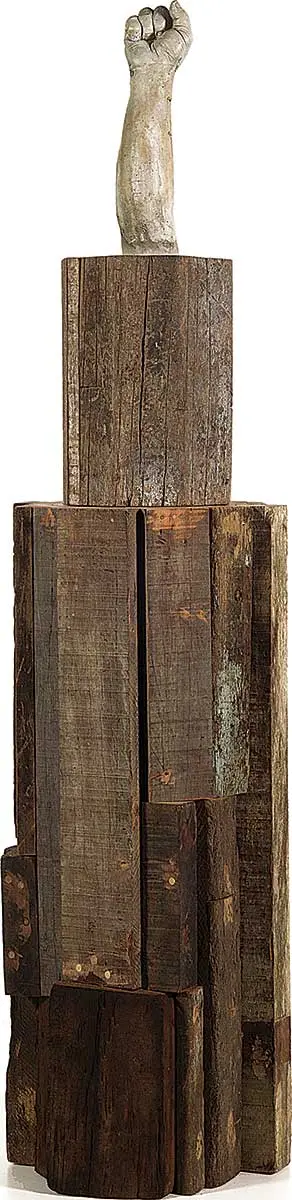
The exhibition includes his monotypes, partially covered ancient and forgotten documents rendered in the manner of Rorschach inkblots that invite the viewer to connect with each image according to his/her subjective interpretation. The show also features sculptures in which the original function of everyday objects is subverted at the same time that their intended use is enhanced in such a way as to cause concern. The overlapping of times and sharing of authorships operate in the work Dogma, an unfinished drawing that belonged to Karl Marx, made by his father during the period of his detention as a political prisoner. Rufino intervened in the image by adding wooden cups that hang from the portrait. The composition, which paradoxically alludes to an altar, transmutes the expression of and ideological manifestation into a work of art exhibited in a space that is part of the capitalist art system. Tovarich (comrade, in Russian) closes the cycle of the Soviet Union’s utopia by joining the individuals who were respectively responsible for its rise and dissolution. A reproduction of the birth certificate of Gorbachev invades Lenin’s head in a portrait of the latter from Ukraine, acquired at auction.
Ideological dogmas are not the only things explored, as Rufino also addresses issues related to art and the cycles of life. The canvas Manifesto superimposes the names of various movements and precepts of modern and contemporary art that have had a great impact on aesthetic thought, not just for Rufino but also for many other active artists. Two small canvases with strong brushstrokes and vivid, flesh colors, address an issue that is intimate and universal at the same time: death. They specifically refer to the death of the artist’s brother. Strong, shocking, disturbing, somewhere between the particular and the collective, memory, and oblivion, between reality and what it might have been, Rufino’s work requires careful assessment. But besides the aesthetic dedication with which they are executed, one can always discover in them more layers of meaning than they appear to have at first glance.
José Rufino was born José Augusto in João Pessoa, in 1965, and began his career in the 1980s. Choosing his artistic name was a conceptual gesture: it was the name of his grandfather, a powerful representative of the sugarcane oligarchy. His grandfather’s vast correspondence inspired Rufino to create the series Sand Letters. Besides being a visual artist, Rufino is also a writer and professor at the Universidade Federal da Paraíba and Universidade Federal de Pernambuco. He recently released a book of micro-stories titled Afagos (Caresses), and, in 2009, received Funarte Scholarship for Literary Creation for the novel Desvivir (Unliving), yet to be published. Since 1984 he has participated in about two hundred solo and group exhibitions in Brazil and abroad has participated in the São Paulo Biennial, Mercosul Biennial, Havana Biennale, Venezuela Biennial, and the End of the World Biennial in Ushuaia, in addition to São Paulo International Art Fairs, ArteRio, ARCO, and Art Basel.
SYLVIA WERNECK