
Little known outside of Mexico, the country that has claimed the British-born (Isle of Wight, 1923) artist, Joy Laville is now in her 90s and still painting. Hopefully, she is not another woman artist relegated to the back pages, or omitted altogether, only to be “discovered” so late in life like so many others. This exhibition in Dallas should contribute to the recognition of her work beyond the Mexican borders and bring her into the mainstream. Interestingly, Laville has had a stellar and international career, been included in important Latin American auctions and exhibitions, and sought after by museums and galleries for years. She has lived and worked in many places in the world, the last forty years in Mexico where she had her first exhibition in 1964 and has received every award Mexico can bestow, including some of the nation’s highest honors for an artist. She was never political (difficult in Mexico), nor was she a member of any group, nor interested in joining. She does not easily fit into recognized stylistic categories, although her work is as surreal, mysterious, and elusive in her approach to abstraction as many of her contemporaries.
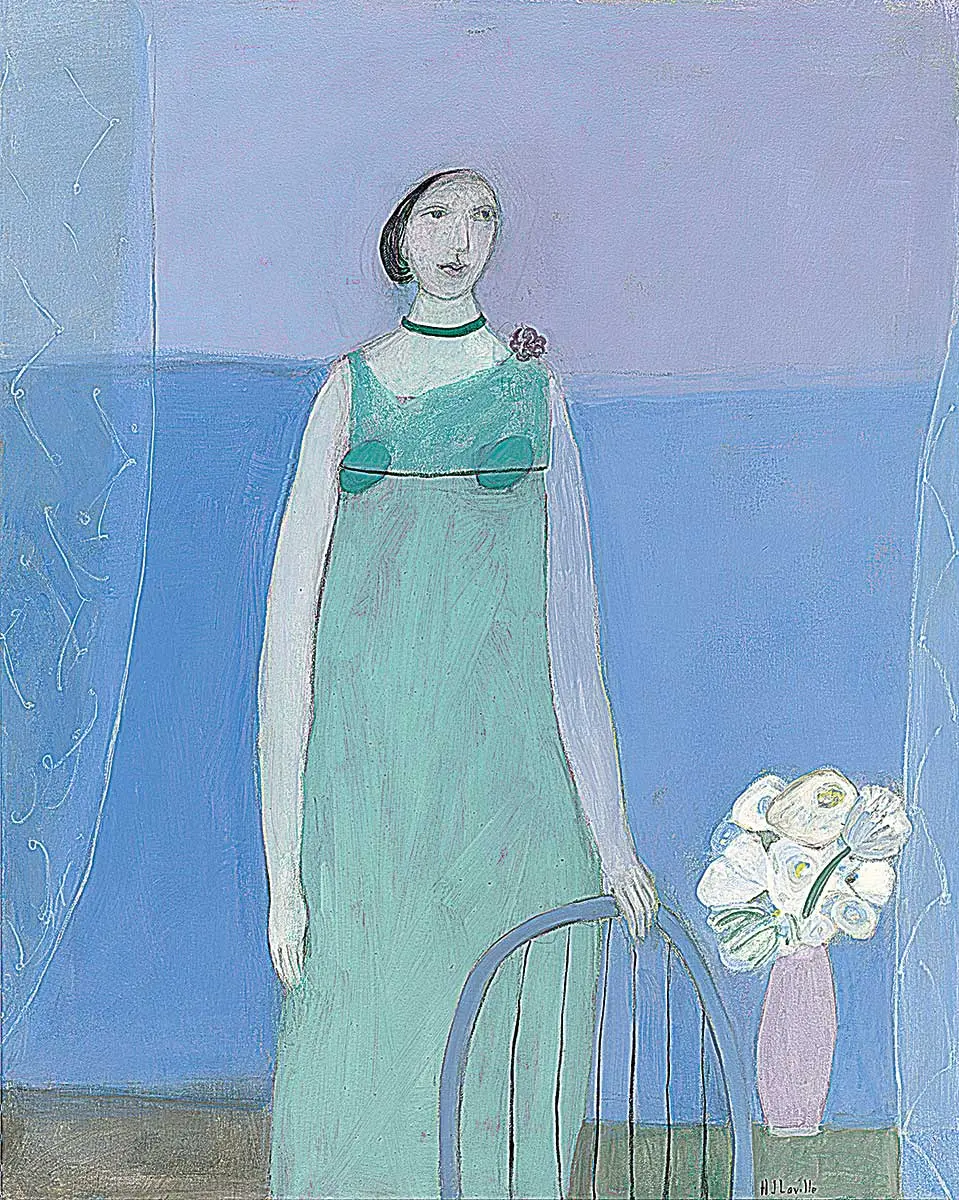
Accompanied by an excellent catalog by curator and Mexican art expert Dr. Salomon Grimberg and others that help to reveal the story of her life, the authors assist the viewer in understanding the life experiences that inform works replete with memories and a sense of nostalgia that play key roles in their creation. The soft and quiet colors may be the first impressions that define and describe her paintings, making them distinct and recognizable over the years, but they are not applied for the sake of color alone, nor even for its symbolic associations. A color is as much an abstract object as the singular personalities and scenery it describes. Each canvas is built up in tonalities that allow its hues the privilege of the moment. Color introduces a kind sense of abstract figuration and simplified landscapes, and gives her subjects a sublime sense of presence.
The figures, such as the one on the cover of the catalog, Girl standing wearing a green dress, 2008, and in Woman and paintings on a wall, 2010, are as sparse as their backgrounds, barely revealed, and as absent as they are present. The same is true of the landscapes, based on a lifetime of travel and as varied as nature in the different parts of Mexico, Greece, Paris, London, Canada, and Spain where she lived during her lifetime. Bahia, 1991, is barely a landscape and more a color field of blues and grays severely reduced to little more than five shapes and shadows. She presents her subjects as if they are illusionistically inside the subtle hues of an almost transparent container, blurred with beautiful sensibility and refinement, and almost crystallized between dream and reality. The shapes themselves suggest the subject, not the subject the shapes – a formal approach to painting with passages of pure pigment determining compositional and emotional effects. These vague and intangible images seem to be suspended in time and an atmosphere of stillness. There is a modern sensibility to romanticism’s manner of approaching landscape and assimilating its light, atmosphere, forms, and spaces into a new reality that speaks to nature’s eternal presence and man’s place in the universe metamorphosed into pure painting. In Toward the Unknown, 2007, nude floats on an endless sea, shades of blue broken only by a few seagrasses on the shore and the distant contour of an island. She is peaceful and alone, barely defined, yet somehow secure in her nudity and what she displays. Chloe Eating Grapes, 2004, is floating in space and time above a still life with a vase of flowers and blooms below. The entire work is again limited to fields of colors: blues, greens, purples, and their soft tonalities that expose little about the subject and more about an aesthetic approach to the interaction of softly responsive hues. Each painting is an abstract statement, perhaps about what she describes as her “craving for open spaces” and visions from private dreams and treasured journeys of the mind.
This retrospective exhibition of the works of Joy Laville presents over fifty years of her softly nuanced paintings and with the accompanying catalog, the works are given new meaning through the story of her life as told by family and friends. The selection reveals a limited repertoire of subjects offered through a simple and direct approach to painting that is, as Salomon Grimberg titles his essay, "Her Quiet Disquiet".
CARLO DAMIAN