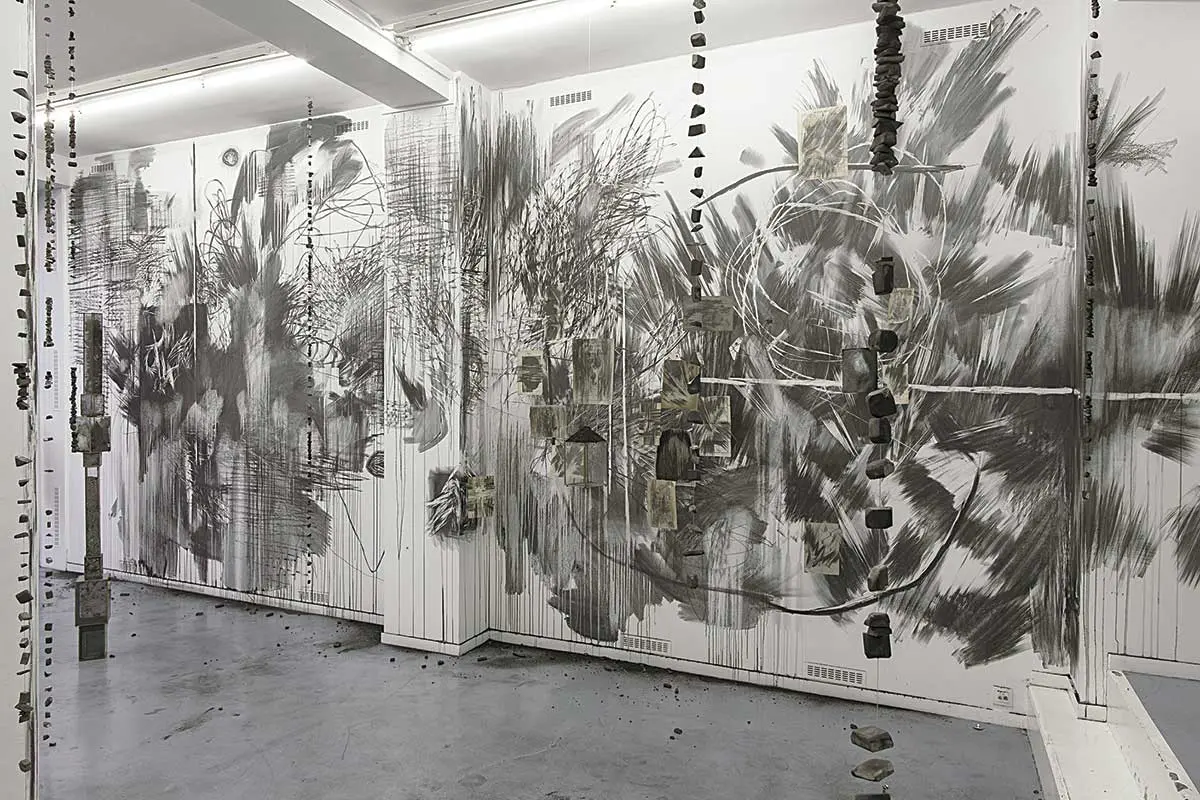
Under the intriguing title Failed State, the exhibition by Mexico-based Argentine artist Mauro Giaconi (Buenos Aires, 1977) was presented at the Bendana-Pinel Art Contemporain in Paris. The group of works can be approached as an installation that confronts viewers with a certain fragility that compels them to pay careful attention as they are immersed on a journey marked by obstacles. The wall, also covered by graphite strokes, is framed by a conceptual dynamic. Remnants that Giaconi had accumulated from other works, from murals he had created, erasers, dust, and other leftover materials are waiting for someone to give them shape. Mystery prevails in three sets of Mexican boxes made of glass. Broken, suspended, or stacked on the floor, they contain traces of graphite, worn surfaces, and fragments of previous drawings and structures.
Each of the approximately forty drawings rendered with graphite on the pages of printed books that participate with their own stories is characterized by expressive chaos and a subtle figuration in imprints on cartographies.
At first glance, the works do not appear to be part of a simple or clear universe. They have been laid out in a seemingly random manner. Separated from the wall by metal rods, they hang on the walls as if they had been affixed to the surface by flying arrows. Some are closer to imitation and represent stones. The seventeen groups of erasers stapled with nylon thread suspended from the ceiling obstruct a clear vision of the space and prevent a linear walk. Thus viewers are forced to interact with space by negotiating their way around the works and following a specific route. It is not possible to move freely without being mindful of what happens on the floor or walls.
Obstacles play a protagonic role. They serve to define the materiality of the exhibition and show its inner workings. Through his narrative, Giaconi establishes a direct relationship with memory, with the idea of transforming, of conveying fragility, alteration, embracing change, and finality. Interested in erosion, decay, and destruction, Giaconi used them as compositional elements. But there are no accidents as such in philosophical terms when their occurrence is provoked. The work produces an attractive organic relationship with formal elements and the artist’s conceptions about the world. This efficient and surprising dynamic is established by a series of conceptually recycled twists and turns.
The essence of the architecture is also “blurred.” The loss of physical control of the “territory” is also a theme generated through the interaction with the works and the movement through the environment. It formulates or evidences a tension that must be perceived. Giaconi’s polysemic discourse is not linear. Failure in his work becomes another aesthetic element.
The term “failed state” used in the title describes a state whose sole guarantee, according to the artist, is being sovereign. The term also implies the erosion of any legitimate authority.
The concept does not have a precise definition: it refers to social, aesthetic, and formal terms. Used methodologically, Giaconi presents it as a “failed act.” The mind draws a mantra.
Just as the Sanskrit term refers to sounds (syllables, words, phonemes, or groups of words) with spiritual power, the drawings have the same function, with or without literal or syntactic meaning, and can be used to give meaning to repetition, in order to establish and reinforce a circular conception.
Mauro Giaconi’s obstacles are transformed into instruments of thought. They encourage a meditative state used to establish a relationship with others. He does not talk about anything specific but draws inspiration from various elements. He attempts to convey crisis and conflict. According to Giaconi: “The conception of space is closely related to my work, and I am passionate about architecture. In times of crisis, chaos, violence, or confrontation, I always find aesthetic energy that interests me ... that which does not work, chaos. It has to do with the kind of world I want to experience or build. I use graphite, erasers, an electric sander, thinner, corrosive materials, which show a mechanism: drawing and blurring are used to build or destroy moments, situations; to create a discourse that transforms and is fueled by what is found. The idea is to create a world that evidence other worlds ... It is like dancing to a song that has not yet been written.”
SUSANA SULIC