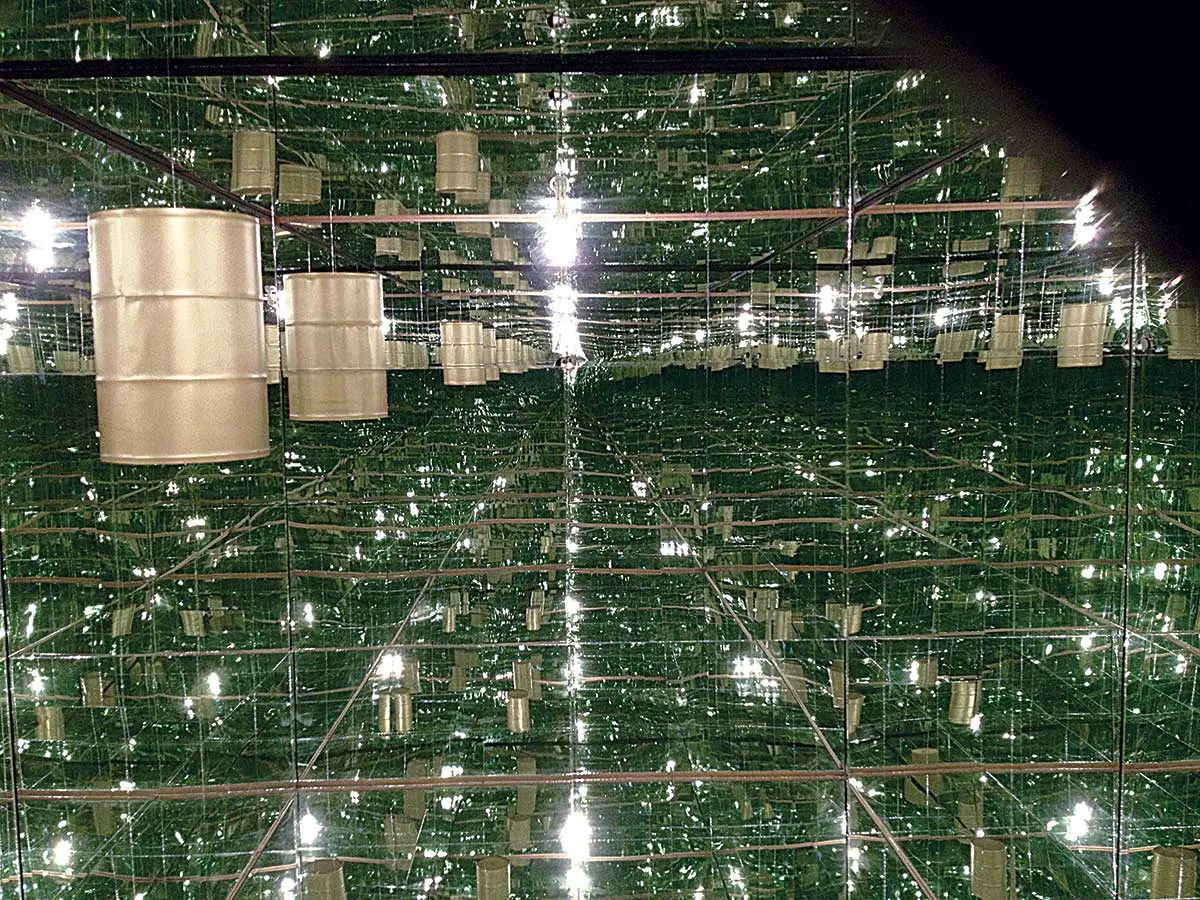
The exhibition titled Black Gold by Rolando Peña consisted of an installation titled Cubo de Dios (Bucket of God, 2014), a series of twenty-four prints titled Black Gold (2014), digital images inspired by the Teoría de las Catástrofes (Catastrophe Theory, 2014-2015), and the projection of a 3-D animation titled Oro sobre Negro (Gold on Black, 2014). The triad of works revolves around the iconography of the oil barrel, a referent that has characterized the creative evolution of Rolando Peña since the 1970s. However, these three works also need to thoughtfully answer questions related to the conception of nature and, therefore, the universe and the realities it contains. All of which are fundamental questions that govern the aesthetic conceptions of this trilogy characterized by the confluence of art, nature, science, and society.
Known in the art scene as the Príncipe Negro (Black Prince), Rolando Peña uses the reflections developed by French mathematician René Thom pertaining to his Catastrophe Theory, and specifically, to the implications of such theories in the strictly philosophical field. In this sense, both the work by Peña and the work by the mathematician project a desire to interpret nature in new ways. For René Thom, the purpose of epistemology must be ultimately to understand the hidden meanings of nature from the perspective of geometry.
The key governing this hermeneutic interpretation of reality is the question about forms and their evolution: What shapes the forms of things? For Thom, the answer is structured through the confluence of forms and forces, and therefore between geometry and dynamics. By understanding in this manner the universe of that which exists, the Catastrophe Theory aims to promote an interpretation of the world through its movement. René Thom pretends to define reality as a dynamic text. He is not interested in the instrumental control of a predictable and static nature. On the contrary, he suggests the development of a permanent reading of nature during its moments of uniqueness and changes through the geometry of forms. This implies an ontology-based on discontinuity, on the progression of beings. Thus, natural perception and experience become a particular form of knowledge and of strictly metaphysical significations.
On these premises, in Black Gold Rolando Peña presents an inventory of iconographic singularities based on the image of the Oil barrel. The matter is conceived as a container (barrel) at the moment of transformation, of emerging discontinuity. This dialogue that Rolando Peña establishes with René Thom is based on an understanding of forms approached from the perspective of discontinuous dynamics, while also contributing to the strictly formal implications of an interpretation that is contingent upon contextual and political meanings. While René Thom aims to create an intelligible text about the future of nature, Rolando Peña turns the altered image of the barrel into a critical text about reality and possible changes, beyond the actual physical universe.
From this perspective, the exhibition “black gold” shows the work of a creator committed to reality and the implications of its socio-cultural processes. For Peña, the implied ecological impact on the exploitation and consumption of hydrocarbons is an issue that motivates him to continue experimenting with the image of the oil barrel. But he does not do it from an apologetic perspective. On the contrary, in his most recent inquiries, Rolando Peña addresses the need to alter the ties, or bindings, which make us dependent on the oil-based material culture; a topic of global consequences and regional and local significance.
The three exercises presented in the exhibition Black Gold represent creative approaches showcased to address fundamental concerns about our contemporary world. As a group, they elicit critical reflection on our understanding of nature and the manners in which we interact with it as the social fabric.
Likewise, the group of works is supported by a common understanding between René Thom and Rolando Peña: the essence of nature is contingent upon, and the result of, the context of a dissimilar and diverse universe. Therefore, diverse and complex realities are not amenable to univocal simplified idealizations of any sign. Realities, as discontinuous singular systems, can hardly be prisoners of stagnant ideologies; unless they are subjected to systems of domination that undermine the exercise of freedom and democratic forms as alternatives for the promotion of human dignity in connection with nature.
GERARDO ZAVARCE