
Brazilian artist Sergio Camargo’s work has returned to London after thirty-three years: “Camargo started in London so I thought it was the right place to re-start,” said Raquel Arnaud, who has represented the artist since 1975 and Sergio Camargo’s Estate since 1990.1
Sergio Camargo: Mármore was shown from May 22 to July 4, 2015, at Lisson Gallery, London -- a particularly fitting venue. Back in 1967, a couple of years after Camargo’s first exhibition in Europe at Signals London, Nicholas Logsdail opened Lisson Gallery and has long wanted to show the Brazilian’s work. “It is partly in memory of those times that I have now felt compelled to make an exhibition of Camargo at the gallery,” says Logsdail.
The well-curated show, a collaboration involving Lisson Gallery, Galeria Raquel Arnaud, São Paulo, and the Camargo family, presents Camargo’s late work made from white Carrara Bianco Pi and Belgian Black marble. The show opens the artist’s work in marble to a wider audience and successfully demonstrates its artistic value against the artist’s better-known wood reliefs. In fact, Camargo (1930-1990) worked for more years in marble than in any other material and it remained his preferred medium.
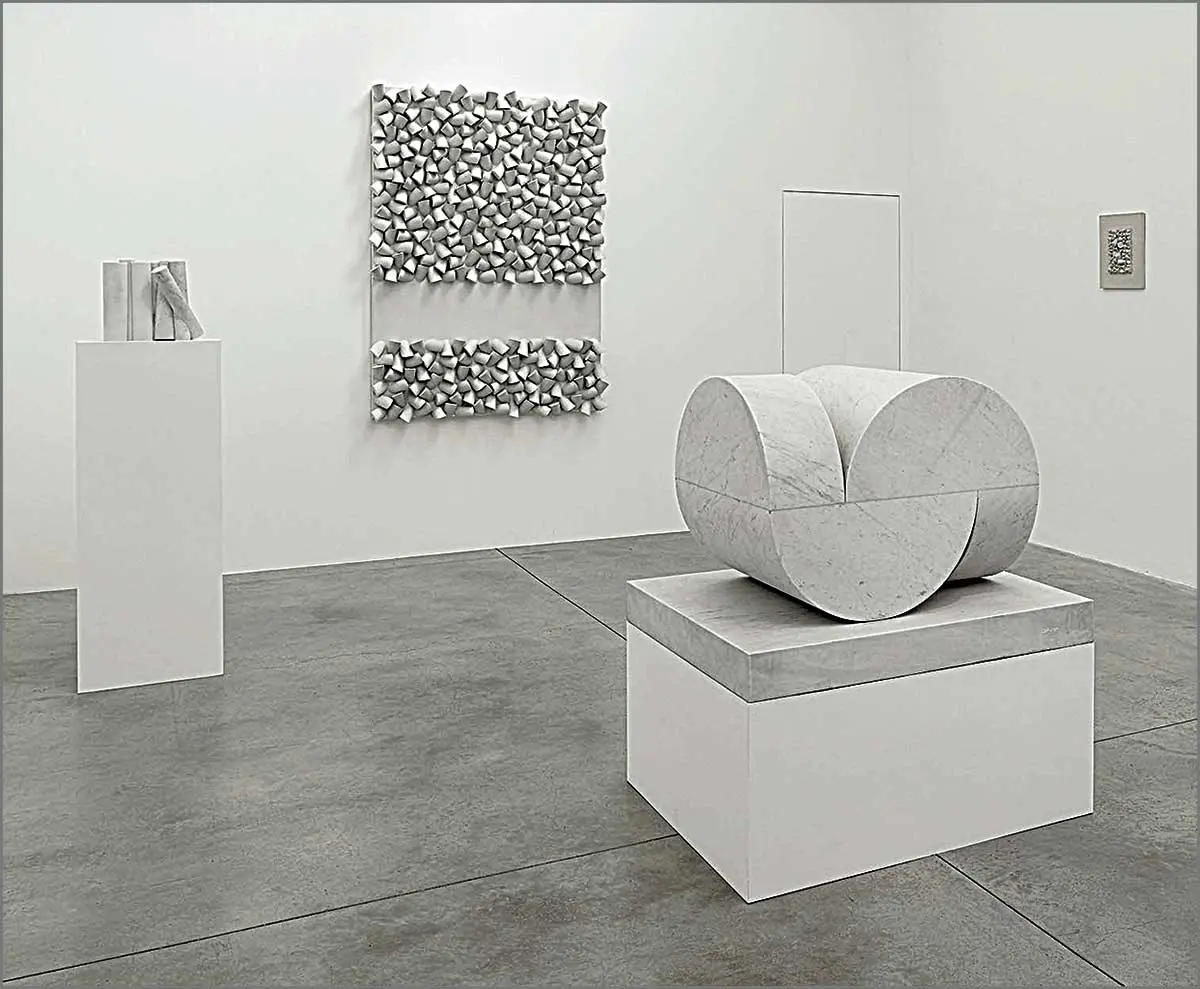
Refined and minimalist, the works on display range from 1964 to 1990, covering most of Camargo’s career apart from the early relief works and his more figurative bronze and plaster sculptures. The main room included three sculptures in white marble and three white-painted wood reliefs. The white marble expands the sculptures in space, and together with the monochrome white reliefs that generate a play of light and shadow, warm-up space and fill it with light.
Placed on top of a marble base and located at the center of the first exhibition space, Untitled (1970) is composed of four white marble blocks: four half-cylinders arranged so that the planes and volume flawlessly combine in one form. The superposed wheel-like forms add to the work’s independent quality and generate a rotational sense of movement. Camargo’s modular geometric constructions arise from his continuous study of the relationship between the cut, the volumes, and the planes.2 Thus, they depart from a single geometric element: the cylinder or the cube. The repetitions of forms, the use of ‘primary structures’, and Camargo’s focus on the essential elements of an art form have much to do with the ideas that underline minimalism. The latter puts him in alignment with Lisson Gallery’s pioneering focus on minimalism and abstraction.
The repetition of the same form also has an organic connotation. Made of stone, the sculptures are connected to the natural order of things. Camargo is interested in the structural aspects of the natural world. For him “everything has its own determined order” and “everything has a skeleton.”3 This is reminiscent of Paul Cézanne, who suggested using geometric abstractions to characterize nature: “treat nature by means of the cylinder, the sphere, the cone.”
It was not until 1972 when Camargo was commissioned to sculpt a chess set, that he had to find the purest black to combine with the pure white marble: Belgian Black marble. The three long black sculptures Untitled (1988), Untitled (1980), and Untitled (1980), which Camargo referred to as whales because of their shape and color, recall Brancusi’s Agnes E. Meyer (1967) in their length, their cylindered cuts, their polished surface and the presence of repeated forms. But whereas Brancusi’s sculpture retained certain figuration and stood vertically atop a plinth, Camargo’s black sculptures are more geometrical and lie horizontally. Compared to his white marble sculptures they present a dense and opaque quality that absorbs and also reflects the light. White and black symbolize the presence and absence of light. They are opposites that work well in this exhibit, complementing each other by simultaneously absorbing the light and expanding it. These reflections, the choice of noble material, marble, and the absence of color add to the works’ elegant aura and convey harmony and balance complemented by the clean and silent gallery space.
One of the gallery’s basement rooms was dedicated to showing a film by Camargo’s daughter, filmmaker Maria Camargo. It is a moving, biographical video that includes interviews with the artist and reveals views of the artist’s creative process in Massa, Carrara4.
Camargo’s work revival offers a posthumous re-launch of his work intended to elevate his recognition and to pair his work with his European contemporaries’. For instance at Art Basel, Basel, 2015, David Zwirner Gallery showed a 1970 Camargo relief together with a Piero Manzoni ca. 1962 Achrome. Camargo was not only inspired by figures such as Constantin Brancusi, Lucio Fontana, or Gaston Bachelard but also closely connected to them.
Sergio Camargo: Mármore is a starting point; more collaborations will flourish as we see more of the artist’s remarkable works. Further exhibitions are being planned.
NOTES
1. Interview with Raquel Arnaud, São Paulo, June 19th, 2015. Interviewed by the author.
2. Interview with the artist shown in: If my father were made of stone, a film by Maria Camargo, 2010.
3. Ibid.
4. The film “If my father were made of stone” is available at: https://www.youtube.com/watch?v=bZEGC1r4sXA
AGUSTINA STRUENGMANN