Under the curatorship of Hortensia Montero, Tomás Sánchez exhibited his work after a nearly thirty-year absence from the Museo Nacional. He showed previously unseen medium- and large-format oil and acrylic work on canvas produced over more than two decades under the title of Paisaje (Landscape), his emblematic genre since the late 1970s and the basis for his longstanding presence in the international scene. Committed to environmental feeling, to the virtues of the natural world and its magnetic appeal for human beings, Sánchez’s landscapes continue to invite us to reflect on our survival as a species, our loneliness, and our harmony with the environment, be it through sustained meditation and our will to integrate, or through subtle modes of protest expressed in his painting by the presence of industrial detritus, dumping grounds, refuse, and all the damage that humanity can cause to itself.
Tomás Sánchez seems always ready to present us with new landscapes, but also, and even better, with a new way of looking at the natural world around us, which we are often incapable of appreciating in all its nuance and splendor. One would be hard-pressed to identify with any precision the sources of inspiration for these masterfully executed “portraits” of nature (the artist has already left behind the hyper-realist orthodoxy that so entranced Cuban art during the last quarter of the Twentieth Century, thanks also to Flavio Garciandía and Rogelio López Marín). They could be Cuban, Central American, or South American locations: the artist travels widely with his photographic camera and captures everything that catches his attention—forests, oceans, rocks, lakes, rivers, grass, lagoons, islets. These are at once objective and subjective landscapes, states of mind that drive Sánchez into a permanent “expansion of consciousness”, as he has often said. He also leaves behind the melancholy, unattached romanticism of Nineteenth Century-style landscape painting for a contemporary space that negates all periodization and all temporal boundaries, shining brightly with all its lights and shadows and leaving no observer in a state of indifference. Indeed, Sánchez’s paintings unfailingly attract the attention of all observers; it is, in that sense, democratic in its celebration of the beauty and magnificence of Nature. Even as it denounces the way in which humanity damages it, one perceives in it the hidden sparkle behind the refuse and garbage dumped so heartlessly in so many places.
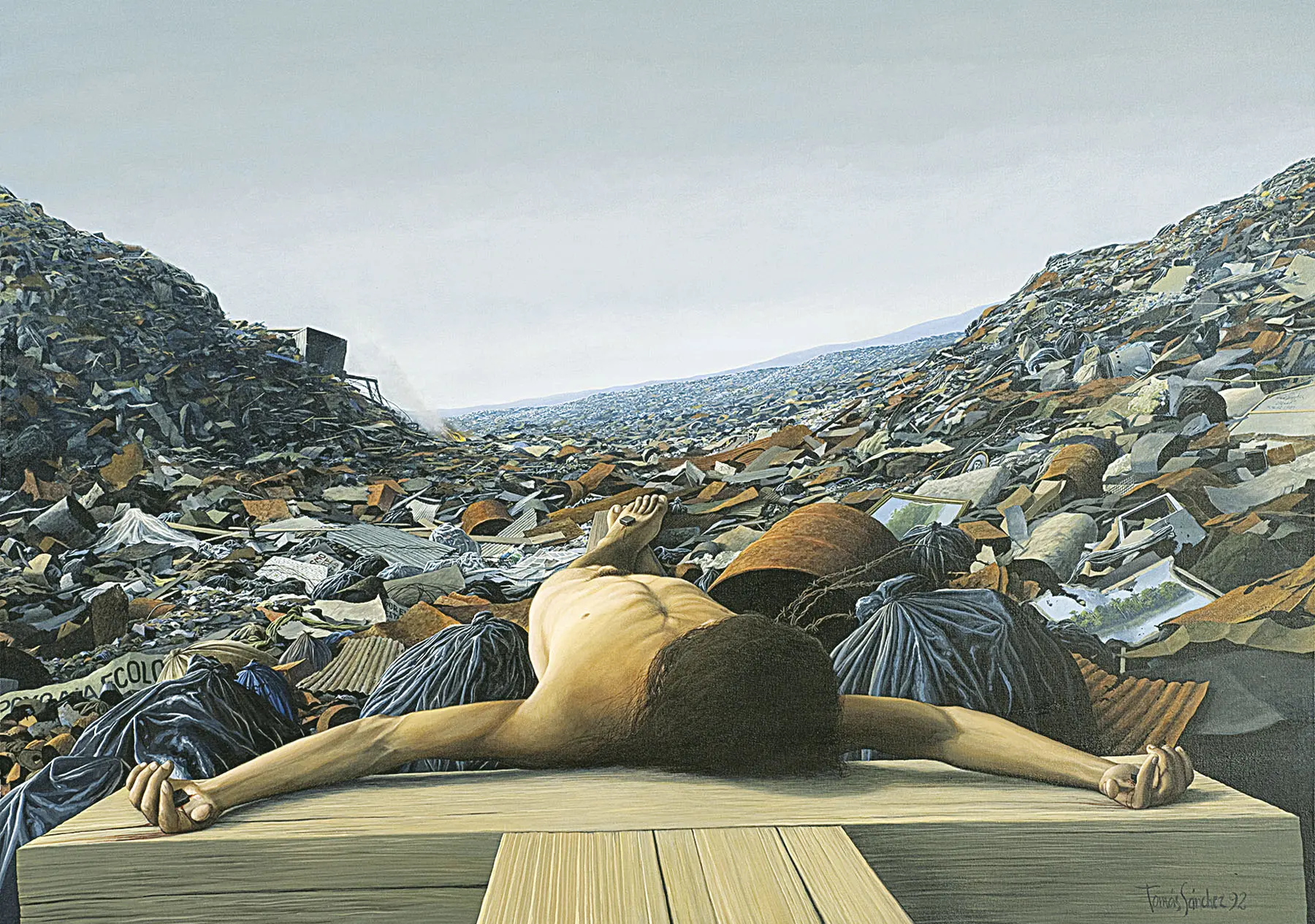
In Hombre crucificado (Crucified Man, 1992) we see a man on a cross seemingly abandoned in a garbage dump: we see his head, his back, and his arms in the foreground, with his legs and feet somewhat farther away. Around this figure, we see broken brooms, pieces of fabric, plastic bottles, fragments of furniture, all very different from the mythical scene of the Mount of Olives, with its soldiers and other people surrounding the fallen Jesus. In this case, the “landscape” reveals Man’s historical loneliness: a two-thousand-year-old allegory that retains its potency, or at least remains latent and full of meaning.
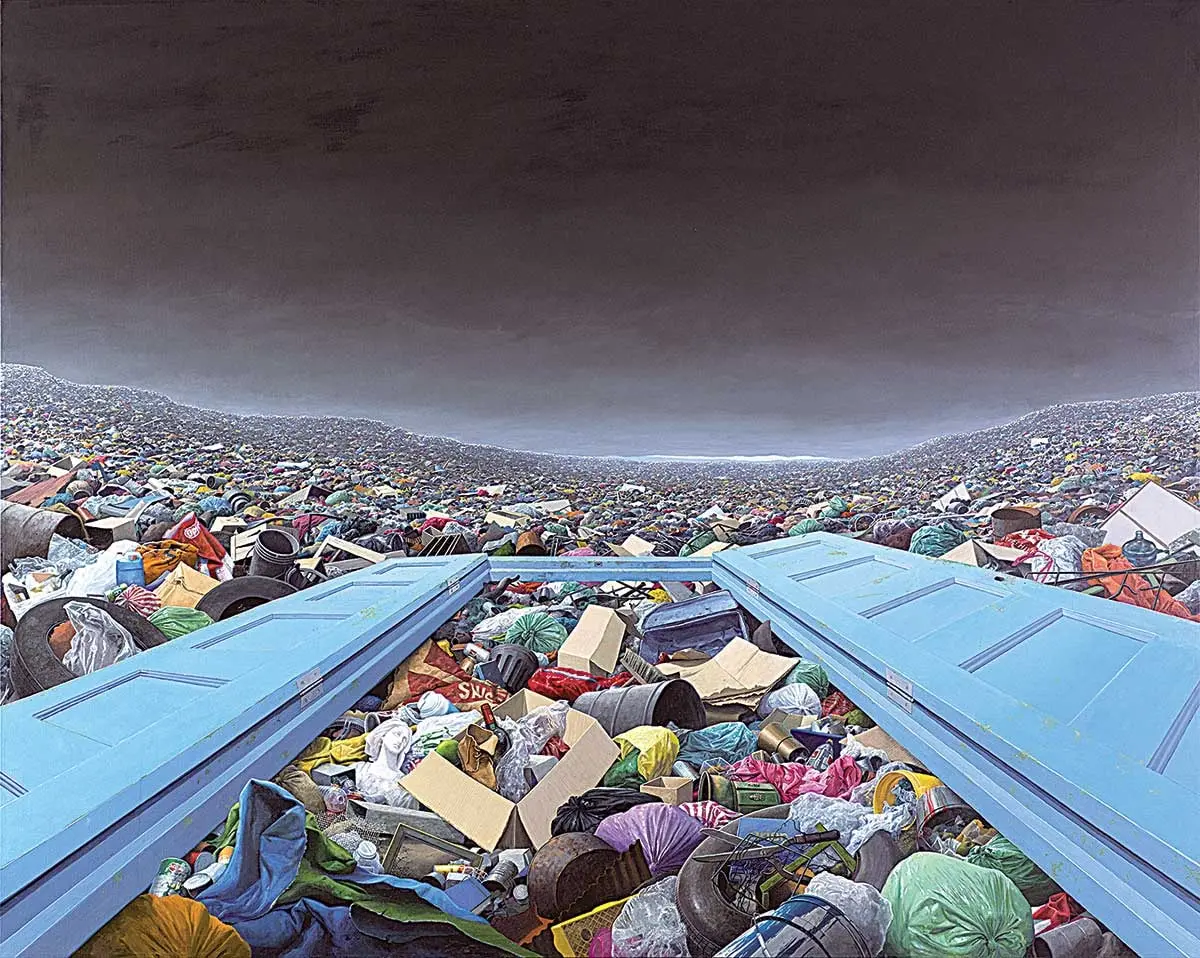
More than twenty years later, Sánchez painted Con la puerta abierta (The Blue, Still, 2015) from the same angle and the same perspective, this time substituting a door for the crucifixion but abandoning it, the door, to the same fate as the man in the earlier work, as if time hadn’t passed and circumstances hadn’t changed. This condition of inalterability is found in most of Sánchez’s landscapes, his “landscape imaginary,” as Fernando Castro Florez dubbed it, sustained through a rich multi-decade career. Abstaining from any abrupt twists or dazzling surprises, Tomás Sánchez bears witness to a beauty that exists both in external reality and in our inner perception, as there is something in his landscapes of a paradise once again lost, of forgotten illusions, of dream states and other things consigned to oblivion by the stressful, tedious life we lead. Things that humanity is still in time to recover, if we are willing to join and converse with nature and its laws: Sánchez represents this in Adoración (Adoration, 2005), oil on canvas, where the immensity of the trees and branches seems to overwhelm, from their great heights, the diminutive man who kneels down and prays at their feet, his head resting on the grass in silent dialog with the land.
Sánchez’s themes, his craft, and his modes of representation have already generated unique rhetoric in the context of Cuban and Latin American painting, singling him out in any exhibition space. His ranges of greens, grays, and blacks are immediately recognizable against the white background that often catches the attention of the viewer most firmly. A thick horizontal line of bushes and trees across the canvas, thinning as a fragment of the sky appears above and a band of water or land appears below, suffices to alert us of Tomás Sánchez’s presence; in the same way, a thick forest around a moonlit clearing reveals the hand of their artist who has made it into a tangible reality, illusory and symbolic at the same time, present in most of our galleries and Latin American art collections.
In the ample spaces of the lower floor of the Museo Nacional, Wilfredo Prieto exhibited 35 works in diverse materials and techniques, offering viewers—under the title of Ping-pong cuadrícula (Ping-Pong Grid) and with the curatorship of Delia López and Aylet Ojeda—a panoramic review of twenty years of patient and polemical production. Small oil on canvas titled El multimueble (Multifurniture, 72 x 72 cm, 1995) informed us of something many of us ignored: his beginnings as a painter before graduating from Havana’s Instituto Superior de Arte. This and another painting functioned as the initiation rites of a career that would later be fully devoted to conceptualism and its various modalities, specifically starting in the year 2000 and achieving its greatest international resonance with the controversial and much-debated glass of water (half full, half empty) Prieto exhibited at the most recent ARCO fair in Spain, 2015.
With great autonomy of flight, both in Cuba and in the international scene, the work of Wilfredo Prieto has been at the epicenter of many controversies about the very concepts of image, gesture, and action, often on the basis of a single work. This was confirmed here by his Mapa del mundo (Map of the World, ink on a pea, 5mm in diameter, 2002), of which the artist has made several versions. It may be the smallest artwork in the history of Cuban art, and perhaps of other regions, and it was placed at the center of a large white wall, 8 meters in length and 5 meters in height. At the opposite end of the spectrum but equally controversial is Montaña con río (Mountain with River, multi-ton dump truck with its back section elevated, ready to dump its load on a small fishbowl on the floor, filled with multicolor fish, 2014), an installation on the museum’s main façade, on view for all passers-by.
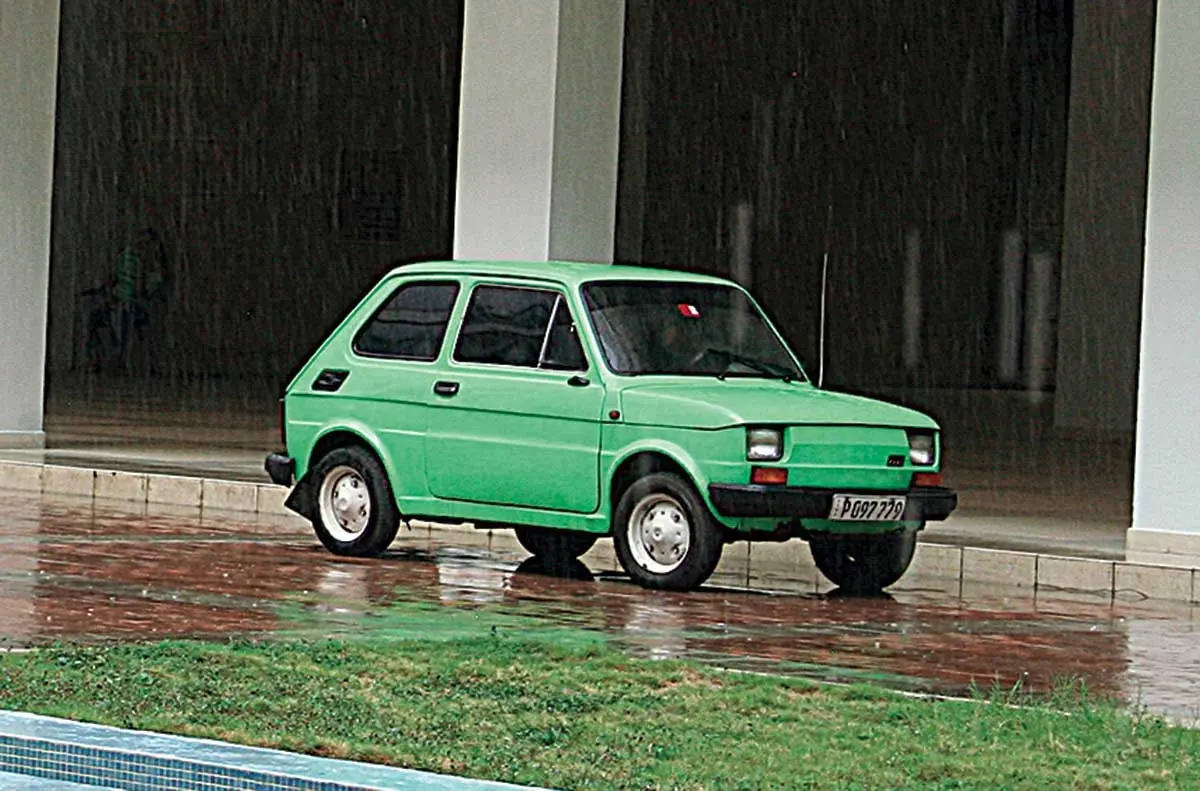
Wilfredo Prieto has liked to move swiftly between different modes of conceptualism. He has broken the rules of the genre (if there ever were any) while operating from its most hardcore regions, and it's most contextualized. The scarcity, the rationing, the material difficulties faced by the Cuban people, the inventiveness needed to survive through successive economic crises, as well as allusions to the craziness that dominates the aesthetic realm, are some of the materials used by the artist with great openness and sincerity. He does nothing to hide or soften these realities; he doesn’t make use of metaphors or allegories, like when he places a cubic meter of lime (Una de cal, [One of Lime, 2011]) and another one of sand (Y otra de arena, [And Another One of Sand, 2011]) at a distance of several meters from the museum’s large ground floor, separated by a small Polish-made Fiat automobile painted green (Un polaquito verde, ¿y qué?, [A Little Green Pole, So what?, 2015]) and by a cement-covered brick wall, 440 x 285 x 30 cm, titled Paisaje abstracto de Regla (Abstract Ruler Landscape, 2015), all across the building’s entire central patio, challenging the “good art” on exhibit in the elegant galleries of the historical and emblematic institution’s upper level.
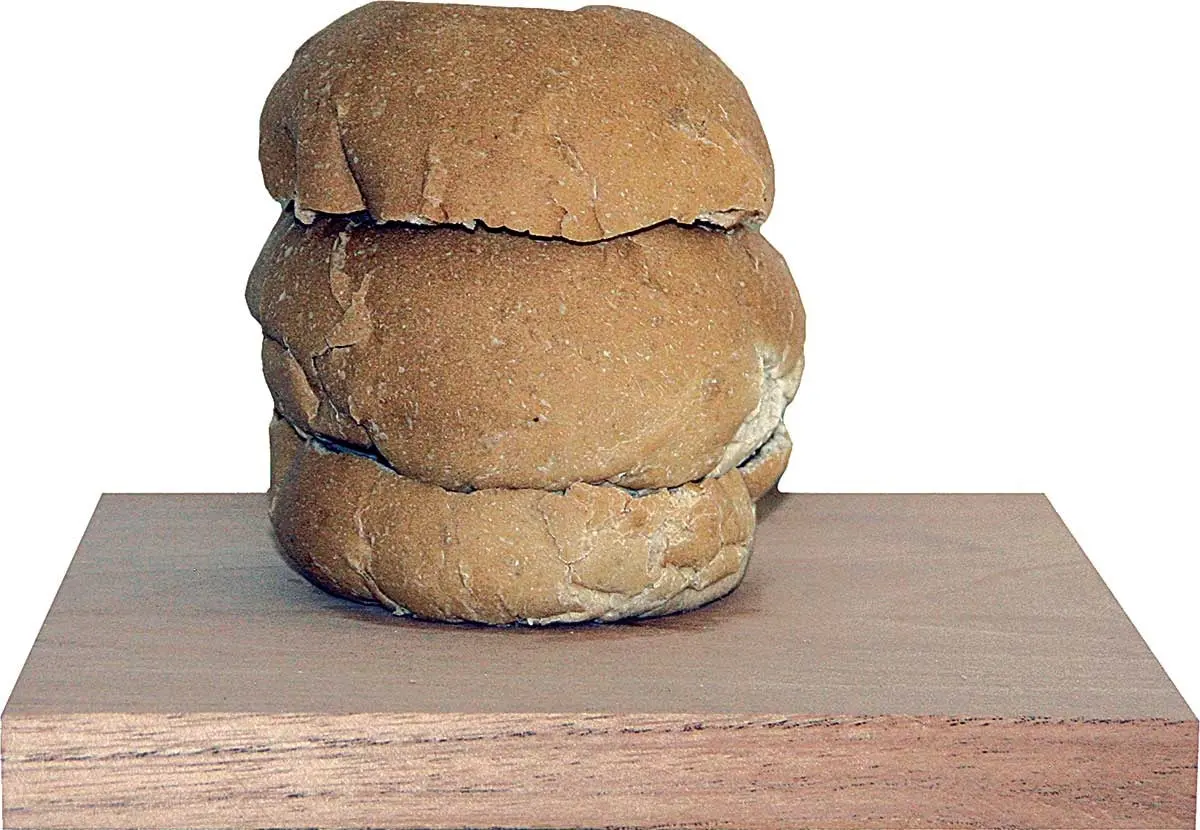
The artist had to print a map in order to show the precise location of the 35 works in the enormous space, where one could also find a misshapen truck tire placed on the floor (Desahogo, [Relief, 2015]); used black shoes and black socks (Dos zapatos y dos medias, [Two Shoes and Two Socks, 2012]); a match inside one of the cracks between the patio tiles (Estrella muerta, [Dead Star, 2010]); broken glass strewn on the floor (Destello, [Twinkle, 2011]); and even a tank and various containers for collecting potable water (Matrioska, 2010) and 80-gram loaves of bread set on wooden shelves (Pan con pan, [Bread with Bread, 2011]).
Some of these works had never been exhibited in Cuba and were of great value to understand the trajectory followed by an artist who plays with the precariousness of his materials and of the Cuban context from the standpoint of a critical relationship with art itself and with the social, economic, and political realities of his native country. In fact, these works put once again on full display Prieto’s irreverence in the wide spectrum of contemporary Cuban art, his lack of attachment to any local or global tradition, and his distance from any school or style other than those of his own sensibility, imagination, and talent deployed in the generation of ideas and objects that have, in one way or another, already passed the tests of history and time. And those imposed by critics and curators.
Situated at the antipodes of each other in terms of creation and reception, Tomás Sánchez and Wilfredo Prieto presented themselves openly, hid nothing, and didn’t back into the margins: they allowed us to see just who they have been and are.
In the case of Gustavo Pérez Monzón, first a fortuitous encounter and later a sustained investigation made it possible to get Ella Fontanals Cisneros to conceive one of the Biennial’s most celebrated exhibitions. Pérez Monzón abandoned the creation of art in Cuba in the early 1990s and devoted himself fully to teaching in Mexico, where he now lives and works.
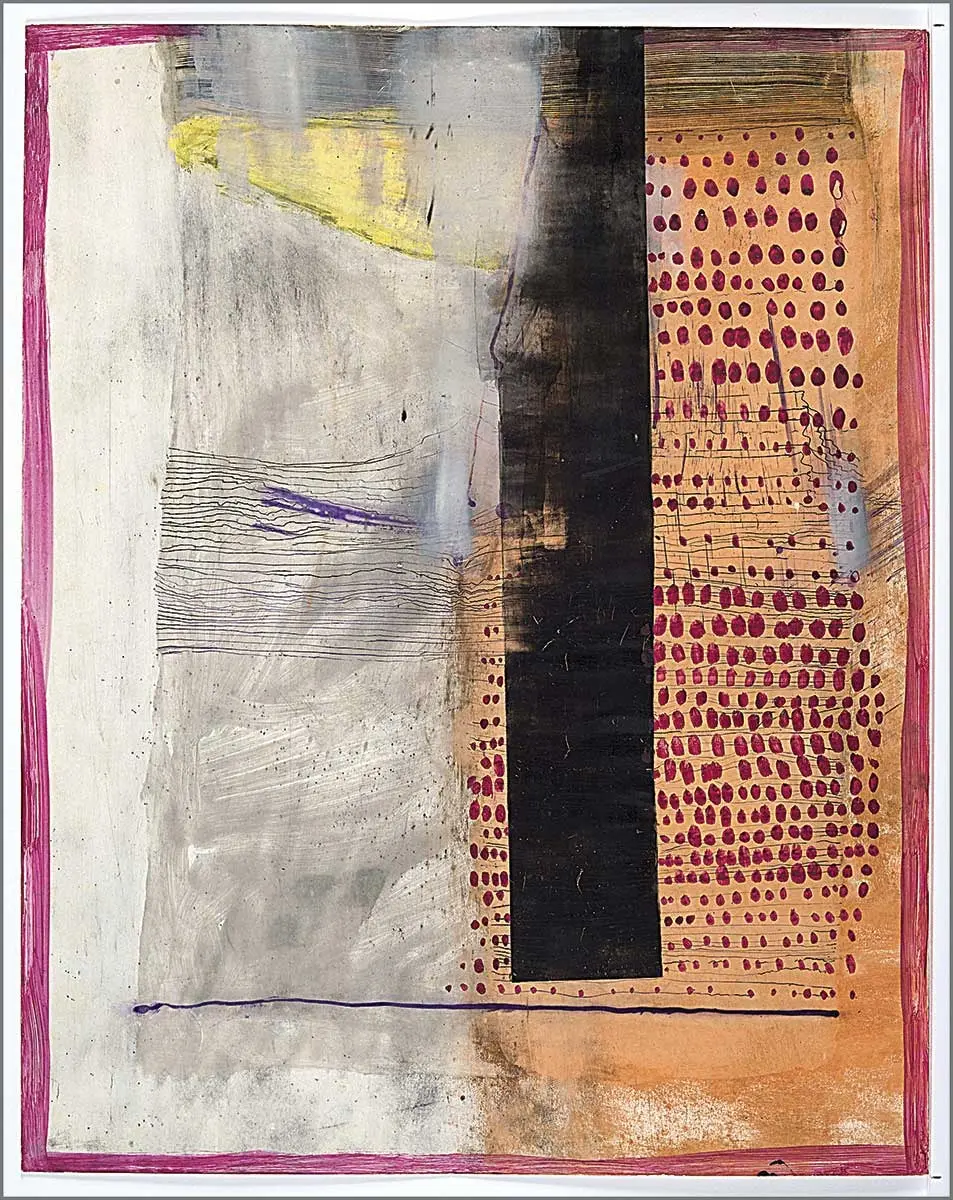
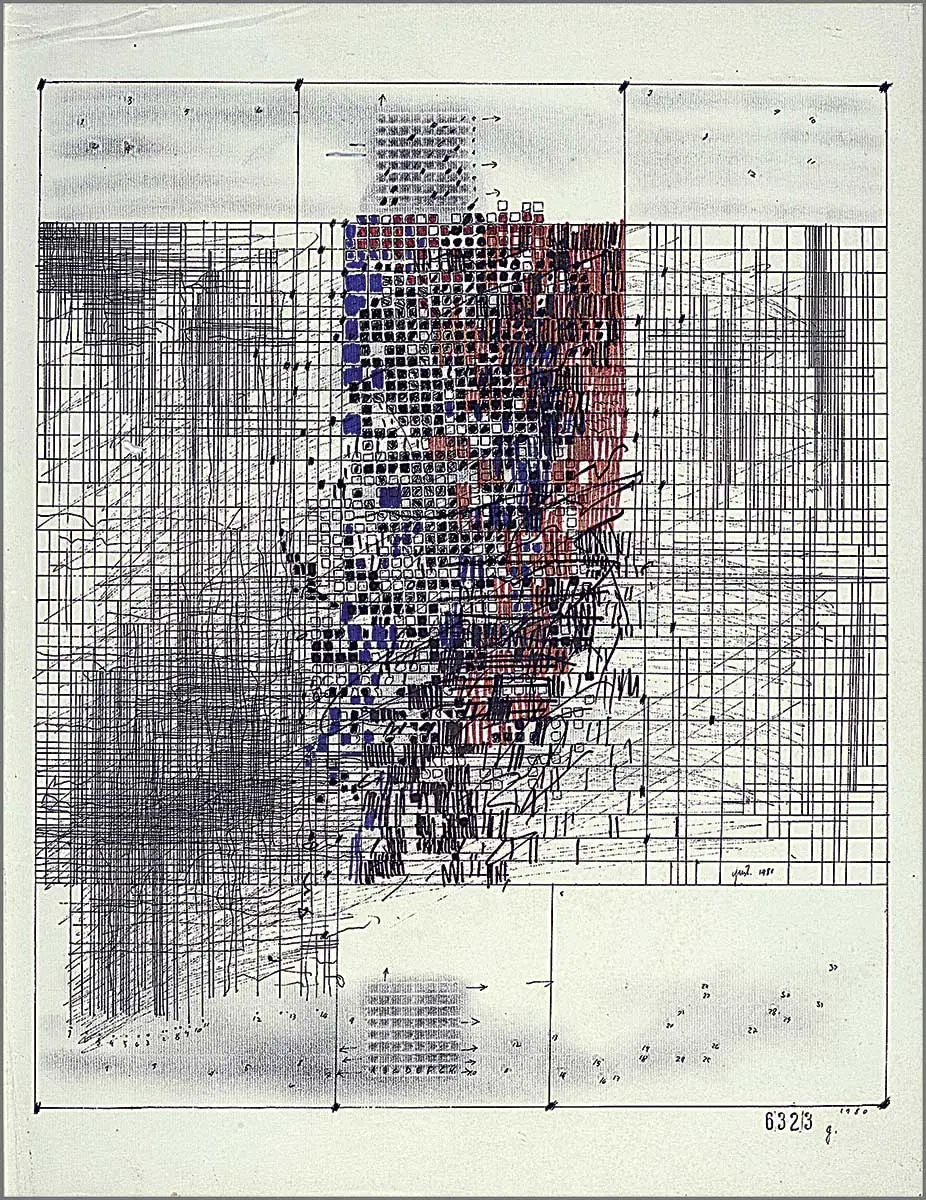
Curated by René Francisco and Elsa Vega, and titled Tramas (Plots), the exhibition revealed the substantial and prolific interweave of intellectual subtleties, mysteries, extreme sensibility, cosmology, imagination, geography, and mathematics deployed by Pérez Monzón to bring us closer, like very few Cuban artists have been able to do, to the infinite pathways of lyrical abstraction, calligraphy, the relationship of art and science, installation, and, especially, drawing, now dignified by this artist as a pillar for almost every traditional visual expression.
Seen historically, this exhibition was our reunion with one of the protagonists of the movement for aesthetic renewal in the 1980s, a known figure since the Volume I exhibition in Havana (1981), where Gustavo Pérez Monzón participated while still a student at the Instituto Superior de Arte. At that time, he didn’t dazzle as much as Juan Francisco Elso, José Bedia, Flavio Garciandía, Rogelio López Marín, José M. Fors, or Rubén Torres Llorca, but over the tumultuous and in more than one sense polemical years that followed, his name and career became fully established. His low personal profile—the result of a simple, reserved personality, devoid of the pomposities and stridencies that characterized the then newly-minted postmodern era—was distinguished by a peaceful way of being, with sharp insights that weren’t always understood in the midst of the conceptual and intellectual complexity of his art.
The evocative richness we now encounter in his small-format drawings on poster board (the majority of the 50 x 65 cm, some 25 x 25 cm, and a few 70 x 95 cm) came about under the influence of Mark Rothko, Sol LeWitt, Raúl Milián, arte povera, conceptualism, minimalism, and, very decisively, Ana Mendieta, all of whom were dynamic points of reference in the 1970s and 1980s. Pérez Monzón also read widely in esoteric subjects, philosophy, and anthropology, and intensely imbibed music and film along with many members of his generation who shared his thirst for knowledge and boundless curiosity. The discovery of materials to use as newfangled supports in artworks and projects revealed for him a universe of drawing and installation possibilities: from threads and ropes to river stones, as well as silver paper, adhesive tape, and cotton.
The cultural and social context was propitious for Pérez Monzón to fully identify himself with world events of the era. In Cuba, the 1980s were in many ways years of greater openness, influenced not only by the postmodern winds that reached the island from Western Europe but also by changes in the socialist-bloc countries of Eastern Europe. Amidst so many new ideas, both in the culture at large and in the teaching of the arts, Pérez Monzón explored the possibilities of numerology, mathematics, and the Tarot as complex systems of meaning. Numbers, combinatory series, and graphical symbols contributed an important level of diversity to his work, as did unusual expansions like those of 15,625 centímetros cúbicos (15,625 cubic centimeters, 1981-2015) and the cards of the Tarot series (1983), included in this exhibition (the latter seen for the first time in Havana).
In his small-format works, Pérez Monzón reveals for us the spellbinding fascination of weather maps during calm periods or when hurricanes and quakes lash out, geological prospection, cosmic or intergalactic diagrams, as though a strange algorithm guided them to seek our most private inner spaces, giving way to a captivating sense of belonging: we are all part, Pérez Monzón wants to tell us, of an inexhaustible cosmos that begins in the vastness of outer space and ends in the deepest recesses of our minds and hearts. Pérez Monzón’s drawings have the referential power, the aesthetic quality (inherent to all art) that connects, relates, integrates, and completes our individual life cycles and the majesty of the Universe, now rendered tangible and accessible thanks, also, to the spatial sense they possess.
The works on paper and poster board on exhibit here come from the Fontanals Cisneros collection, as do the four series and three installations. It all adds to more than 100 works, a kind of retrospective of the artist’s brief and intense career. From an emotional and intellectual point of view, this is without a doubt the return of a prodigal son of the 1980s, today focused on teaching—as the director of the Centro Morelense de las Artes in Mexico— and intent on instilling in his students the desire to focus and learn under the principles of an “ambiguity with sound foundations” that allows, in turn, for the unbridling of their imagination, for incessant explorations, and for improvisation.
Encountering Pérez Monzón and his work anew, after more than twenty-five years, was an extraordinary experience. The majority of the people expressing enthusiasm for his work were just now discovering (while I and others like me “rediscovered” him) an artist as contemporary as—if not more than—many who seek to attain that label at any price, under any circumstance. All of this validated something someone once said: all art is contemporary art.
NELSON HERRERA YSLA
Art critic, curator, and poet.