trans-lúcido features works of art that emit light via their materials and realizations, without the use of electrical connections or batteries of any kind. These works bring forth light and ideas by three different artists, working independently. Héctor M. Flores is a young but experienced glass and crystal artist; Claudia Pérez-Pavón explores a complex mixed technique involving nylon thread and acrylic plaques, with different images resulting for the front and back of the object; Bertha Picallo works in Mexico’s important but forgotten Twentieth-Century tradition of glass art. The exhibition is presented at the Cloister of Sor Juana museum’s Celda Contemporánea gallery, which has always been a unique, magical space laden with history, literature, archaeology, and gender issues. Every exhibition held there has engaged its curator and the artists involved in a complex aesthetic game of balancing contemporary works of art with the magnificent historical location, which must not be altered in any way, not even by the use of nails or other hanging devices.
Space reopened with trans-lúcido after the restoration of the gallery area and the protection of items in the museum. The materials used are revealing and so are the resulting works by Héctor M. Flores, Claudia Pérez-Pavón, and Bertha Picallo, the three artists selected by Berta Kolteniuk—Celda Contemporánea’s efficient curator—who is also a notable artist in her own right and has been careful not to have her two callings collide in this space. Celda Contemporánea is part of the vast Cultural Expansion program coordinated by Ana Piñó Sandoval. A 2012-2014 Memory for Celda was published under the coordination of Sandra Lorenzano Schifrin, vice-president for Research, Creative Projects, and Publications. The restoration work was initiated by Carmen Beatriz López Portillo Romano, president of Universidad del Claustro de Sor Juana. This institution occupies the former Convent of San Jerónimo’s buildings, where Sor Juana Inés de la Cruz, the Mexican nun, poet, and administrator, lived.
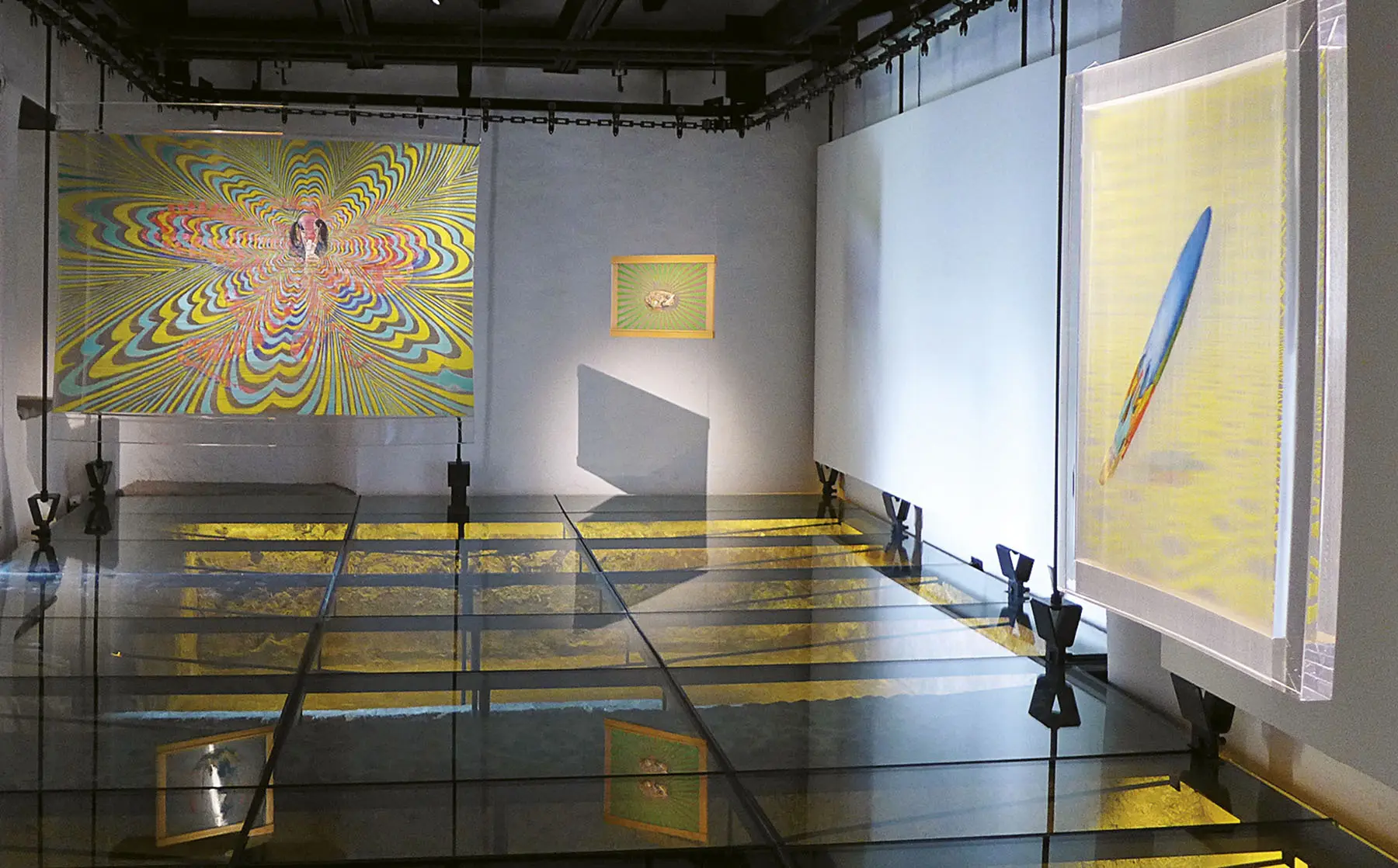
Visitors are welcomed into the exhibition by three horizontal layers of light, which drive them to seek out the works located in the mid-and upper-level sectors of the gallery. Celda Contemporánea is located in a corner of the larger cloister; its “L”-shaped plan is traversed by the vertical interference of doors and windows that shower the recently installed partitions with natural light. This creates a weaving of light and shadows, the complexity of which we shall analyze in what follows. The glass floor newly integrated into the architecture enables the viewing of the building’s remains while keeping them protected; that entire lower section is lighted in yellowish hues with gray notes, with vistas of the damaged construction and areas in a more golden color. The support structures for the glass floor form a dark grid between the “underground” area and the gallery proper—or, perhaps, between the past and the present. An interesting industrial scaffold, in metal, was added to a section of the gallery. Its function is to support and move the partitions for each exhibition, and it evokes the historical period of industrialization, the post-Revolutionary years, which in Mexico imposes a script that connects the old construction—Sor Juana’s era—and the second half of the Twentieth Century. Museographically, the visible support structures add weight to space already containing many elements for the exhibition of artworks. It can be noted that this kind of exposed scaffolding has become common in institutional and private exhibitions in many parts of the world. This brief introduction must have made clear to readers that this is an intense sensorial experience.
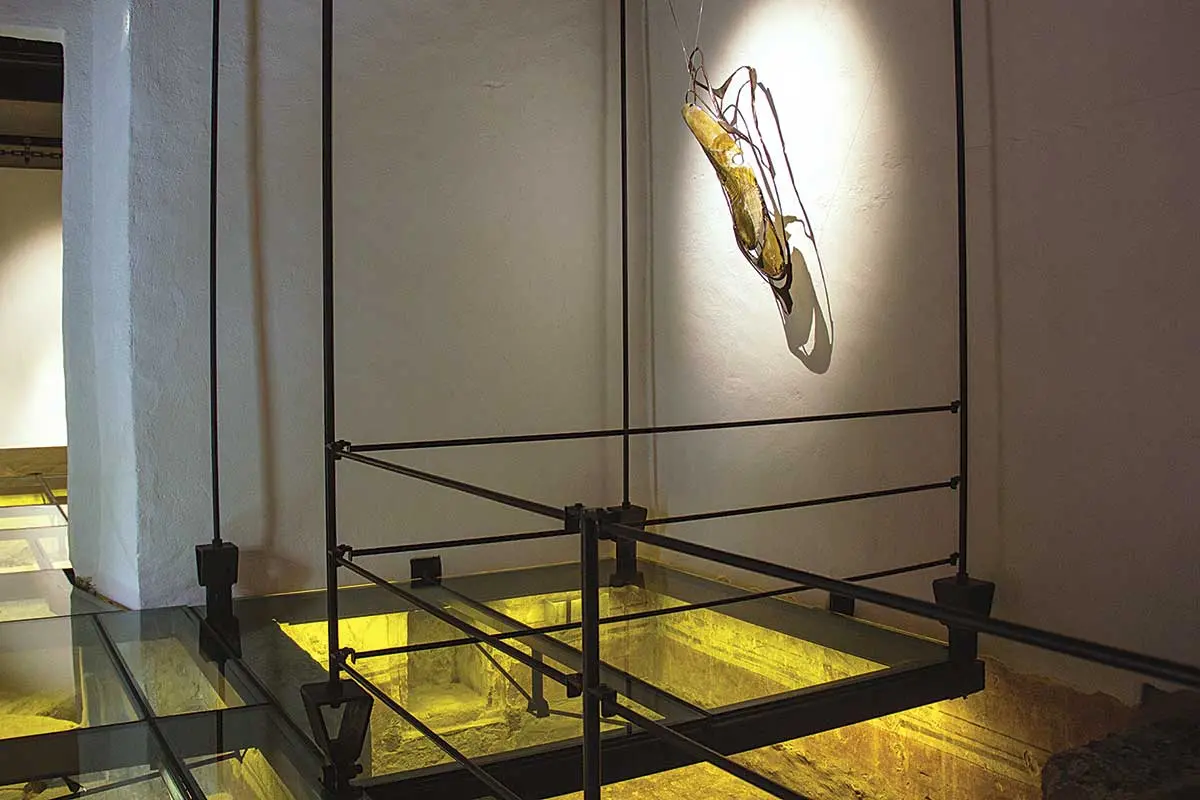
The museography of trans-lúcido was organized in vastly differing ways according to each of the three artists. The light, shadows, darkness, and larger empty spaces in the long arm of the “L” were reserved for Claudia Pérez-Pavón and Héctor M. Flores. Bertha Picallo occupied the other section. Picallo used different techniques and presentations for her works: thermoformed glass on cast iron; blown borosilicate glass; fused glass. Seven translucent objects in blown borosilicate glass were placed on a black ladder-shaped platform. Technically, all her works are demonstrations of her knowledge. Their aesthetics vary. The seven abstract, translucent works, where some observers found semi-figurative associations, are decorative. They measure between 23 and 53 centimeters on their largest side. Verbo and Fósil measure, on their largest side, 120 and 158 centimeters, respectively. These two works in glass and cast iron mesh well with the translucency and the exposed scaffolding we have mentioned. The iron outlines dark shapes on the white walls and complements the shapes of the amber-colored glass (hues rhyming with the light underfoot, visible through the glass floor). Both works are reliefs of a sculptural type. Verbo is suspended from nylon cables, a method of exhibition often used at Celda in the past given the imposing height of its ceilings, now reduced after the construction of the glass floor. Fósil—in black and red—is placed horizontally on a low-rise plank supported on iron legs. Renuevo is a somewhat animalistic work, resembling skin in the process of drying, rather tiger-like in its pattern; its largest side is almost a meter and a half long, and it is very well done.
Claudia Pérez-Pavón, the painter, presents viewers with works that have an unusual focus and reveal the research to which she is devoted. She contrasts the concept of painting with translucent materials, especially when using wooden edges. “I have always been obsessed with understanding what lies behind the painting, like what lies behind the mirror. When I first learned to write, all of my notebooks were written backward, as if reflected in a mirror; to this day I still write that way. Later I found in ‘Painting’ many traces of inversions, small paintings with a reverse side. Secrets! Mystery! In the art of New Spain, letters were often written frontwards and backward, as if there were a reality behind the ‘painting’; thus taking the painting down from the wall is an act of the imaginary. What is behind this painting? And with acrylic frames, you have the possibility of ‘looking’ inside. What is there?” This recent e-chat enriches the experience of the exhibition and of the many techniques that exist in the contemporary scene. In 2011, after five years of using oils on metal, Pérez-Pavón began to focus on another feature of physical light: refraction. Working with two weavers, she mounted the nylon thread like the warp on a weaving loom or frame. It is painstaking work, and the tension must be kept constant. On this support, she painted figurative images, while tension and refraction deformed her creations and produced differentiated versions on the front and the back, as well as around each work. Three works were on display: Aurora, on a wooden frame; La brevedad and Kaopantopus, on a translucent acrylic frame. Kaopantopus, dated in 2013, is an oil painting on 10,113 meters of nylon monofilament, on an acrylic frame measuring 120 x 150 cm. The artist presents in trans-lúcido an embodiment of the relationships between various disciplines.
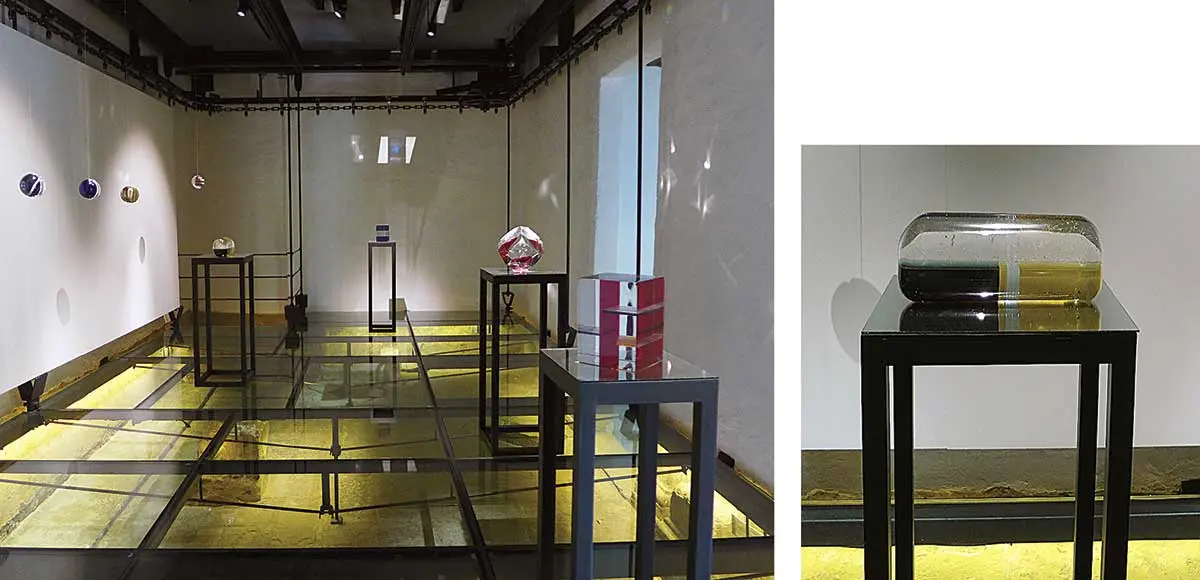
Among the three artists selected, the greatest degree of authorial consistency is found in Héctor M. Flores’ sculptures. Specialized in glass in his father’s workshop and in crystal via his studies abroad, Flores is an artist of highly demanding creativity and skill. He creates sealed objects with irregular or regular contours. He is attentive to the generation of different nuclei inside each work; as we walk around them, we notice shifts and interactions. This relationship between the work’s fixed exterior and its shifting, compartmentalized, playful interior sets a stimulating visual/haptic situation for the audience: the desire not only to observe the flow of lights in the object but to pick it up with one’s own hands. Flores decided that his works required to be set in a darkened area in the gallery and to be illuminated individually and directionally. The decision was correct, as it brings each item out and works with the relevance of the concept of translucence. Working with color and with the projection of light and shadows, Flores is able to achieve emissions of light and tone into the darkness. The results come close to being hallucinatory. Thematically, some of his works (not included in this exhibition) feature everyday geometric references; one example is Trompo. Flores brings the universe into focus in alternative ways via allusions/titles such as Fuego, Las 4 estaciones, and the series El Universo: M42. Works like Óptica geométrica #1 and # 2, in cut, laminated, and polished optical crystal, give concrete shape to the diversity of his creations.
More open criteria are becoming the norm during the second decade of the Twenty-First Century: we know that what makes the work of art is not its subject matter, the discipline to which it is ascribed, the movement to which it belongs, or the materials of which it is made, but the personal development of its creator. The relationships between design applied art, and the work of art is moving into transmodernity, which in this exhibition expresses the coexistence of the four aspects mentioned above and the options of re-evaluating the past, inhabiting modernity and postmodernity, bringing science or conceptualism to bear, appreciating technical capacities, and familiarizing ourselves with experimentations in the presentation of the finished, ritual work of art.
At the inauguration of trans-lúcido, the president of the Universidad del Claustro de Sor Juana, Dr. Carmen Beatriz López Portillo Romano, quoted a verse by the poet after whom her institution is named: “hear me with your eyes, as the ears are so distant…”
GRACIELA KARTOFEL