The latest work by Viviana Zargon (Buenos Aires, 1958) was shaped by archival research as the source of inspiration, reflections on the decay of the contemporary world as an expression of the unraveling modern capitalist discourse, and formal experimentation. In her recent exhibition at the Museo de Arte Contemporáneo in Lima titled Archaeologies of Memory, the Argentina artist presents a selection of works created during the last decade that center on portraits of old and abandoned industrial spaces rendered through paintings and photographs, as well as variants of those two mediums turned into installations or objects.
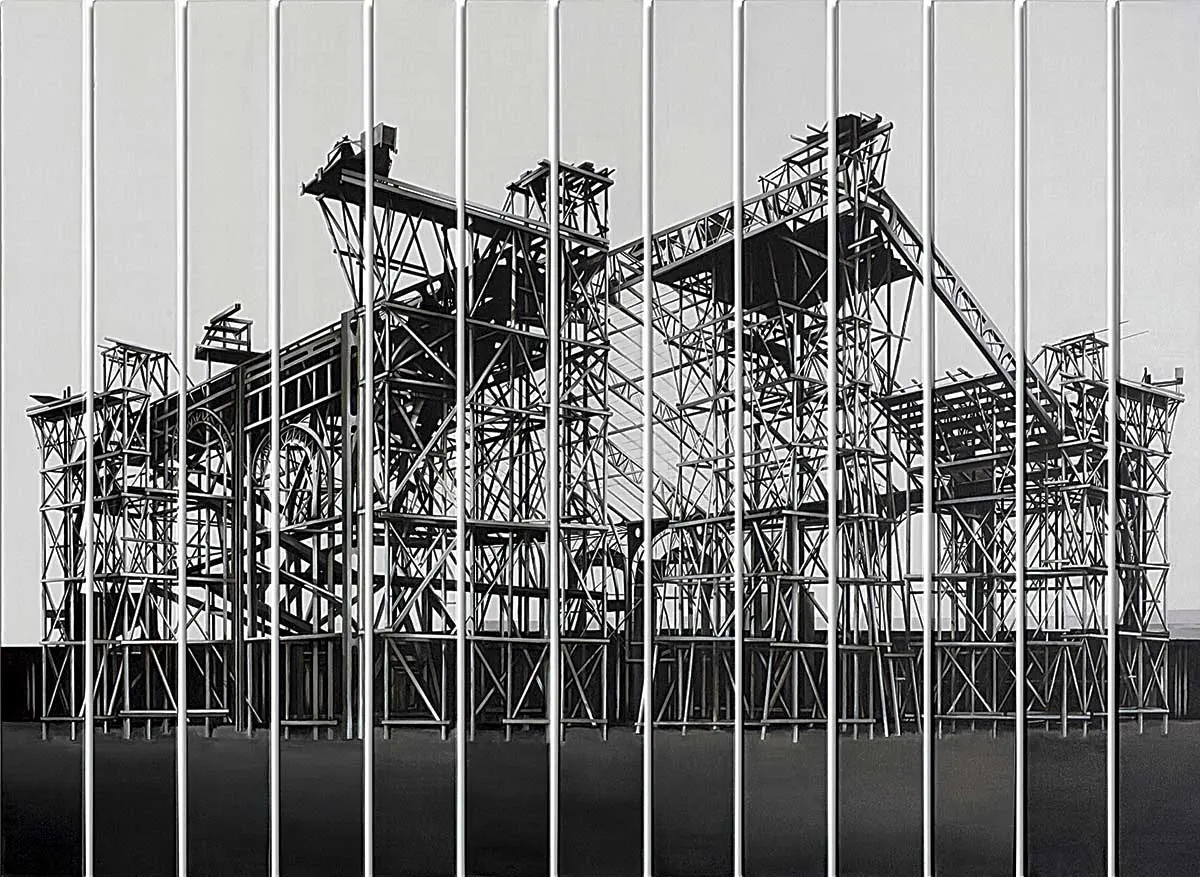
Thus, we enter a universe presided over by the Palais des Machines—built in Paris for the Universal Exhibition of 1889 as a place to showcase French industrial power, a century after the French Revolution—and populated by abandoned factories and other industrial buildings that, as a group, expose the expiration of an idea of progress that emerged with the Industrial Revolution but that was gradually abandoned as a result of contemporary social and economic developments: a train station that becomes a museum—the D’Orsay, in Paris—and an old factory of vaults and safes in Buenos Aires that eventually is transformed into a synagogue.
However, as the curator of the exhibition, Rodrigo Alonso, points out, this: “[...] archaeological approach is not nostalgic but analytical [...] her research is not scientific but poetic: it is not based on accurate statistics but on illusions, roads traveled, and the heart.” And Zargon’s are roads paved with photographic and archival material produced on her return to Argentina at the end of the dictatorship. The encounter with her homeland, the discovery of the transformations that occurred there during her absence, and, to some extent, the exploration of her roots—a childhood spent in the port of Buenos Aires playing among the machines operated by her father and her parents’ friends—led her to photograph, with no other purpose than to preserve something that would soon disappear, those abandoned industrial buildings that the economic policies of the nineties would eventually turn into commercial buildings or residential areas.
The product of this exercise in the documentation was motivated by a nostalgia that resurfaced in recent years as raw material for Zargon’s work and that became the subject of formal inquiries. These in turn led to works of various dimensions that favor the fragmentation of the image. The result is a representation of contemporary ruins that evidence, on the one hand, a nostalgia for the dream of a future that has already expired and, on the other, a clear awareness of the modes of representation offered both by painting and photography. All this brings to the table the question of how social and economic processes shape the lives of people, depending on how well such people are able to adapt to the systems of production. A question that the black and white images in this exhibition are more than able to answer compellingly.
CARLO TRIVELLI