
Not only philosophers, theologians, and psychoanalysts are fascinated by the relationship between universal concepts and particular traits and actions. Collective Unconscious, the title of Yoan Capote’s second solo New York exhibition—the last one came in 2010— is not only an obvious reference to the psychologist Carl Jung but a restatement of the artist’s long-standing claim for the specifics of his work: his process and work are rooted in universal conditions of the human psyche. What exactly this means and where and how it is determined remains open for discussion but it is more-or-less of its time.
Remember that the 2013 Venice Biennale curator Massimiliano Gioni placed Jung’s famous Liber Novus at the heart of the Central Pavilion as a unifying principle. Best known as The Red Book it was the visual product of what Jung called his “mythopoetic imagination,” his personal visionary confrontation with the generalities of both his own unconscious and his cultural moment as the First World War began. In many ways, this inscribes the quest and motives of the politically oriented Capote in relation to Cuba these past several years, an embodiment of what I called in 2010 his exploration of “the double-consciousness of Cuban island culture” with its impossibility of separating the socio-political from the personal.
Of the 20 works in Shainman’s main gallery, the largest physical presence is the 10-foot high portrait of Fidel Castro created from welding used metal door hinges gathered from old regime buildings across Cuba with about eight full sizes, used, doors on the floor casually surrounding the sculpture (Immanence, 2015).
English speakers often interpret the word “immanence” in its briefest and secular sense, as qualities held inherently within an object, situation, or person, a concept often used to define modernism. We forget a fuller derivation is from its deistic sense, with references to both earthly and metaphysical manifestations attributed to the Godhead. Such has been Fidel’s presence and now his behind-the-scenes absence. Here he functions, as Carl Jung found in World War I, as a "hinge" moment in history with many doors yet to open…or close.
Smaller and more arresting for this reviewer were the double-hung groupings of seven small (domestic size) plastic cutting boards, all with the same simple design: a thin horizon line across the same middle point of all, with brief monochrome washes created from blood to give us a vague feeling of land below and sea above, stretching endlessly. The “sea” and “seeing” have been consistent themes in various media for Caputo but here the still quietude of the monochrome blood more powerfully establishes the “poetic imagination” in him and us, emphasized by the poignancy of the series title, Deep Cuts.
At the entrance hall stood two vitrines, like glass fish tanks mounted on metal frames, which contained assortments of medical equipment, mostly a suffocating clutter of glass vessels likely to be found in science labs and/or marijuana shops. (The double reference seems purposefully incendiary.) Within each container are photographs of what seem to be random crowds gathered across time in protest. Now and then a word filters through but not enough to give you a specific anchor. Their title, Laboratorio (2012), remains a general reference to the contested social experiment that was Cuba. The past tense is evoked through the aged physical condition of the photographs as if imaging a dream now past.
But the use of photographs and vitrines also link to a major work in the second gallery where numerous bundles of round concrete cylinders fitted with fuse cord and bundled together to look like stacks of dynamite are covered in similar photographs of protest crowds. The title reaffirms the historical tension referenced in Laboratorio, with Charge (Miraculous Static) of 2013-2015. Is the present charged by the past? If so, with what explosive possibilities?
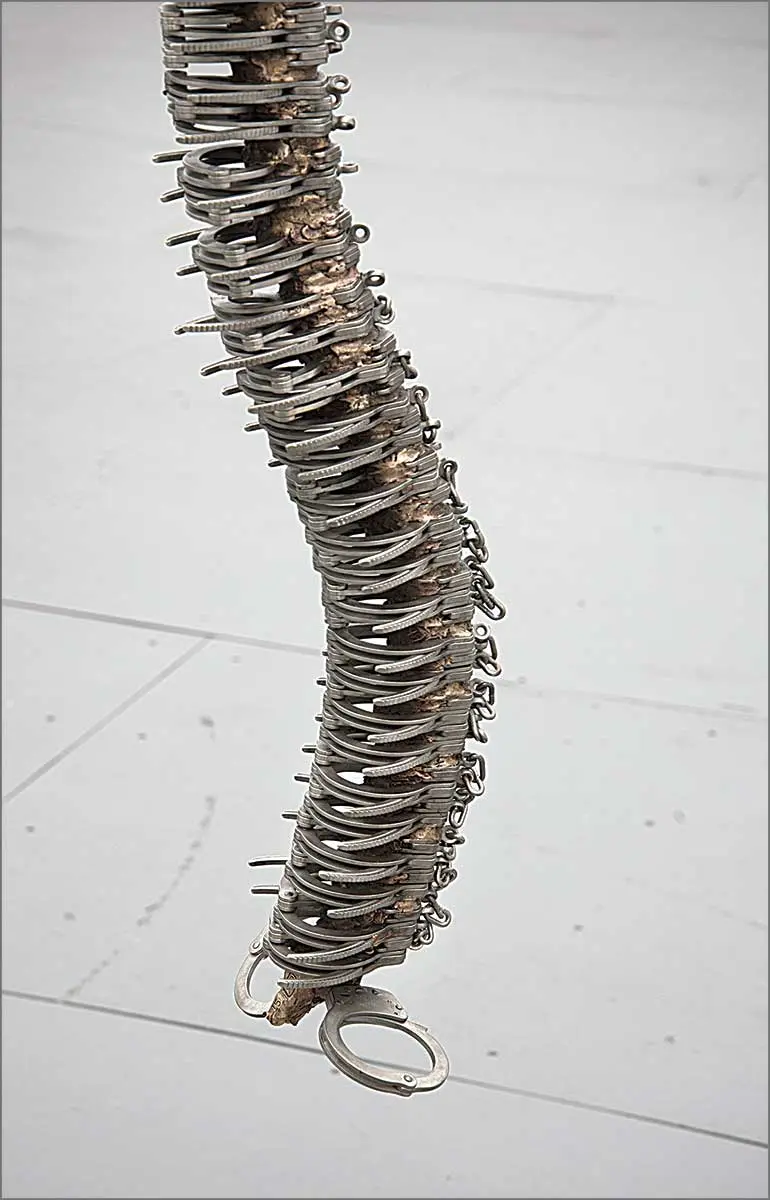
The nine works in this gallery establish a conversation between themes in both galleries important to Capote: the visceral body, the Cuban flag, absences, and voids. For example, his better known 2014 New Man, a full-size human vertebra made from handcuffs welded to a bronze column, refers to several works in the 513 space: the later (2015) watercolor drawing of the same name; the full-size bronze ribcage (Visceral, 2015) whose cast bones form the map of Cuba; and the subtitle of Deep Cuts is Visceral.
A new note seems to sound here with the new (2015) work Rate (Fucking Money) where a large wall triptych has a generalized watercolor landscape of the early Flemish painter Hieronymus Bosch’s famous Garden of Earthly Delights (ca. 1490-1510). The delights for Capote are sex and money, as multiple groupings of humans sexually cavort across heaven, garden, and hell, constructed from the paper currencies of many countries. But Bosch held hell as devastating punishment; here, only a continuum.
RICHARD LESLIE