
What could be more appropriate for Adrián Villar Rojas’ site-specific installations than the two designations Marian Goodman has chosen for the two sections of her well established New York Gallery: North and South. Two Suns, as the exhibition is titled, delves into the transitory and the ways in which perishability is revealed in the artist’s work. Villar Rojas’ work is the ephemeral that partially survives itself, visualized yet not recognized, in the process of losing/transforming its DNA. Between curtains that stopple the light coming from outside, there emerge mosaic tile floors in gray, brownish, and worn-blue hues, with irregular designs that seem to get along well in some sections and to interfere abruptly with each other in others. As we reach the gallery, the “garments” of the curtains reveal the installation that the flooring actually belongs to, pointing the visitor’s way along a narrow corridor into the next room. There, the penumbra dissipates and the gray and blue tiles are presented under more intense lighting, encrusted with various elements such as shells, pieces of paper, plastic, and beverage cans. A physical metaphor for “let there be light” is the large figure of a reclining David, based on Michelangelo’s. This replica traverses time, and it lies as though in mortal repose, although it is also supported by two columns that will allow it to shoot into the future.
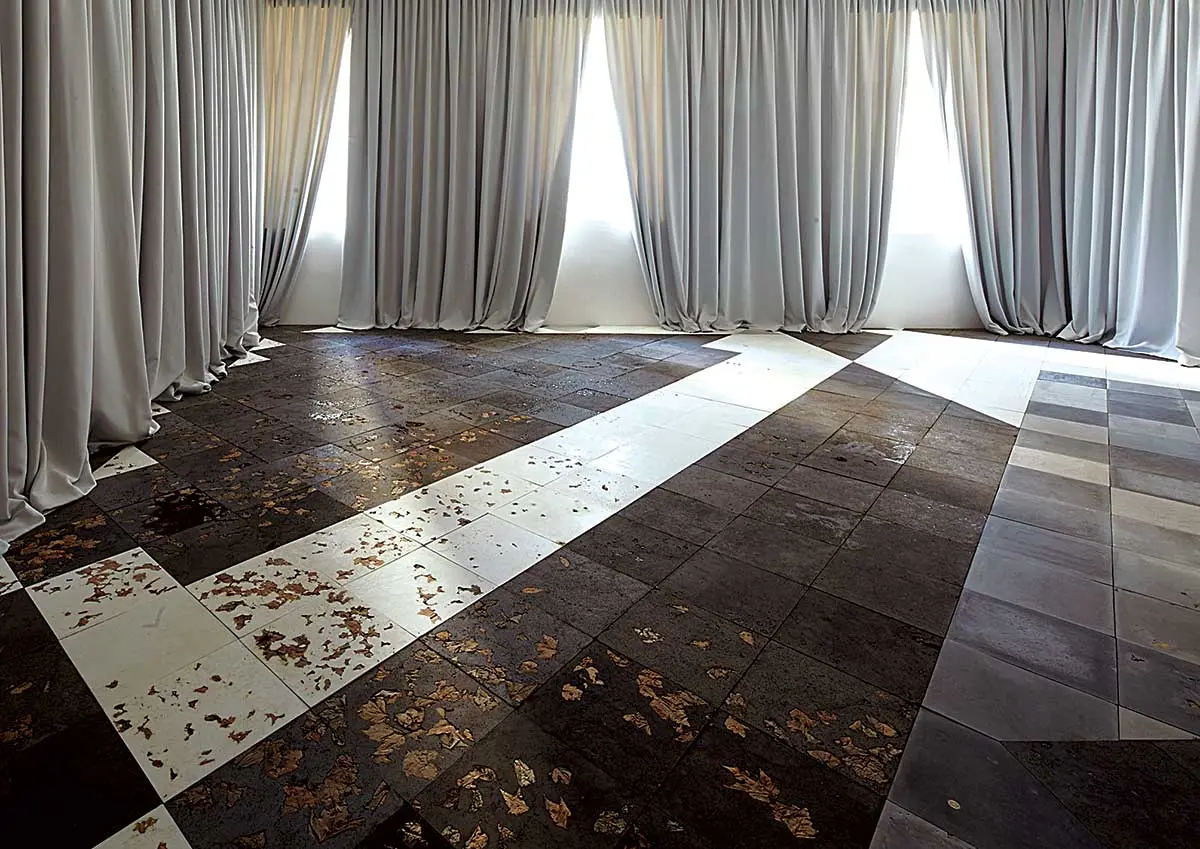
It can be said that in Villar Rojas’ work, especially in Two Suns, nothing comes from nothing. The medium used is the recycling of pieces from other installations that travel from one site to another, where the artist presents a project in the mode of action/direction alongside his assistants/actors, complemented with drawings, plans, descriptions, and experiences. There are no sketches or preconceived plans of action. The material of the floor tiles is basically clay, to which the artist has decided to add different amounts of silt, garbage collected from the faraway places where his work has been presented, some cement, leaves, rocks, sand, and also organic materials like meat, fruits, and fish. On the floor, we also see samples of the industrial detritus that characterizes our civilization—soda cans and pieces of what appears to be devalued Argentinean coins—accompanied by various incisions and textures. There is no doubt that Villar Rojas is interested in the passage of time; specifically, the passage from the past to the future. It is a disbelief in the actual existence of art, exhaustion of all that is human on this planet.
His many exhibitions have also included a high-tech robot, Michelangelo’s David, a dinosaur, and other miscellanea. Connected across time without a chronological framework to contain them, these elements even refer to different popular cultures, different human societies, and attempt to focus on what the art of an extra-planetary future could consist of. When visual artists attempted to create/leave, the few mostly conceptual proposals were intimately connected to geography, to reforestation, and to the resistance of materials—to earthquakes, acid rains, bombs, and other known agents. Adrián Villar Rojas, born in Argentina in 1980, has as his precedents in the land-art realm by the work of Joseph Beuys, Frans Krajcberg, Nicolás García Uriburu, and Robert Smithson, among others. He was born almost twenty years after these authors began practicing their art focused on sustainability. Does Villar Rojas catapult a mixture of this civilization towards another? Others? Towards where? With this, he proves his recognition of today’s baroque decadence and ultimate search.
Adrián Villar Rojas’ approach comes, as did his antecessors’, with a diachronic cut that could be called a “theory of elasticity”: to bring—stretch—what is salvageable into a next state, and to include it in the new mass/planet/habitat. The difference is that Villar Rojas enhances the mobility of his practice, with site-specific installations that survive in minute partial ways. Also, he carries his studio and, in good measure, his troupe of helpers from one site to another. The issue is not only the itinerancy and the mini-survival of the materials but the implications of time on the actions. The artist traveling alone versus the artist traveling with the weighty baggage of exhausted, intermingled civilizations, to institutional destinations or commercial galleries. These archeological clays from the Twenty-First Century are thus imbued with a thoughtful objective.
GRACIELA KARTOFEL