
Alberto De Michele (Venice, 1980) constructs a story that verges on the improbable and tests the ability to believe in this adventure called The Second Trip. A video installation displayed across three large exhibition rooms at the Museo Rayo, the work weaves a series of stories that combine chance and De Michele’s intuition, always in connection with an enigmatic character that has a violent past. The rhythm of the walk through the exhibition rooms resembles that marked by the chapters in a book as the piece possesses strong literary qualities despite being a video.
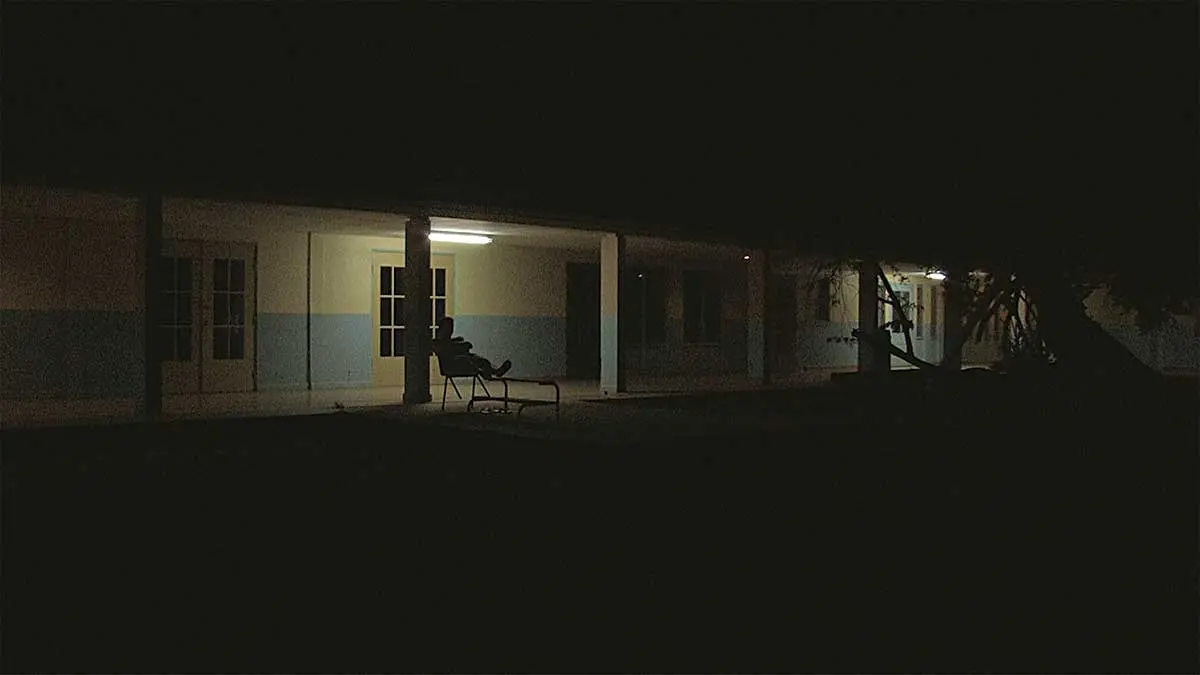
It all starts with a subject in Aruba who fled from Colombia to Cuba to escape his enemies. In Cuba, he struck up a friendship with Alberto De Michele. The first room of the exhibition shows a series of videos in which this character, the protagonist of the video installation, talks to the camera in detail about his crimes in Roldanillo, the town where he comes from. He is always recorded in darkness or covered by a mask to protect his identity and to underscore the featureless nature of his presence. Gaining this mercenary’s trust became a central objective for the artist. With this purpose in mind, De Michele gave the subject a camcorder as a gift to be used in Aruba to record the video. In earlier works, De Michele had already approached characters from the world of crime in order to document, alongside them, certain aspects that attracted his imagination from a poetic standpoint. Some good examples of this are the works I Lupi (2010), Pasquale De Michele (2011), and Adriano (2007).
The second room of the exhibition shows videos that were not recorded in Aruba but in Roldanillo, the town where the Museo Rayo—where the installation is on display—is located. Following the first contact between De Michele and his enigmatic subject, and after corresponding for some time, the latter informed the artist that he returned to his hometown because he missed his family. Since his return coincided with an artist in residence program that De Michele was completing at the time at Lugar a Dudas in Cali, they agreed to meet in Roldanillo, despite the inherent dangers of such encounter. Their meeting took place at the Museo Rayo which is also the place where one of the videos was recorded. Thus the presence of several paintings by Omar Rayo in the background; a backdrop that became the stage for a series of confessions by a masked subject who perpetrated crimes in the town.
During the stay in Cali, De Michele’s visits to Roldanillo became frequent. There he went to the subject’s home, rode with him on a motorcycle at night, and toured the town and its scenic views, always under the cover of darkness, as it was the only safe time to venture out for someone with many enemies and a criminal past. And everything was captured on video. Thus, the first and second videos showcased the world inhabited by the character through a sort of video description of the context and the approach to a story that attracted De Michele’s interest by virtue of the uprooting and illegality themes contained in it. In this manner, the video installation begins with scenes in the dark and a voice-over that confesses both uncertainties as secrets, the sea of Aruba and the streets of Roldanillo. Quien lo Vive, Quien lo Goza– La Máscara de la Maldad (Live It to Enjoy It – The Mask of Evil) compiles all these documents that at one point were already regarded as part of a finished work that had nowhere else to go and whose content was similar in meaning to earlier proposals by De Michele.
However, the work has a third act involving the moment in which the mercenary was forced to return to Aruba after one of his enemies learned of his whereabouts in Roldanillo. Having settled in Colombia, Alberto De Michele decided to accompany the fugitive on the trip, which was illegal. The third exhibition room shows videos recorded at sea after the boat sails broke—the only way to bring this character back to Aruba was on a sailboat from La Guajira. El Segundo Viaje (The Second Trip) centers on the theme of getting nowhere; revolves around being drift for eleven days on a sailboat across the Caribbean Sea and the risks taken by everyone involved: the artist, the mercenary, and the illegal capital. As a whole, the video installation takes viewers through a continuous journey of inquiries about contexts, history, and credibility, as it immerses them into atmospheres swallowed by the darkness of the museum, the place where the interview with the anonymous subject was taped earlier.
Thus, El Segundo Viaje is a collection of stories told by the artist that resemble the adventures of a stranger which may or may not be true. De Michele weaves the stories in an audiovisual manner, without platitudes, favoring an ambiguity that is necessary to avoid falling into morbidity or simplicity. The poetic element in his work becomes evident in the idea of being adrift, in the twists and turns of the story, and in the manner in which the artist relates to his character—first in Aruba, then in Roldanillo and finally in La Guajira, where they had to wait over a year to find a boat in which to sail. Thus waiting becomes the second trip, since getting nowhere led De Michele to consider other important experiences that occurred in the “meantime”.
BREYNER HUERTAS