
Since the beginning of his career, Ángel Marcano has experimented with different types of wires that he uses to create structures that combine drawing, relief, sculpture, and installation. This use of different media allows him to explore the expressive possibilities of the selected wires for the development of his proposal. His constructions are articulated in a succession of weightless, subtle, aerial, and lightweight frameworks that are referred to as “three-dimensional drawings,” “virtual volumes” or “strokes in the air,” which necessarily refers to the concept of “drawings without paper” initially developed by German-Venezuelan artist Gego (Gertrud Goldschmidt). However, in the hands of the artist from Cumaná this practice takes other formal and symbolic resonances that are in line with the renovated artistic languages developed by the young generation of artists to which Marcano belongs.
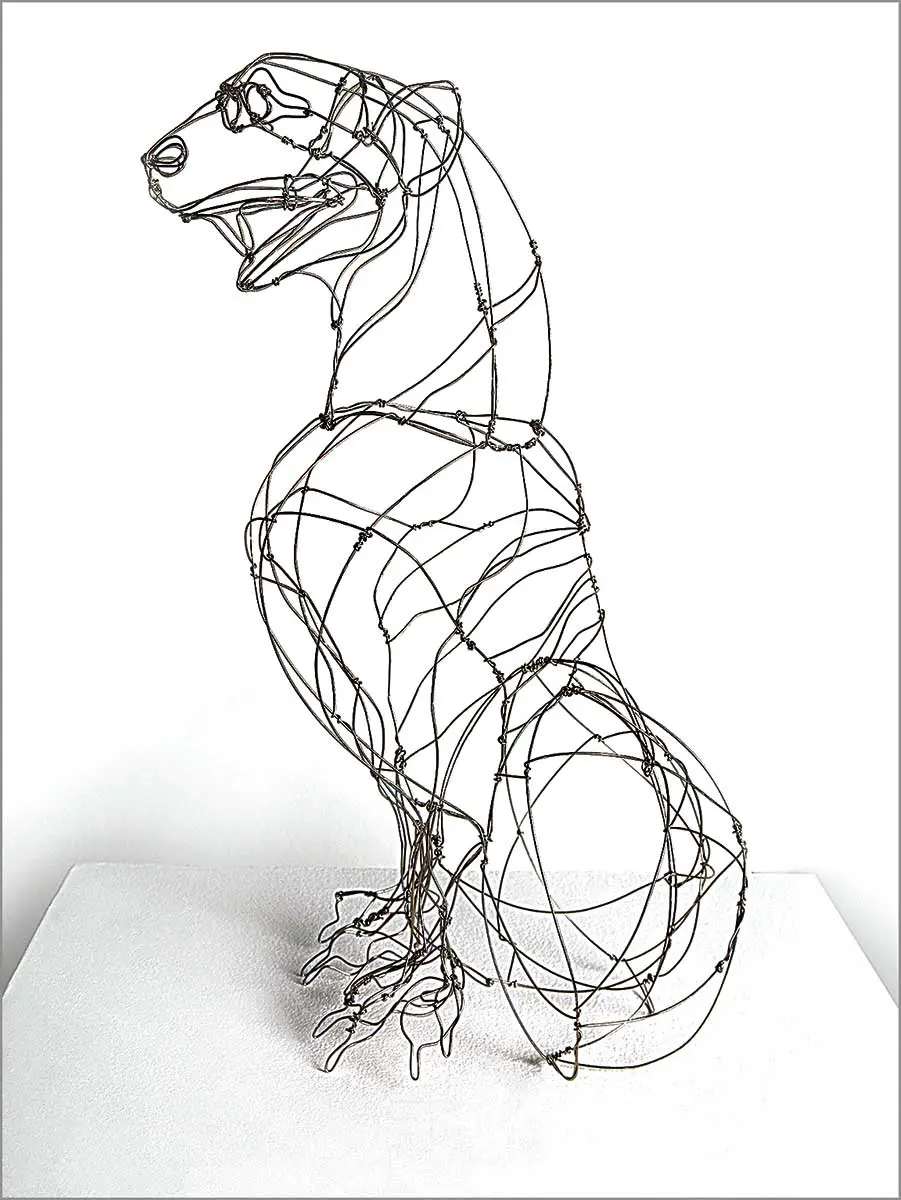
In 2000, Marcano began working with cables, threads, rubber, and, mainly, wires, with which he has developed much of his artwork, using different thicknesses and consistencies: enameled or chrome-plated copper wire, gold or black nickel-plated alpaca wire, among other combinations. His knowledge in handling this material comes from his training as a goldsmith in internships and workshops in Europe, and from art courses that he has taken in Venezuela. In his recent exhibition presented between June 21 and August 2 of this year at the Galería D’Museo under the title Personal Relics, Marcano reaffirms these inquiries through which he has been consolidating his discourse for the last fifteen years. In the text that accompanies the exhibition Susana Benko wrote: “The technical industriousness—almost verging on preciousness—of the pieces does not detract from Marcano’s willingness to rescue, through the projection of shadows, the sculptural and volumetric nature of the figures, as well as the architectural ornaments that some of them offer […].”
Indeed, the group of seventeen works creates an atmosphere that envelops the exhibition space, causing the contrast of light and shadows that reflect the delineated forms on adjacent walls. This mise en scène, which takes into account the lighting resources implemented in earlier exhibitions, successfully dimensions the delicate framework beyond its actual physical size, thanks to the lighting directed upwards, which expands the skeletal representations on the background walls. The author bends the wires through knots and weavings to render hollow, transparent, and almost ethereal forms that mimic the postures of sheep, birds of prey, felines, and deer, as well as imaginary creatures such as the gargoyles and dragons that usually adorn old buildings. The work that is part of the series Gárgolas, Híbrido 4 (Gargoyles, Hybrid 4, 2015), is an example of the imagery collected during his travels around the old continent.
During the exercise of these activities, Marcano also captures the fragility of these small living creatures that he sometimes watches from his window or when they come close to his home, like colorful hummingbirds captured in small figurines spread across a net of flowers along the entrance wall. This is seen in Colibríes (Hummingbirds, 2014-15), an installation made with enameled copper. With this same idea in mind, Marcano recreates a group of beetles—fashioned with black nickel-plated alpaca wire—that appear to silently climb on the sidewall; as well as the tiny minnows, barely discernible in the distance, arranged on a nearby surface.
In another context, his gaze falls on architectural aggregates and ornaments made by artisans of the past. As an artist and goldsmith, Marcano is attracted by the sinuous shapes, the organic volumes, and the design of ornaments that he then reproduces in free compositions. The configuration of these works encourages remembering because it leaves a wide margin for the recognition of images associated with allegorical, historical, natural elements and everything else that involves the visual and the fantastic. In the artist’s own words, “I appropriate figures, take their pictures and then transform them into drawings. The narrative is different in each of the pieces. I mix linear elements with weaves, always looking to get closer to the aesthetics of beauty [...].”
The peculiarities of this exhibition rest not only on the conception and execution of the pieces but also on the combination of scales and the encounter of the palpable with the immaterial, triggering dynamics related to the perceptual, concrete, and intangible. The incursions into these approaches have earned Marcano national awards like the First Prize at the 7th National Salon, CANTV, Youth People with FIA, 2004, First Prize at the Grand Arts Competition, 2006, and the recognition granted by the International Association of Art Critics, AICA, Chapter Venezuela, 2008, in the category of Emerging Artists, among other recognitions.
GLADYS YUNES YUNES