
Brazilian photographer Caio Reisewitz (1967) presents in two concurrent exhibitions in France, at the Maison Européenne de la Photographie (for the first time) and at the Galerie Bendana-Pinel (for the second time), monumental photographs of Amazonian landscapes accompanied by small collages that visually contrasts the enormous growth of Brazilian cities—with their vast favelas and skyscrapers—with the wild exuberance of a rainforest still untouched by mankind.
These images—which don’t solely showcase the beauty of untouched natural landscapes but also attest to their vital energy—were taken during the last decade. For the most part, the center of the photograph on the Atlantic Forest that borders Brazil to the east and that is in the process of accelerated extinction. The primitive Atlantic Forest that amazed Amerigo Vespucci in the early sixteenth century no longer exists. Devastated by urban development—luxury residential buildings and hotels—the landscape is nothing more than the eroded shadow of a receding jungle. When the Portuguese arrived in the sixteenth century in the land that today is known as Brazil, the Atlantic Forest expanded across 1.2 million square kilometers of territory. Since then, about 93% of the forest has disappeared as a result of (private) economic interests taking precedence over the preservation of the (collective) ecological balance of the planet.
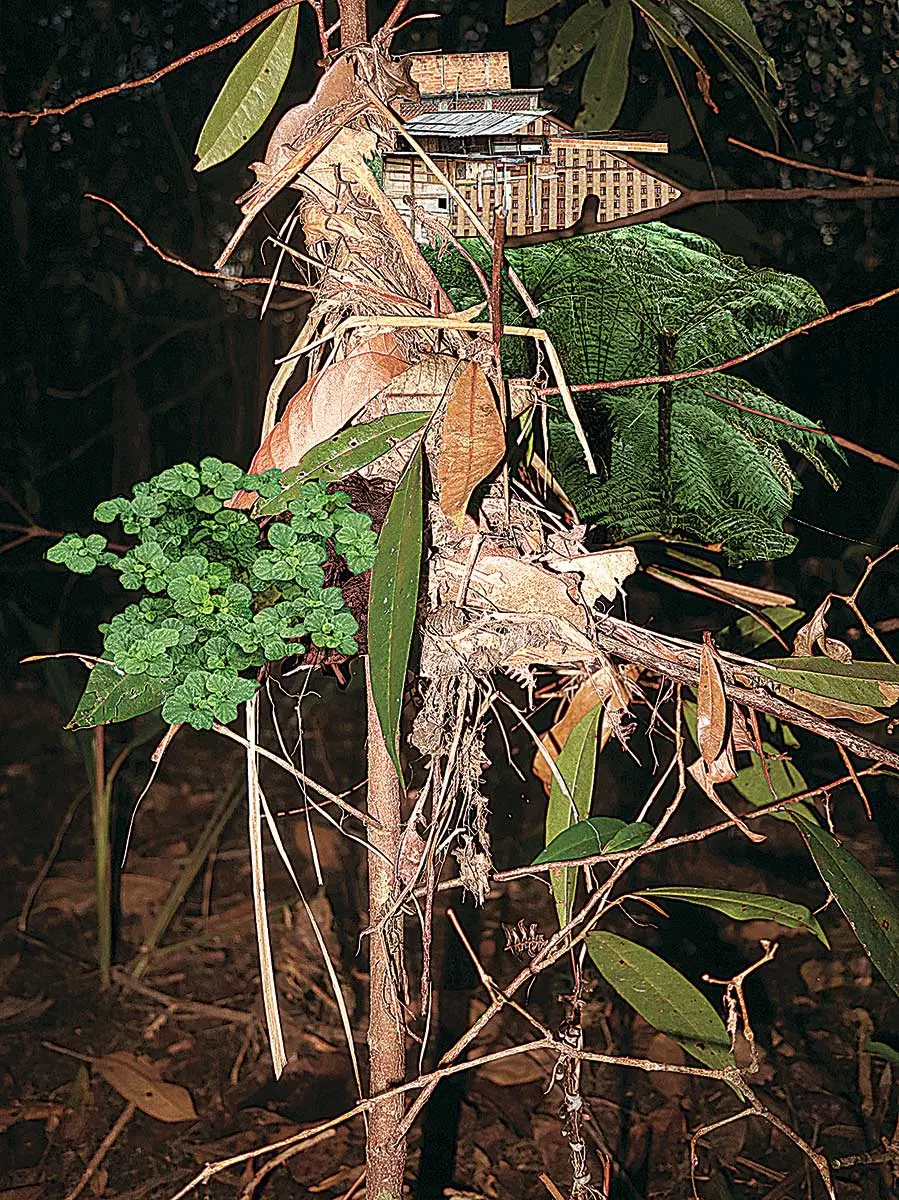
For Caio Reisewitz, who returned to his homeland at the age of 29 after many years in exile in Germany, the contrast between memories of an idealized natural heritage and the reality that he encountered instead was shocking. The exhibition titled Disorder at the Maison Européenne de la Photographie consists of nine large photographs and eleven small photographs and collages that Reisewitz began to work on in 2010. These works rely on the opposition and complementarity between formats as well as on the antagonistic relationship between nature photography—in the pictorial tradition of landscape, and informed by the works of German photographers Andreas Gursky and Thomas Struth, with whom Reisewitz collaborated—and collage photography, in which urban constructions and the natural landscape are interleaved and overlapped. This choice underscores Reisewitz’s fascination for the organic “scene” that untouched nature offers, its inextricable and almost impenetrable fabric of giant trees and vines crossed by powerful, raging water.
Such magnetism is gradually obscured by his concern for that original, real-world—sometimes miraculously preserved—that faces an “artificial” one in which staked and precarious peripheral buildings and skyscrapers weave the fabric of Latin American megacities as they inexorably erode the natural environment.
Whether it is Itatinga (2012), Porangaba (2012), or Manacapuru (2011)—all names are taken from the Tupi-Guaraní language—visitors find themselves before great “documentary” photographs of nature. In Tupãceretan (2012) predominant greens are violently fragmented by a “mysterious” blood-red spilled on the paper. The threat of destruction seems to be present as a “pictorial metaphor” of the imminent chaos and death that besiege the jungle.
The Galerie Bendana-Pinel complements this aesthetic and activist journey with another monumental photograph titled Hausverlassung (2015), which focuses on the rim of a fountain, a relic of the architecture of a rubber town abandoned in the early nineteenth century. Already present at the Maison Européenne de la Photographie, with Casa Canoas (Canoas House, 2013), his photographs of architectural interiors reflect Caio Reisewitz’s fascination with Brazil’s colonial heritage and the achievements of twentieth-century modern architecture.
Three large photographs, three collage photographs, and two original collages—Reisewitz’s most recent fine and delicate work—conform this more modest but equally strong exhibition in terms of its aesthetic and “activist” discourse. Like with the purple violence in Tupãceretan, the photograph titled Goiania Golf Club II captures the attention because of the contrast between the green (almost fluorescent) of the meadow and black tree lost in the monochromatic vastness that seems... artificial! However, Reisewitz is more often than not content with capturing reality and few of his images have been digitally altered.
Two small photo collages attract the attention not solely for their aesthetic beauty but also because they suggest the destructive interaction between architectural construction and nature. In the work Avanhandava (2015) the buildings of the city appear to be floating in a sea of greenery, and in Piracuhy (2015), under a coppery light, the remains of dead leaves and branches whose colors have been changed by water are inserted into the tropical vegetation.
These photographs are not only aesthetically seductive. With the presence of several types of architecture—favelas, vestiges of the past, or large urban complexes—these images by Reisewitz also reflect an awareness of the impact that the uncontrolled economic development in Brazil has had on the natural environment. They are also reminders of the ephemeral nature of beauty due to the action of time, but also increasingly as a result of the interference of mankind.
CHRISTINE FRÉROT