
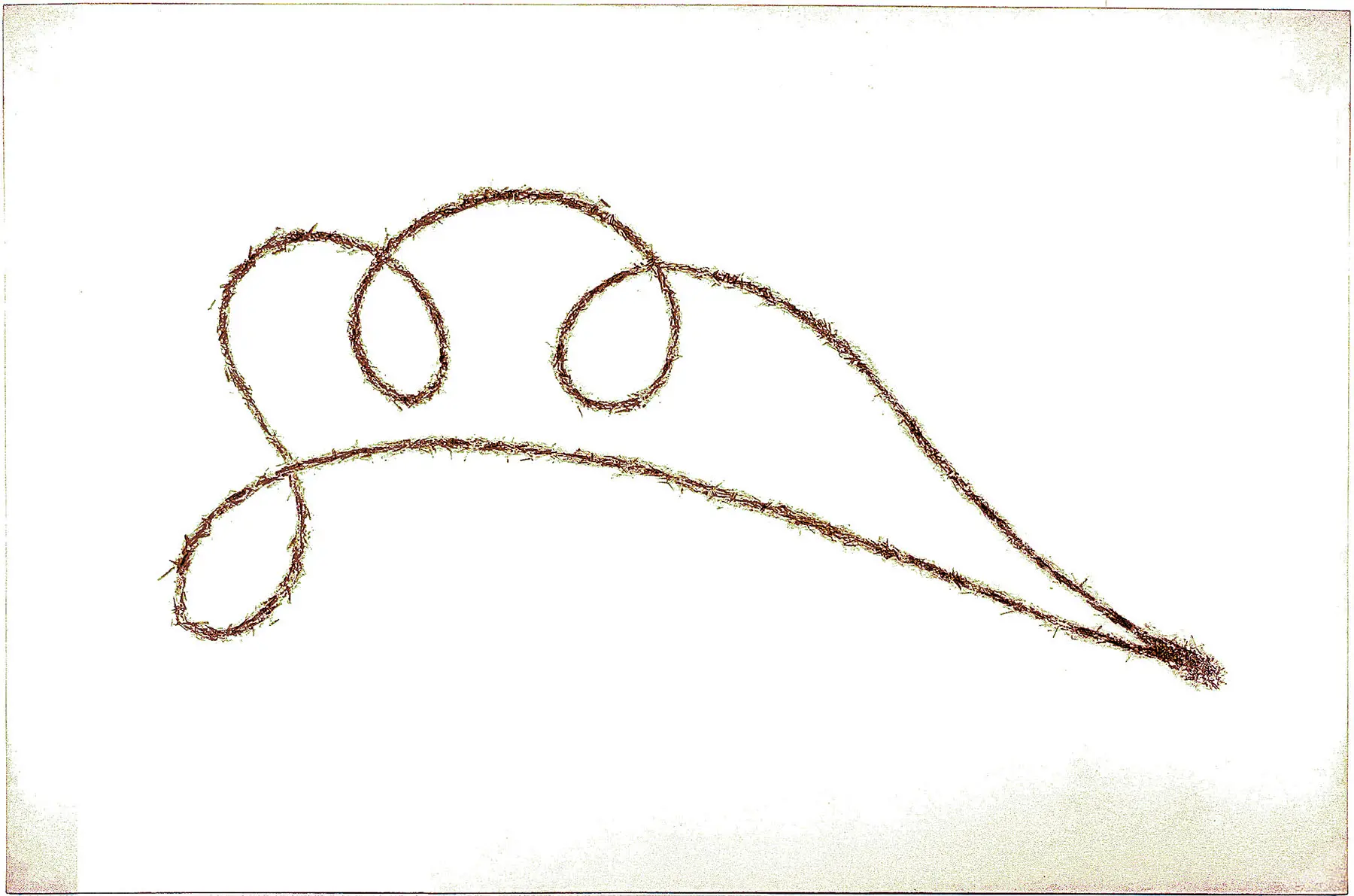
Boomerangs. Possible trajectories for a boomerang. Curved, sinuous lines that stretch and turn on themselves one, two, several times, returning to their point of origin. Meanders that appear seamless to the gaze that follows them, but is in fact the result of hundreds of line fragments, each fragment the ferrous imprint of a nail left to rust on the canvas.
There is an interplay of small paradoxes in the way these representations of boomerang trajectories, created by Daniel Senise in the mid-1990s, are made and shown. The imaginary line followed by these toys (weapons) in their dogged flight, the secret for which is perfect aerodynamics, emerges here from the accumulation of many static units (those nails) whose actual function is precisely to keep things in position. Also, the vertical and specialized arch of the trajectory becomes a line on an eminently horizontal plane, since it is mainly from this position that the oxidation of the nails takes place. At the same time, the line’s indicial relationship with the boomerang coexists, tensely, with the equally indicial relationship that the rust-colored scratchings have with the nails manipulated by the artist.
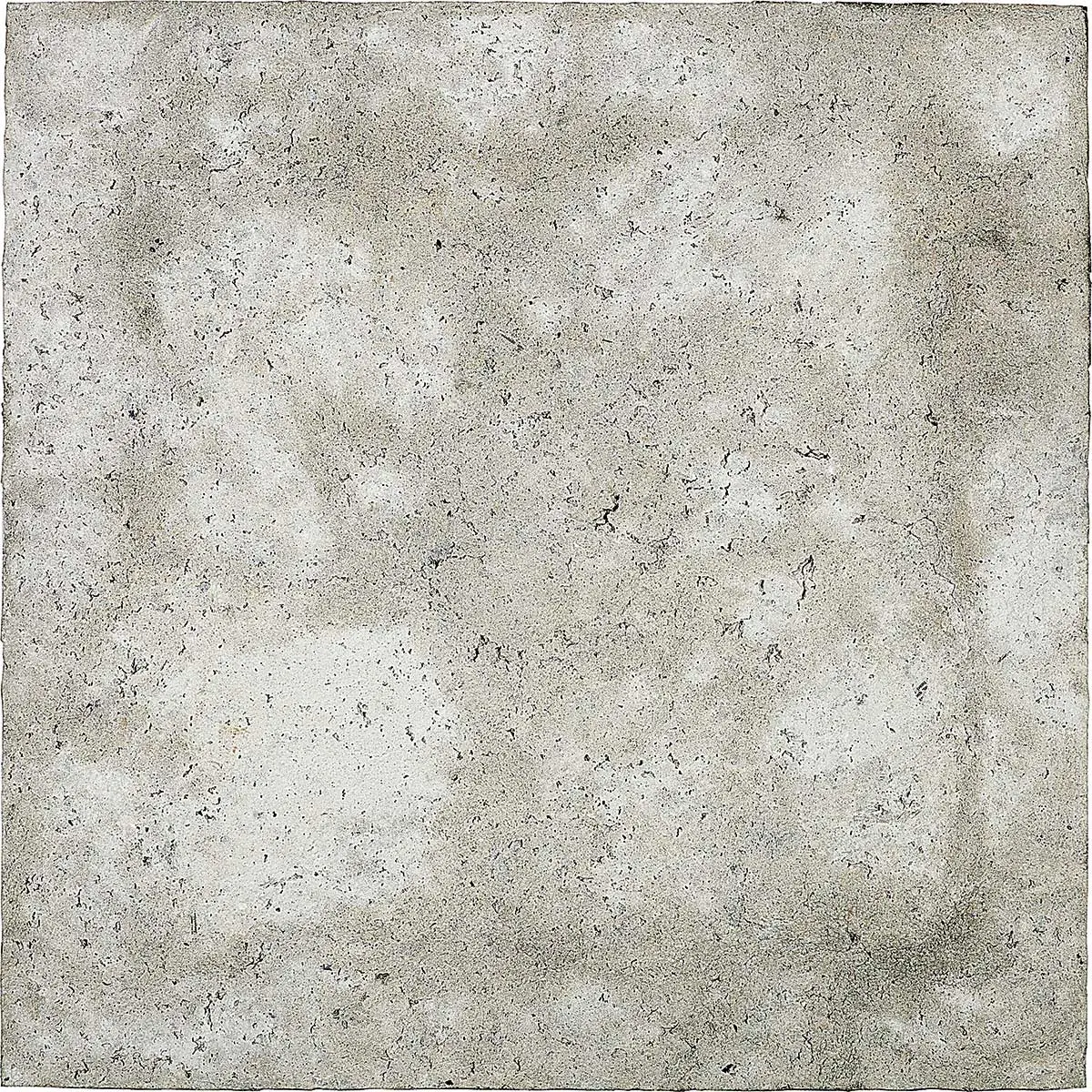
In the strictest sense, there are no pigments or paint here; nevertheless, this simple yet contradiction-ridden image is one among many explorations of the nature of painting and pictorial perception Daniel Senise has produced since early in his career.
Senise had begun his intense, albeit informal, training at the Parque Lage School of Visual Arts about a decade before the creation of those lines, as a young engineering graduate in the early 1980s, alongside many names who would later be part of what came to be known as the “Return of Painting” in the Brazilian art circuit and marketplace.
There are several landmarks in the story of that generation’s emergence and prompt enshrinement: the 18th São Paulo Biennial, in 1985, where curator Sheila Leirner lined up dozens of large-format paintings—both Brazilian and international—along the walls of two 100-meter corridors; or gallerist Thomas Cohn’s decision, in 1983, to make room in his calendar (dominated by artists from the 1960s and 1970s) for the exhibition (and sale) of a young Leonilson’s inward-looking works. The “big canvas” of the 1985 Biennial included paintings by Senise, and he met Leonilson that same year, but his generational identity had been established since 1984 when he was included in the noted show/event Como vai você, Geração 80? (How are you, 80s generation?).
Held at Parque Lage, Como vai você stands out as a synthesis of the era precisely for its occupation of an anti-academic, pluralistic, experimentation-based teaching space. Over a hundred mostly very young artists took over the building with a spectacle that in the reports of its participants has registered as a festive occasion, more concerned with propitiating convergence than with judging the quality of the art.
It wasn’t all painting, but painting was present in a proportion, scale, diversity, and gestural eloquence unimaginable in the art scene of the previous decade, albeit without any manifestos or stylistic mandates. It was there that Daniel Senise exhibited Sansão (Samson), a large-format painting on canvas made with great fluency and installed between the columns of the Palace’s central patio, like its biblical namesake as he overturned the temple pillars. A kind of site-specific work in terms of its relationship with space and its ironically iconoclastic subject, this stylized painting is typical of Senise’s formative years and can also be seen as the first example of the clash of systems of representation that characterizes his oeuvre. A planar figure, this pictorial colossus nevertheless wants to fit into the perspective provided by the space, inserting itself in its structures and interacting with them, at least in the viewer’s eye.
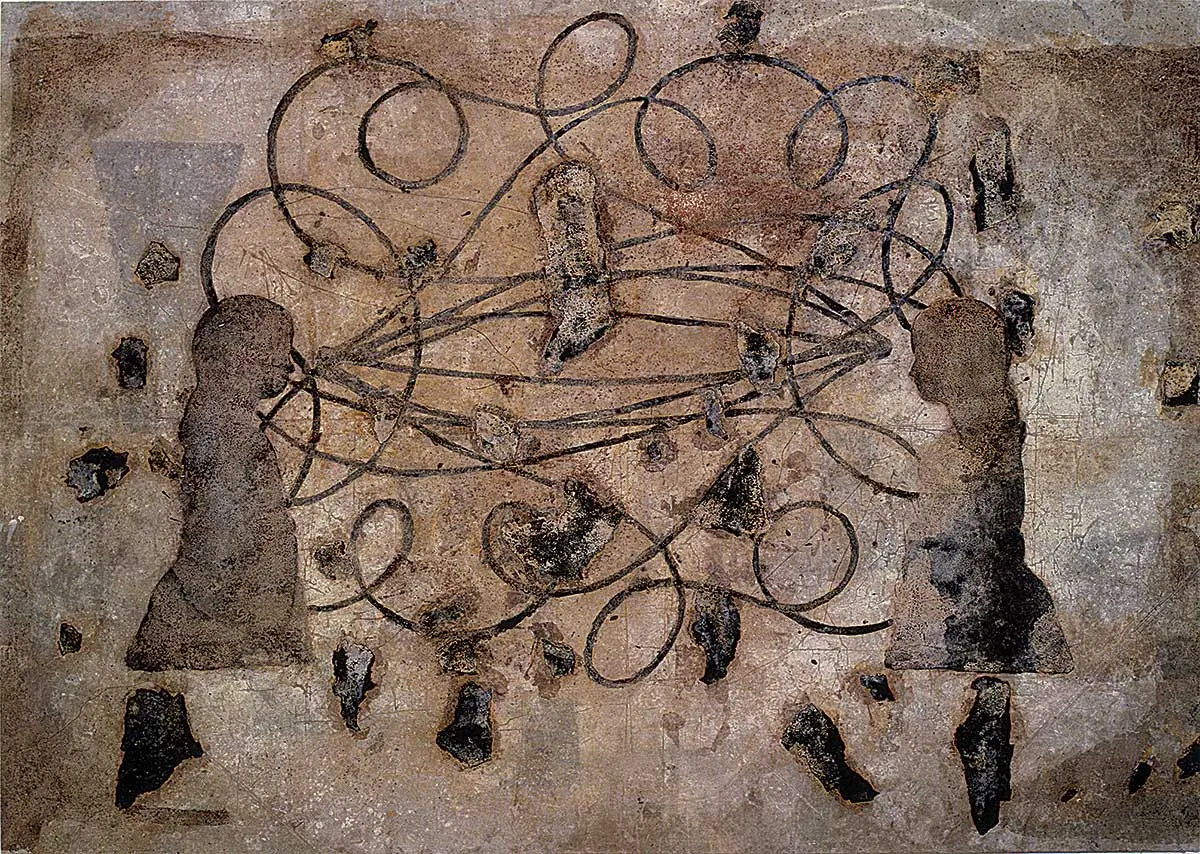
Back to the boomerangs, we find some images in which the artist fused and overlapped different trajectories, creating mazes that no longer correspond to any reasonable measurement for the flight of an aerodynamic object. These arabesques bring to mind Duchamp’s Trois stoppages étalon (Three Standard Stoppages, 1913-4), with their graphic syntheses evoking an objective record of physical phenomena that nevertheless appear as forms/enigmas and underscore what is beautiful and arbitrary in the change-driven drawing.
In 3 caminos (3 Paths), the tangled web composed by this same torrent of curves is anchored to the eyes of female figures presented as silhouettes, in profile. These rather unusual outlines resemble an old, perhaps medieval-era optics study, from before the development of perspective techniques. In general, the back-and-forth of our eyes draws curved lines across space without effort, almost automatically, as they traverse it in search of identifiable elements. Daniel Senise’s work, however, creates ruses to interrupt the process. The discrepancy between two or more systems of representation generates friction in our reading of the image and voids all certainty in the interpretation of what we see.
Senise was already exploring this mechanism in the mid-1980s, when, already out of the Visual Arts School, he began experimenting with painting and its capacity to produce results not based on rigid structures or on brush-and-paint work.
Through his many experiments, the artist made himself familiar with various ways of appropriating pictorial elements. It was not the linear kind of appropriation promoted by the ready-made model, but borrowings of arbitrary texture, color, and form fragments from what was around him, be it dust in his studio, art-historical images, or everyday materials such as nails, metal filings, or the remains of objects.
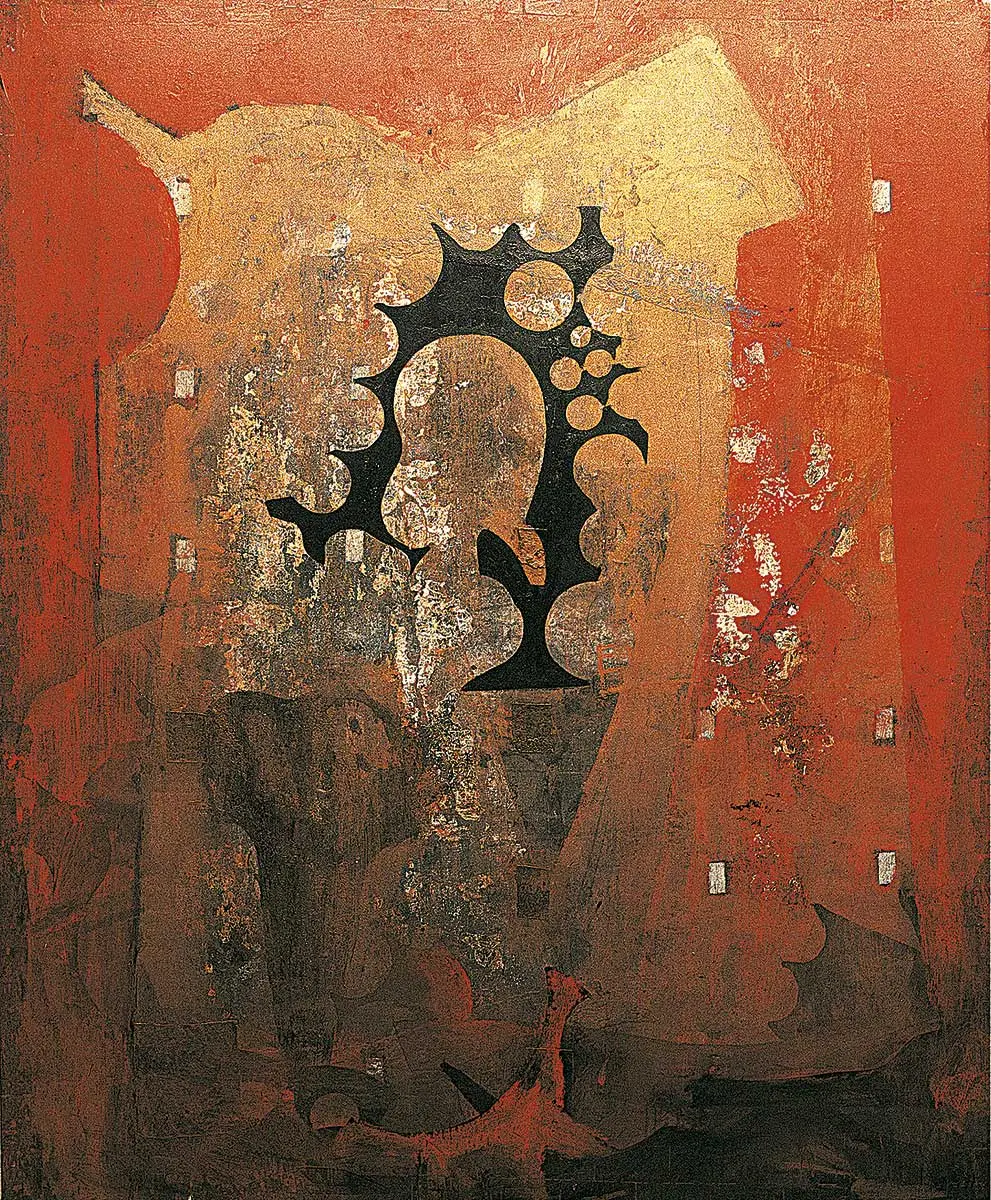
Sin título (Eva) [Untitled (Eve), 1988] is a perfect example of a transition process where those borrowings begin to overlap in sensual, conflicted, and explosive ways. For an initial layer, a medium is applied to the canvas as it lies on the studio floor; on the resulting texture, the artist paints a series of indefinable shapes, filled with segments of curves. In fact, these are reproductions of pieces of wood left behind by Angelo Venosa, the sculptor with whom Senise shared his studio. The artist avoids these negative shapes by applying a layer of red varnish almost on the entire canvas, to the great visual effect. The black silhouette at the painting’s precise compositional center is preserved, and the most visible section of the first layer creates a kind of illuminated halo, dotted with blotches, around it. Advancing inwardly from the edges of the canvas, the reddish magma threatens to cover the purity of the central shape, as it has presumably already done with others.
In sum, the multiple pictorial layers imposed by Senise come to clash on the canvas, and the energy that irradiates from their friction sustains the gaze’s interest and evokes possible meanings and narratives that are clarified only in the artist’s and viewer’s brains. Gradually, Senise’s language was moving away from the idea of an energetic and individualized pictorial “gesture”, so dear to his generation, and closer to montage as a principle for the creation of ambivalence.
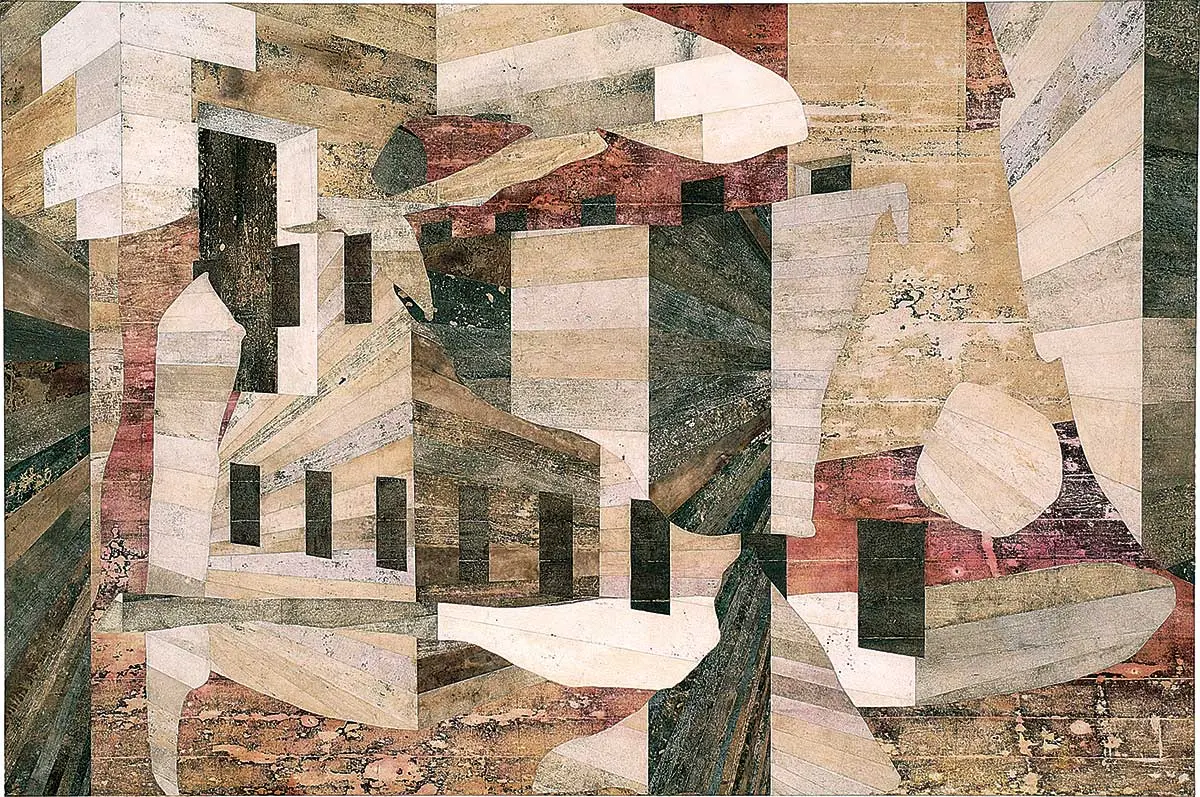
The shift became definitive during the period (some fifteen years, around the turn of the millennium) when Senise lived between New York and Rio de Janeiro. Working in large warehouse-like spaces, the artist perfected the process of appropriating the sites’ textures and tones, imprinting pieces ripped from the floor onto large cotton canvases via a monotype procedure that involved water and white glue. These copies of his physical space were then subjected to painstaking marquetry-like processes, where pieces of wood in different colors were crammed into a surface in order to create flat, fissureless patterns. Trimmed and mounted on a rigid surface, those bands of stained fabric formed a drawing, often a vision of architectural space.
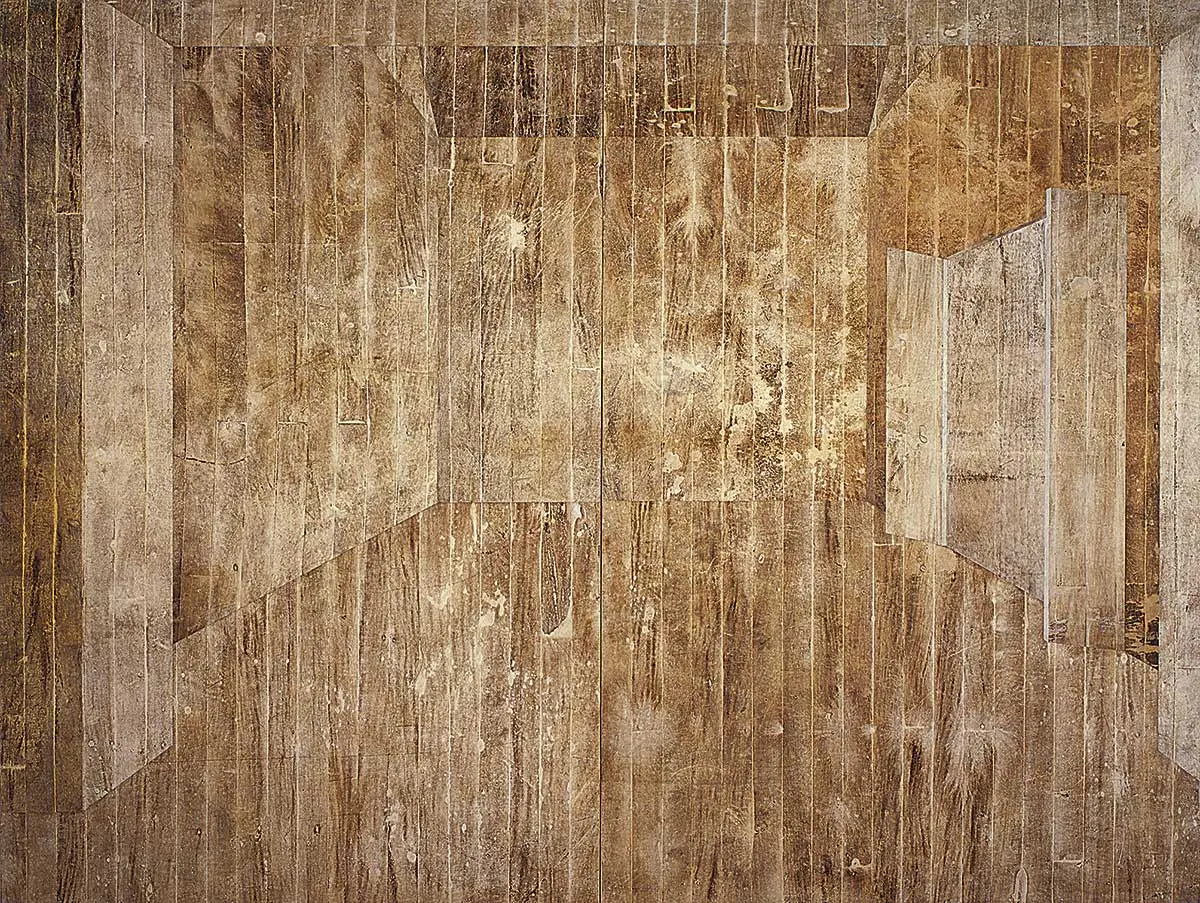
In front of the observer, the planar character of the monotype on the floor clashed with the spatiality proposed by the lines, which were set in a perspective defined by the collage of the canvases. Thus, the eye moves in parallel along the canvas’ surface and the orthogonal grid defined by the floor, all the while submerging itself into the depth of the conical-perspective space. Or, to be precise, the eye focuses on the surface or on the depth one at a time, but the brain entangles both perceptions and mixes them with our atavistic memories and with the spatial distortion of the work as arranged in the exhibition area.
With these series of works, Senise seemed to have found an opportunity to neutralize any remainder of pictorial expressivity and allegorical content, had he insisted on the conceptual/tautological character of his technique. He could copy the dirt on the site’s floor, draw a vista of the same location using cut-outs from the same canvas, and finally exhibit the final work there, as indeed happened in his experiments at the Parque Lage stable in 2001.
It would have been an undoubtedly safe gambit, symbolically reconciling Senise with the conceptualism of a generation dazzled by the expressive expansiveness of Geração 80. However, such an overdetermined feedback loop of conceptual matrices seems to be just one of many available tools for Daniel Senise, never a final destination in itself.
What could that destination be? There are three ways to speculate about it. First, following what we have established so far, a forceful investigation of visual mechanisms. An investigation that begins with an inventory of systems of representation, from indicial blotches to conical perspective, including registers of a shape’s negative spaces and even words and names assigns. Arbitrary selection, precise treatments, and recombinations are, then, resources Daniel Senise uses to create ever more elaborate “visual word games”, exercises in what Marcel Duchamp would have dubbed intellectual perspective.
In his case, the intellectual character of perspective is not limited to the high degree of abstract thought required to calculate the vertiginous spatiality of some of the works; it refers also to the confrontation of different regimes of representation that reinforce and at the same time ignore one another, challenging the viewer to observe them not only with his or her retina, but with memory, imagination, and will, the sovereign pillars of our sight.
Or negative space. With a different emphasis, one could think that the border-area problem confronted by the artist’s practice is the creation of forms that remind us of the fact that, in themselves, images are empty of meaning, and that the gap between what is attributed to the image and what it actually contains is perhaps greater than commonly assumed.
Senise’s installations Branco 462 (White 462) and Branco 2430 (White 2430), at Rio de Janeiro’s Casa Francia (2011), where white used bed sheets—one from the Cancer Hospital, one from a motel in the Flamengo neighborhood—are stretched on two outsize wood panels, interrogate the discrepancy between what is revealed as form and the attributed meanings carried over from an object’s previous life, revived by the audience’s speculative imagination. And the same goes for other works by the artist, made using processed paper from art publications, encyclopedias, and, lately, even the Bible.
The metaphor of the Holy Shroud that is implicit in these works brings up a third way to speculate about Senise’s art, one that is at the same time the most allegorical and the least self-evident. The artist’s most intense passion is perhaps related to the spatiality that great paintings make possible. A dedicated observer of the history of painting, Senise trained his gaze to notice, in those works that most fascinate him, everything that is not their most salient focal point, their dominant narrative and rhetorical symbols, their demonstrations of technical mastery and fidelity. Instead, what he sees most clearly are the peripheral artifices, from accidents (for example, the damaged section of a Giotto fresco) to drawn lines incorporated into an image (like the outline of James Whistler’s mother or the mountain range in a Caspar David Friedrich canvas), to the peculiar spaces created in Annunciation scenes.
This concern with the pictorial spatiality that gives religious paintings their unique combination of verisimilitude and disbelief-suspension is most explicit in Senise’s paintings from 2006 when he produced his series O Reino (The Kingdom). Deploying mysterious architectural signs, the artist seeks to create precisely that kind of space built on the basis of conical, human-centered perspective, but outside of any vulgar temporality: a space in suspension that cannot be of this world.
Although sparing in his explicit allusions to such imagery—barely suggested by occasional references to shapes or names—Daniel Senise seems motivated, as he builds his already extensive oeuvre, by the desire to reestablish the same suspension of time in pictorial space that those paintings achieved, but in today’s secular, conceptual, and pragmatic sense.
His most recent exhibition, Quase aqui (Almost Here) included a laconic yet highly suggestive installation. Caminhante (The Wanderer) was presented in the main gallery of Oi Futuro, in Rio de Janeiro, and it began with the removal of all lining from the gallery’s exhibition panels to reveal their inner structure, their asymmetrical aluminum innards, the dirty wall behind them, and, even more importantly, the windows of the old manor that was renovated to house the institution. Senise decided to enhance the available lighting by placing two potent lamps, in two different color temperatures, behind the milky film that filters natural light into the main gallery. This maintained the windows in a permanent state of radiance, as though subjected to an unending Rio noontime sun.
Adding no other element, Senise left the space empty, luminous, constantly expectant. Framed by the irregular network of undressed panels, bathed by the more-than-natural light, visitors produce a shadow as they face the window, like involuntary versions of the man depicted in Caspar David Friedrich’s Romantic-era painting Der Wanderer über dem Nebelmeer (Wanderer Above the Sea of Fog, 1818). Senise did very little, yet we are filled with the sensation that inside this room, neither the accelerated pace of the city nor the legibility of contemporary art is worth much; in their stead, we are offered an opportunity to experience in our own bodies the suspended space of the greatest paintings of the last millennium.
PAULO MIYADA
Instituto Tomie Ohtake curator.