
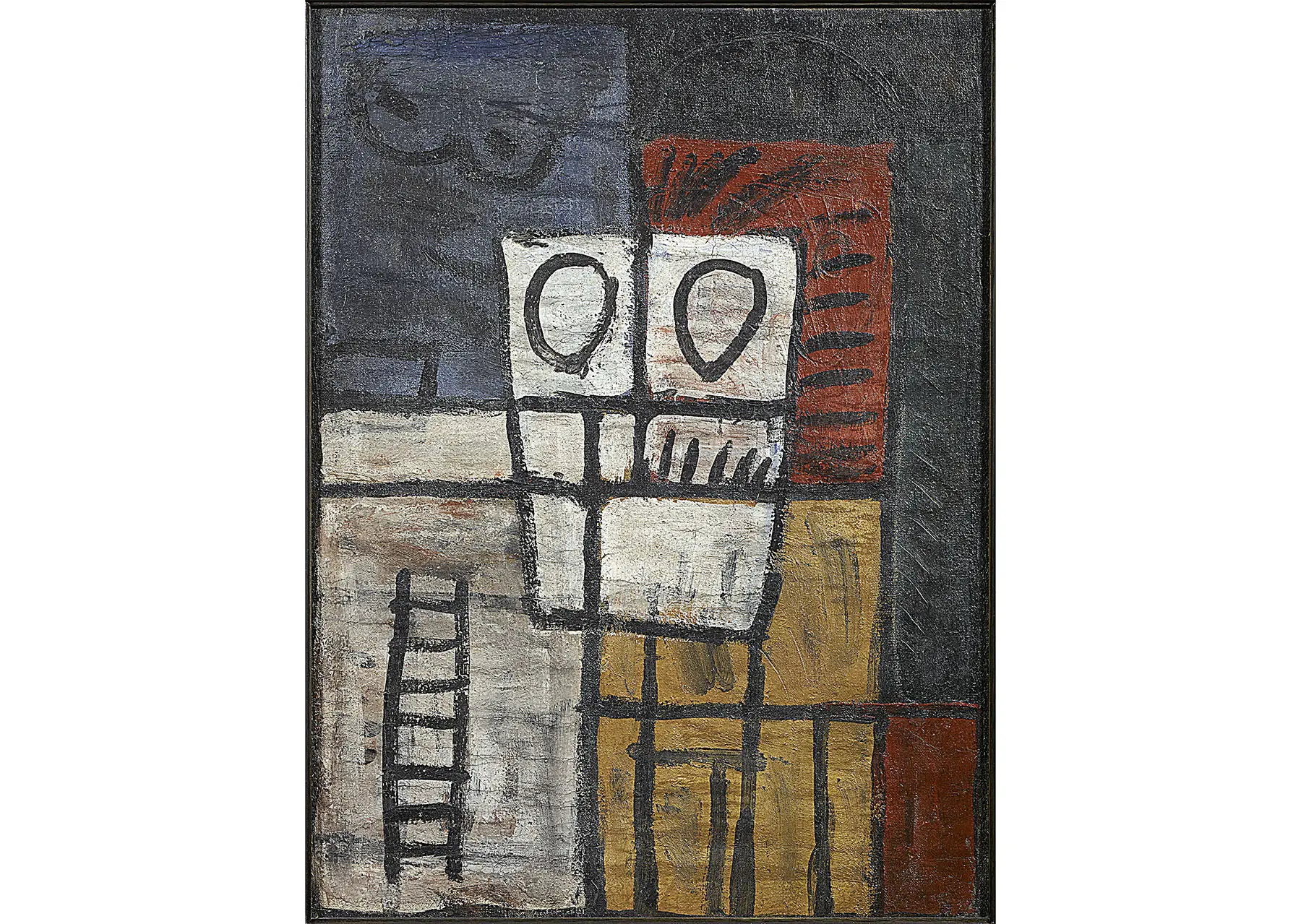
Like all significant artists, Joaquín Torres-García (Uruguay 1874-1948) broke with established norms, as can be seen, both in his works and in his essential thoughts, expressed in conferences and in writing. This well-articulated exhibition at the Museum of Modern art thoroughly clarifies two of his key ideas: “Time is but a human convention,” and his conviction that figuration and abstraction are not two opposing and exclusionary zones, but belong to the same situation. The flow of the works on exhibit here reveals series and contributions such as Torres-García’s early portraits with the subject posed away from the viewer, which anticipate the coherence of figuration and abstraction; wood’s relationship to semi-natural rusticity and painting; the interaction between the draftsman and the painter, between the artist and the sculptural-toy entrepreneur, between the painter and the teacher; the dynamic between his early connection with Art Nouveau, with touched upon all areas of creativity during his time in Barcelona, and those who decided to be painters and nothing else. The Arcadian Modern, MoMA’s Torres-García exhibition is organized chronologically. This review includes a brief biographical outline1 showing how Torres-García anticipated the current moment from a variety of points of view. First, connecting his childhood with our time in 2015, it is essential to recognize him as a migrant motivated by tragic reasons, such as World War I, the cancellation of his contract with the Generalitat, and the surge of fascism.
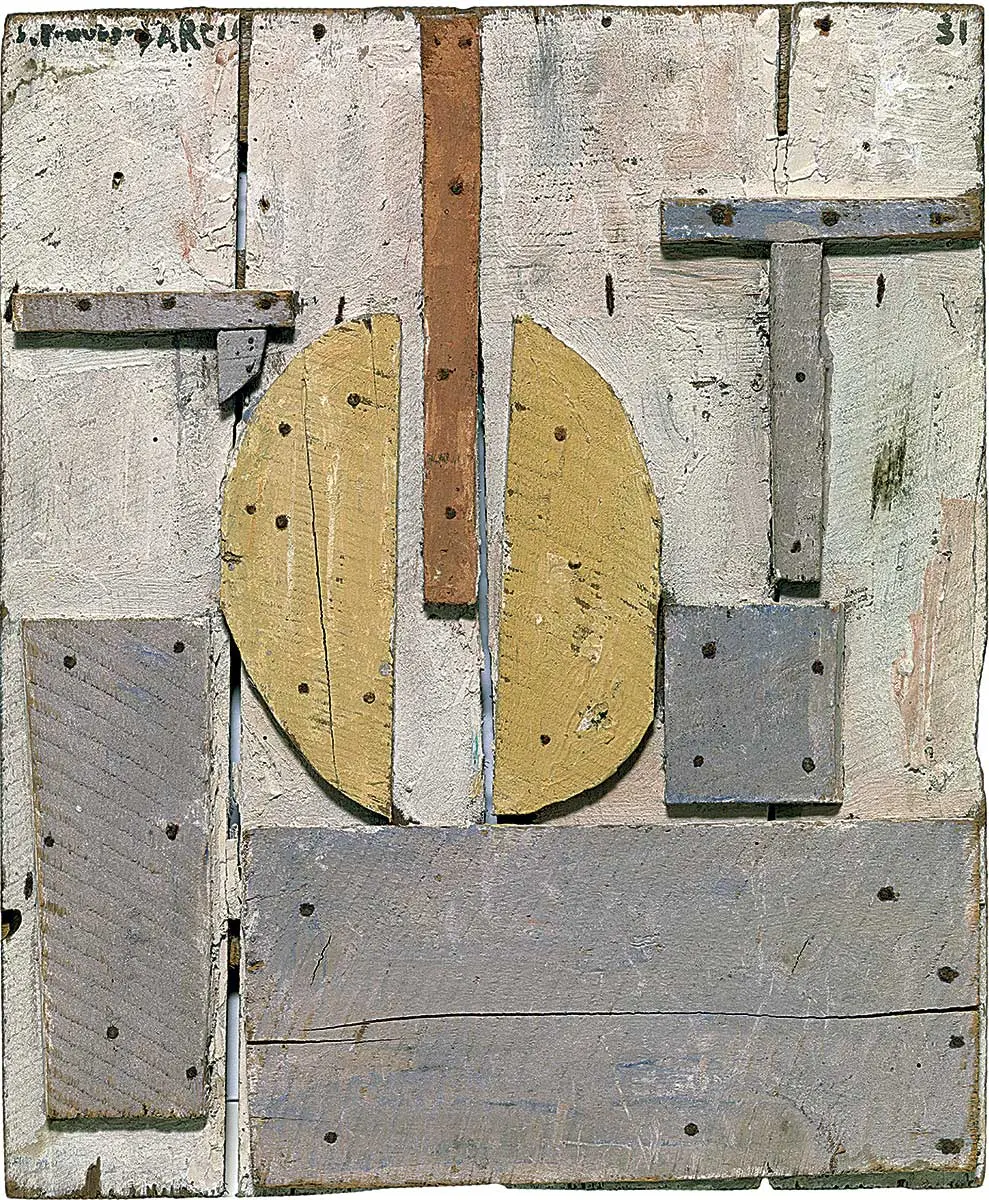
Torres-García’s interest in wood arose in his childhood, spent in a general store owned by his father in Montevideo. Torres-García’s father was a Spanish immigrant who in 1891 decided to return to his native land, bringing his family with him. Joaquín was 17 at the time. In Spain, he began his studies at the Mataró Municipal Trade School and continued them in Barcelona the following year. He was to incorporate raw, unrefined wood into his fresco and painting work. The Arcadian Modern includes a reflection about first cultures—from pre-Columbian to Greek—and those settled in the places where he lived. This ratifies Torres-García’s thinking, as he disbelieved in time as a linear progression and saw it more as clashes of different periods and human conventions. His passionate belief in Arcadia and the origin of the world intensified in the suburban homes he inhabited with Manolita Piña and their four children. The bucolic environment contrasts with the cities he visited, especially with a two-year stay in New York and with Paris, his last European station before returning to Montevideo. In that melting pot, the artist refined his ideas and creates the drawings that anticipate his theory/movement of Universal Constructivism.
In 1917, Torres-García designed his first wooden toys and produces Un enemigo del pueblo (An enemy of the People), the first compartmentalized gesture towards his theory of Universal Constructivism. Present at MoMA is the fourth, magnificent mural Lo temporal no es más que un símbolo (Temporality is nothing but a symbol), finished the previous year, which became the most controversial among those works. The mural grabs hold of the viewer’s gaze right at the beginning of the exhibition; it is one of the lesser-known chapters in the artist’s career outside Spain. The exhibition’s museography has been formally resolved inside a long, box-shaped room with three articulated spaces, the central among which a grid that breaks the longitudinally of the arrangement. A symbolic interpretation could connect the museography with Spain’s fierce religiosity, Torres-García’s work with Gaudí, and the compartmentalization of his paintings.
Luis Pérez-Oramas, MoMA’s Estrellita Brodsky’s Latin American Art curator, assisted by Karen Grimson, from the Drawing and Print Department, emphasizes two periods: 1923-33, and 1935-43. In the former, Joaquín Torres-García is living in Italy and focuses on the design and manufacture of toys; using ink and watercolor, he works on the compartmentalization of symbols that already began in 1917. He still makes classical paintings, but insists on their partial nature, as they do not reflect reality. Using paint and wood, he carries forth an in-depth exploration of the relationship between the grids of Neoplasticism and his own symbols, textures, and relieves. Torres-García returned to Uruguay in 1934, setting in motion the second period, which includes the establishment of the Constructive Art Association (AAC, in its Spanish initials), black and white paintings of structures devoid of symbols or featuring geometric shapes, and the emergence of rock-like textures; the artist maintained his intense activity in conferences and publications, launched the journal Cercle et Carré, and opened the Torres-García Studio for artists impatient to learn painting (and much more) from him. He developed his own constructive art in color and expanded the relationship between the fields of architecture, theory, mural decoration, furniture design, toy making, and relieves. This exhibition confirms Joaquín Torres-García as a many-faceted master.
NOTE
1. See the artist’s Catalogue Raisonée, www.torresgarcía.com, directed by Cecilia de Torres with the assistance of Susanna V. Temkin.
GRACIELA KARTOFEL