
Lampo, the beautiful word chosen by Jorge Macchi for the title of a project that reflects shadows and their presence in space, alludes to a “sudden and fleeting radiance or brightness, like that of a lightning bolt,” a barely visible instant that results in a luminous echo and briefly blinds us. Questions about shadows and their material structure were latent in previous proposals by Macchi; in this site-specific project, however, the artist—confronted with space’s architectural complexity—gives concrete material expression to the shadows projected by a light source that, nevertheless, is never turned on. Macchi studied the site and planned his intervention for a year, seeking to take advantage of the location’s physical features. The fruits of this process are Gloria and Homesick home, two proposals that masterfully counter any disquisition about the invisibility of shadows with their paradoxical maneuvers.
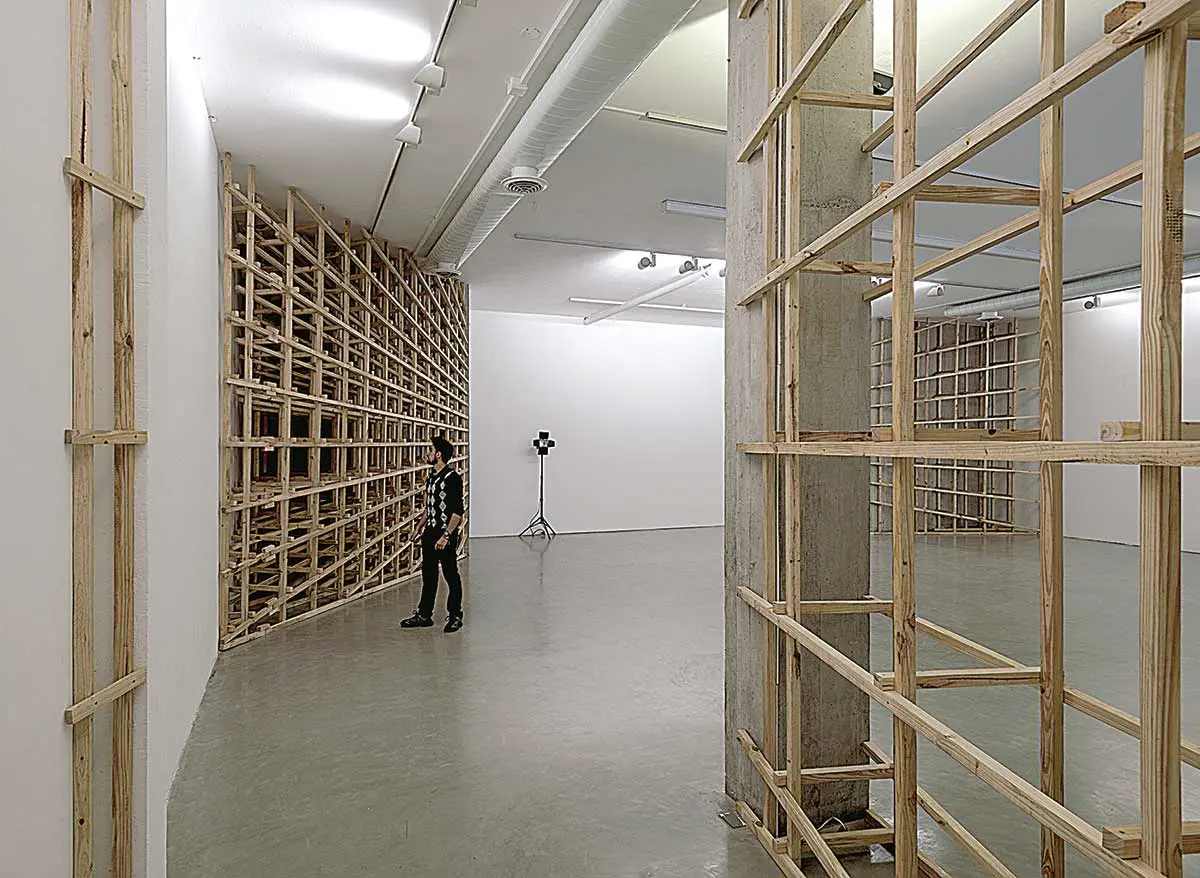
Lampo puts on display the path followed by an artist who enthusiastically explores the possibilities of visual language and understands the contemporariness of the image, as well as the degree of experimentation the image embodies, without obviating its history and the way its identity has shifted through a variety of cultural processes. In Gloria (2015), a potent intervention that transforms the site and its trajectory, a series of wood structures outline, in three dimensions, the shadows that would be projected by the lamp at the back of the ground-level gallery, were it to be turned on. A game in which viewers participate via a seemingly intangible optical effect, which Macchi has rendered material. As the artist put it in conversation after the work was set up: “The site’s large size offered me an opportunity to work with a progression of densities, connected to the purported intensity of the light. In other words, as we move closer to the light source, the structures become more densely packed, and as we move away they become more widely spaced. The progression happens gradually (…) And there was also a decision to work with the planks that flow towards the light source, using them—literally—like rays shooting out from the lamp. It looks as if every structure has a leak in that direction. The fact that the light source is turned off and there is no overlapping between the shadows and the structure is essential for the installation because in some way it begins to produce a parallel reality.”
In the upper level of the gallery, we find Homesick home (2015), the second work created by Macchi as he explored these ideas: a white carpet especially produced for the project, woven by the visual effect that the lamp arranged above its surface would “apparently” produce. Macchi confronts us with a self-created contradiction: again, the carpet outlines the simulacrum of the image-shadow that the light source would project if turned on. He plays with our perceptual capacities, disassembling the premise that shadows are immaterial. The project’s curator, María Iovino, says in that regard: “Space not reached by the effects of the light rays is demarcated as a shadow, but we can’t take it to be devoid of light. Everything is made of light and shadows pass over it, in ways that are also temporary and immaterial. Understood in this way, shadows are revealed as the light that is yet to be known, yet to be unveiled, which our ignorance mystifies as something sinister.”
What is interesting in the images proposed by Macchi and their many interpretations is that both works shake up our certainty as observers; the artist opposes light and shadow not as a clash of negations, but as complementary presences. Illumination is possible because there is a dark space. Homesick home outlines the image of a contradiction: in truth, were the lamp to be turned on, it would not be a graphic rendering of its effects. Macchi activates the properties of visual language precisely through those details, never minor in his case: “There is something that interests me intensely, and it is the potential of the image as language. How can we exploit visual language to a maximum degree, so as to not depend on text, on textual translation? I think this is essential because visual language is very specific. What I notice is that often there is a work of art that cannot exist without the text. But it seems to me that there is something there that is not being resolved visually. And I am obsessed with that. Because in my view there are many strategies that absolutely depend on visual language, which we, as visual artists, can deploy. And, to me, what is key is to exploit those strategies. Moreover, visual language generates a kind of immediacy, and I am always trying to bring back that immediacy, directly related to experience.”
With Lampo, Jorge Macchi, an Argentine artist central to the story of contemporary art, once again prompts us to understand drawing as a fundamental tool in the comprehension of space and spatial work. A powerful conception of the image as a totality emerges from this exhibition, which reveals Macchi’s mastery of a variety of fields of knowledge and the impact that his country’s rich cultural history has had on his art.
ÉRIKA MARTÍNEZ CUERVO