
The work by Jorge Méndez-Blake has been developed around the idea ofliterature as a generality. I define it in this manner to cover as far as possible the catalog of possibilities that he can use as themes (but also as literary material for his work). I would submit that he bases this work on the paradox of a book as an object. It is, on the one hand, indistinct (and indifferent) in form. A book is an object that is and is not—by convention—a parallelepiped. And in functional terms, when left on a shelf, it is. But once one opens a book it becomes an extension (in spatial and temporal terms) that is distinguished (and not) from other books. Méndez-Blake has exploited this paradox by creating objects that suppose not solely the intention of projecting content but also of representing them in a manner that supposes the materialization (which is also an abstraction) of their content.
But Méndez Blake does not solely use (specific) books for his installations and research, for a book is an easy container to project—as a theme and as material—onto that which serves as its container (objects that range from a case to a building). Libraries are the same; they are extensions (or not) of books, objects that fulfill a purpose as places and as buildings. And Méndez-Blake—in a play of correspondences, equivalents, and representations—draws as a starting point of the exhibition at the Museo Universitario de Arte Contemporáneo (MUAC) a line that connects the museum’s premises (although I would rather use the word building again) with that which houses (and therefore is) the Biblioteca Nacional. This line and its representation are the resources that—as installation, document, and action—Méndez-Blake appeals to in order to render it; and they are, in the end, the pieces that make up this exhibition.
In this sense, the title in the exhibition is literal, beginning with the video documentation of the topographical outline showing the shortest path between the two buildings—which goes through the embankment filled with shrubs and volcanic debris—Méndez-Blake performs a series of movements that range from the physical relocation of materials from the Biblioteca Nacional to the metaphoric museum. Along the way, also as a synonym or meaning, there is—as a clue—the transferral of these materials (transformed into content). Thus, along with the video that documents (or recreates) with a camera the topographic tracing of this line, which also supposes the movement of the body—the artist’s—between two other bodies—the buildings—a map is drawn that connects the three. Topógrafo (Topographer), a video with a running time of 13 minutes and 15 seconds—recorded and edited by Julien Devaux—does not serve as a document of duration (which follows the topographical markings of a number of points between the two buildings), but instead uses each of these points as a reference that shows the appearance of the buildings based on takes of each of these specific sites.
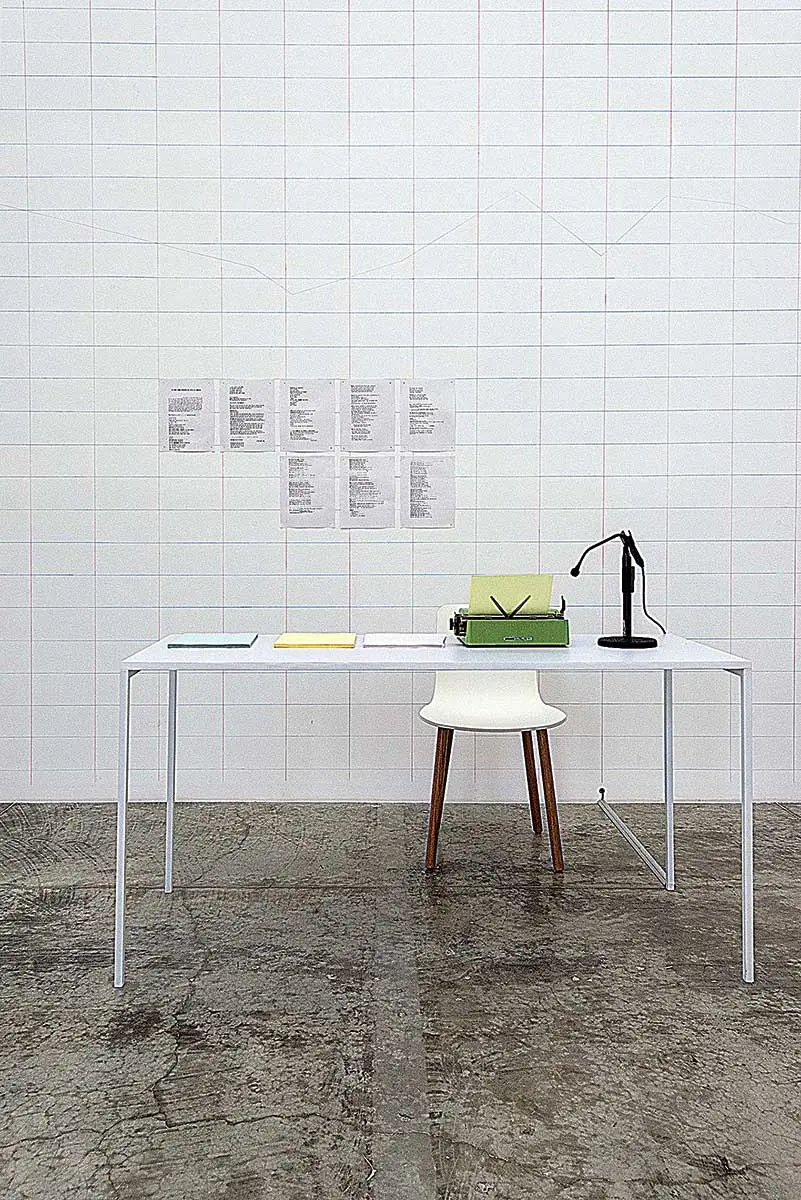
The mounting invalidates the document, it turns it into something else, relativizes it in the same manner in which, for instance, the contents of the 290 books of 20th-century poetry that are part of Biblioteca Nacional’s collection are moved—through a collective action in which the members of the public memorize a couple of verses while in the library, and then go to the exhibition at the MUAC and transcribe the verses using an Olivetti typewriter placed on a desk. The result of this action is El Gran Poema Inexacto del Siglo XX (México) [The Great Inexact Poem of the Twentieth Century (Mexico)], ink on the paperwork of dimensions variable, placed on a wall to attest to the transferrals that resulted from the action and to show how the original contents—inevitably—change when moved from one place to another. This move is symbolic, and yet is not; based on the materials and the paradox that defines them as such; even if the ink is used to represent the objects, the artist appeals to the contained world that expands over pages and pages of text, in books and books that are stored in this emblematic library and in many other libraries. Before Méndez-Blake had already conducted a similar exercise in El Gran Poema del Siglo XX (México) [The Great Poem of the Twentieth Century (Mexico)] when he typed each of the 290 titles of these books to display them on the wall using ink on paper. In El Extranjero (The Foreigner) Méndez-Blake emphasizes the importance of the verses or titles as material (which unfolds, and not, from a book). It consists of an action in which a reader selects a poetry book from the Biblioteca Nacional, takes it to the museum, and eventually returns it. Restrictions on the pieces and actions make their content random, and any sense of a collection arbitrary—collections are by definition always random and arbitrary. The clues and conventions of content and its representation—whether these are the verses or titles of the collection of twentieth-century books of poetry of the Biblioteca Nacional (brought to the museum), or points on the topographic map that indicates the shortest path between two buildings—lose their original meaning to become traces or patches that, as extensions, are susceptible to new interpretations or meanings. Thus, the missing titles (those that cannot be accessed) of 20th-century Mexican poetry have been brought—where from? That is another story—to be displayed in the room as missing (they are to be seen as an absence). There is also the edition of a book, available for consultation in the exhibition room, which contains a color guide created from all of the poetry book covers. The full extension of El Gran Poema del Siglo XX (Mexico) is transferred (or replaced) by a rod with the exact measurements, and the topographic map is replaced by the scale model of a project for a library between the two buildings. The abstracted or transferred contents (and their containers) in Méndez-Blake’s proposals are reduced and relativized to expose the flaws of any cultural institutions with national or universal pretensions. Instead, all that is left is a decoration. The exhibition was curated by Amanda de la Garza and Alejandra Labastida.
RICARDO POHLENZ