
“Is freedom of the press under threat in Mexico? Why was Carmen Aristegui fired? Who governs Mexico? What are Mexican politicians afraid of? Who allowed ‘Chapo’ to escape? What is happening to women in Juarez? Who are the corrupt in Mexico? What happened in Ayotzinapa?” These questions about the current socio-political situation in Mexico, among others, are the starting point for Cómo explicar lo inexplicable (How to Explain the Inexplicable), an exhibition by Peruvian artist José Carlos Martinat (1978) at the Sala Arte Público Siqueiros (SAPS).
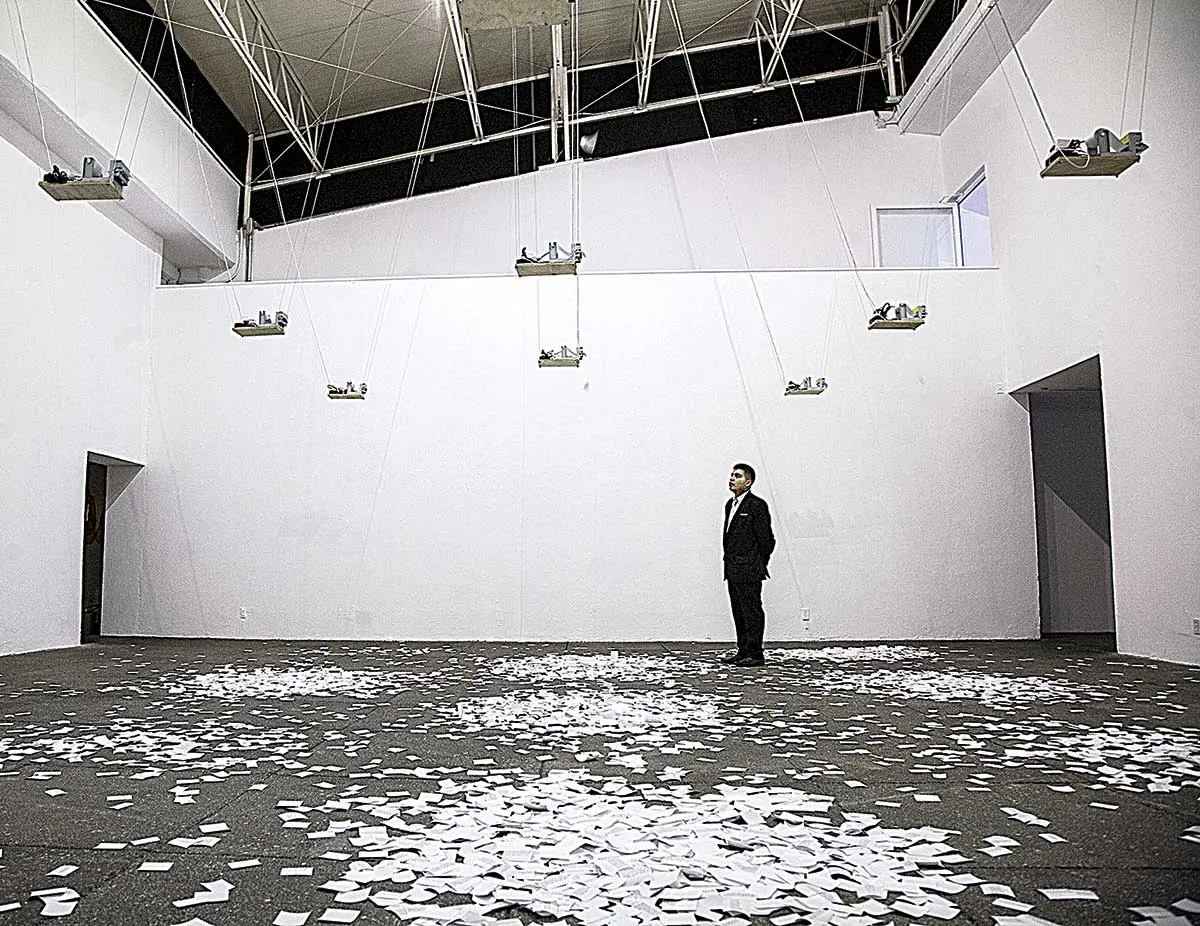
The first good move was to use, for the title of the exhibition, the same slogan designed by the Department of Tourism to promote Mexico’s image as a destination. While in the advertising billboards dotting the city the phrase comes accompanied by exotic and idyllic images of the country, at SAPS, the image of 35 printers hanging from the ceiling, spitting out fragments of news items, declarations, and opinions in reference to economic, political, social, cultural problems afflicting Mexican society, as well as its extreme degree of violence, reverts its laudatory meaning and confronts viewers with an “other”, unfortunately more accurate, Mexican reality.
Martinat’s practice has evolved around the relationship between cyberspace—as an artificial extension of collective memory, where information is gathered and coexists without hierarchization—and space we inhabit physically, where the same information is activated by individuals in connection to the context in which their activities unfold. In general, his projects play with these two levels of the circulation of information, delegating interpretation to the social subject who operates as “visitor.” Martinat’s poetics is among Latin America’s most eloquent dialogs with the concepts of post-internet art and of social insertion.
A clear precedent to the installation at SAPS is Ambiente de stereorealidad (Stereoreality Environment, 2004-2008), a project where twenty automated printing modules occupied the façade of a downtown Lima building, producing over 92 hours thousands of small cyberspace messages in response to the headlines of a local newspaper. Both projects share an operative principle: an algorithm that generates chains of keyword-based information search in the web; the results are extracted as fragments and sent to the printing modules. However, several aspects differentiate poetically the most recent version of the methodology, confirming the idea that the relevance of a project resides in its contextual pertinence.
In a proposed new Telecommunications Act sent to the Senate a few months ago by President Enrique Peña Nieto, licensed internet carriers are given the authority to access specific content, applications, or services. This prompted an intense debate in the media about the censorship of information and its repercussions in society. Read through this lens, Martinat’s operation anticipates, in the most elemental way, a kind of automated, anarchic—in political jargon—censorship, which leaves us with a sea of sourceless utterances, questions, and mutilated information that responds to nothing. How is this action positioned in political terms? Perhaps the only permissible one, given the existence of a constitutional statute—known as Article 33—that permits the immediate expulsion of any foreign citizen meddling in Mexico’s political affairs. One has to position oneself on a podium made of metaphors and leave it to others to fool around with figures and direct confrontations if they think it necessary.
Hundreds of thousands of papers pile up in the different spaces inside the museum, generating a minimal yet forceful image. This image is dominated by the color white, which Mladen Stilinović—who, coincidentally, is exhibiting at the MUAC his series White Absent, made during the war in the Balkans—understood as the color of suffering. The mechanical sound of the printers as they spit out their information accompanies visitors during the entire experience; it is impossible not to think of the many questions posed by Martinat: why has violence become a human condition in Mexico? Why are there massacres in the country? What happened to Nadia Dominique Vera Pérez? Are all political parties in Mexico corrupt? Is Mexico a failed state? What happened in Tlataya? What happened in Tanhuato? What is the Mexican police afraid of? Are the 43 Ayotzinapa students dead or alive?
DIRELIA LAZO