
Planes, points of equilibrium, and emptiness are key elements in the universe of architecture, and exploring their potential is a recurrent endeavor—and a fruitful side effect of academic training—in the poetic of José Resende (São Paulo, 1945). Shortly after a retrospective at the Pinacoteca do Estado de São Paulo, the Brazilian artist presented during the months of October and November of this year a solo exhibition, also of recent works, at the Galería Millan. Smaller in scale, the works in this exhibition retained the resource (to use an architectural term) of the direct relationship with space. In the same manner that the vast urban horizon became the environment in which Resende arranged the monuments of abandoned train cars in his intervention for the 2002 project Arte/Ciudad (Art/City), here the relationship with the spatial dimension is of a smaller scale, but nonetheless impressive. While in the former the dialogue was established with the urban context, in the latter the conversation is more intimate and is established with one visitor at the time.
From the very beginning, viewers are struck by a sculpture near the entrance. Defying the narrow wall that supports it, the piece threatens to become detached from it at any moment while voids framed by brass tubular shapes counteract the tension caused by the seemingly imminent fall. It is a calculated (un)balancing act enabled by internal steel cables that keep the work in place. Exhibited for the first time, Up Side Down (2015) is a work that completes an artistic career that this year will have expanded 5 decades.
While he is best known for using materials strongly associated with construction—such as iron, wood, and stone—José Resende has also worked, especially early in his career, with “softer” elements, such as paraffin, leather, rope, and plastic, but these had not been fully incorporated in his organic shapes like they were in works like the 130 shirts hanging from ropes that dogged the columns at the Centro Mariantonia in 2005. In the current exhibition, however, the artist employs industrial materials but applied to a space that provides a privileged experience away from the hustle and bustle of the metropolis in an almost metonymic exhibition: an individual rather than a large group of people, a gallery rather than a city.
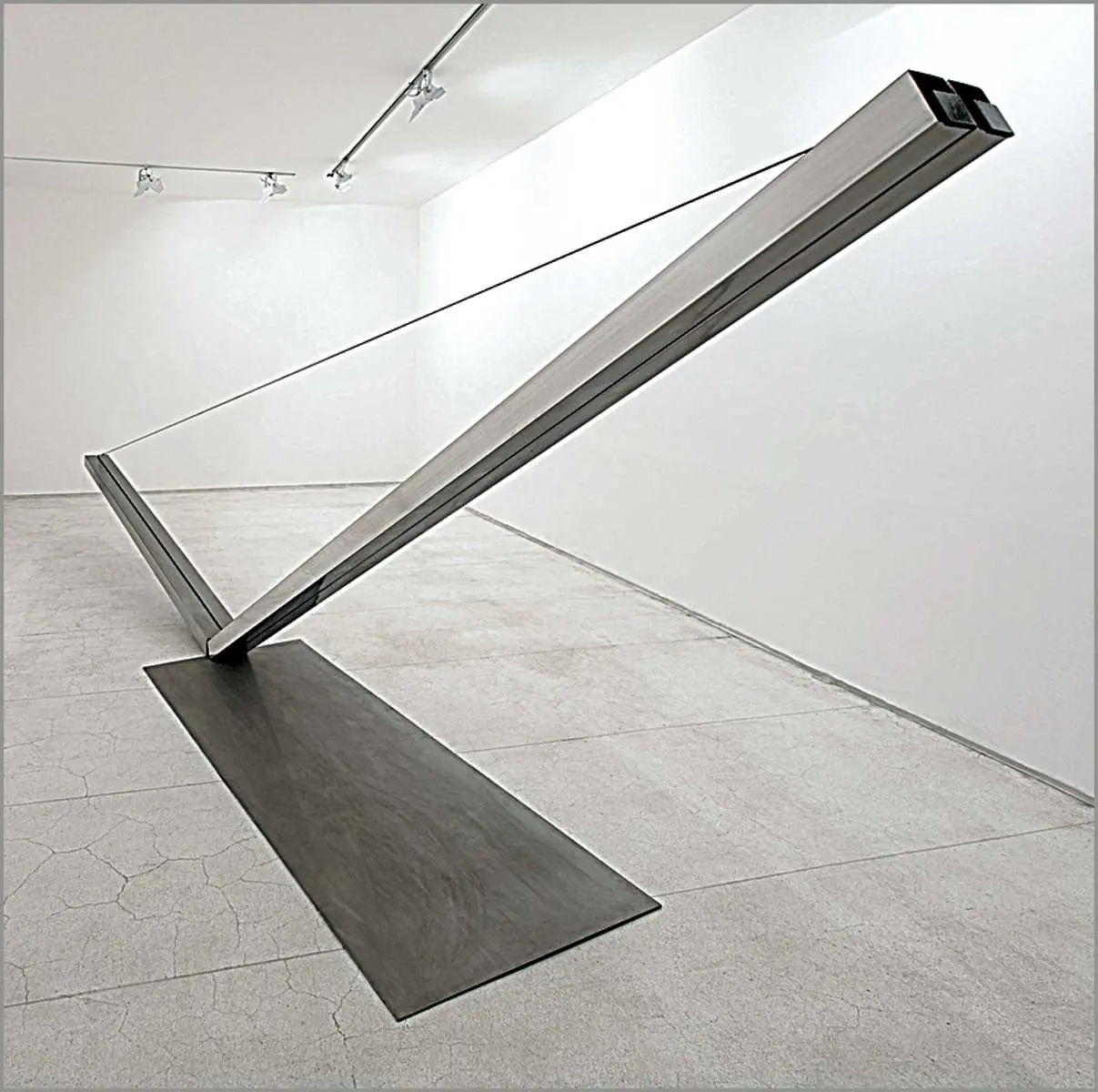
Cuerpo de Prueba II (Body of Evidence II, 2015) occupies the main exhibition room, obliquely cutting the space. Equally “airy,” the piece was conceived to test the limits of the improbable elasticity of its materials. Polished steel beams connected by a rope at their extremities, create the expectation of a close pendulum’s swing that does not exist except in the viewer’s mind. Like in Up side Down, in this piece the lightness of the lines pointing upward replicate the triangulation formed by the projection of shadows. On the other hand, such levity also serves to contrast the weight evoked by Dobleces (Folds, 2015), a work in the same exhibition room made with dark rusty iron that plays with other elements; It seeks the ground with its folded spherical metal fitting cut by a crescent that could probably also fit in other sections of the sphere to generate new forms. Notwithstanding the differences of each proposal, this piece by Resende is reminiscent of Lygia Clark’s Bichos (Bugs) and Amílcar de Castro’s folds. While Lygia Clark proposed public participation by encouraging viewers to manipulate her work to create new forms, Amílcar de Castro defied the rigidity of the material from a sheet of metal, interpreted as unique, by bending or cutting it to maximize the possible variations with minimal gestures. Although smaller “descendants” can be found on the top floor—which is, formally speaking, clearly related—Dobleces is unique in that it offers a more controlled opening. It may not be a mere coincidence—in an interview with the magazine ARTE!Brasileiros, José Resende paraphrased Willys de Castro by stating that “in art, those who have no father are sons of bitches.”
Born in São Paulo in 1945, José de Moura Resende Filho graduated in Architecture from the Universidade Mackenzie, where he counted Rui Ohtake and Decio Tozzi among his colleagues. He worked in the office of Paulo Mendes da Rocha, whose open-mindedness allowed him to learn a lot. Resende complemented his training in the art of thinking about ways of integrating urban and social environments by incorporating an aesthetic thought that was initially shaped by the drawing lessons he took with Wesley Duke Lee. In the sixties, along with Geraldo de Barros and Nelson Leirner, he created the irreverent Grupo Rex, one of the pioneers of the happenings in Brazil. In 1970, he founded with Federico Nasser, Luiz Paulo Baravelli, and Carlos Fajardo the Escola Brasil, an artistic training center that encouraged free-thinking and alternative methods. The school operated for four years. He taught at the Universidade Mackenzie, the Fundação Armando Alvares Penteado (FAAP), and the Pontifícia Universidade Católica de Campinas (PUC- Campinas), and was co-editor of the periodical Malasartes. From his first group exhibition in 1965 at the Museu de Arte Moderna in São Paulo, the artist has presented countless solo exhibitions and has participated in prestigious art events, such as the Venice Biennale, Documenta in Kassel, the Mercosur Biennial, and the Paris Biennale, among others, as well as in several editions of the São Paulo Biennial.
SYLVIA WERNECK