
Los Carpinteros is a group formed in 1992 by Marco Castillo, Dagoberto Rodríguez, and Alexandre Arrechea at the Instituto Superior de Arte, in Havana (Arrechea decided to continue his career as a solo artist in 2003). The name came about while they collaborated with their instructor, René Francisco, whose unorthodox teaching methods were among the factors prompting the group to interact with their environment under three essential premises: the economy, improvisation, and precariousness. From the start, Los Carpinteros have devoted themselves to salvage artisanal traditions that have almost disappeared. Not only by participating in new dynamics of artistic production in contemporary art, but also by revising concepts such as participation and democracy in Cuba’s revolutionary society (or what remains of it) since the 1990s. They belong to a generation of artists educated under a series of political and economic tensions (1989-1998).
Los Carpinteros create works of multiple transitions through objects and the material world that surrounds them, generating a framework for a central idea around which an entire project is generated. In that sense, the experience of visiting the exhibition is based on a selection grouped in the sculptural arrangement of the installations, which makes it possible for viewers to conceive of new meanings and intersections between the works. All the works included in the exhibition curated by Gonzalo Ortega are recent and cover the period between 2006 and 2015. In the museum’s first gallery we observe the centrality of Candela, a 2013 installation, featuring outlines of flames under red LED lights, a paradoxical contrast between the coldness of the cathode lamps and the warmth of a bonfire, accompanied by the permanent hum of the automatic generators that feed the inferno.
Without obviating the Western roots of their culture, this Cuban collective reclaims the non-western, essentially African provenance of a good portion of their work: religion, music, myths, dance, folklore, and magic, to mention a few. There is a presence of everyday elements of life in Cuba, adulterated under the resonance of new territories of distance and exile, where artificiality seems to erase the past with the aesthetic presence of consumerist dynamics freed from revolutionary ideology, in the voracious universe of neo-liberal policies.
La conga irreversible, (The Irreversible Conga, video recording of a performance), Havana Biennial, 2012, presents us with a troupe dancing the conga backward. The carnivalesque tradition of the mise-en-scène turns us into spectators of a chaotic, confused, diverting dialog with ironic references that bring to mind the law signed a few years back to stipulate that socialism in Cuba is irreversible.
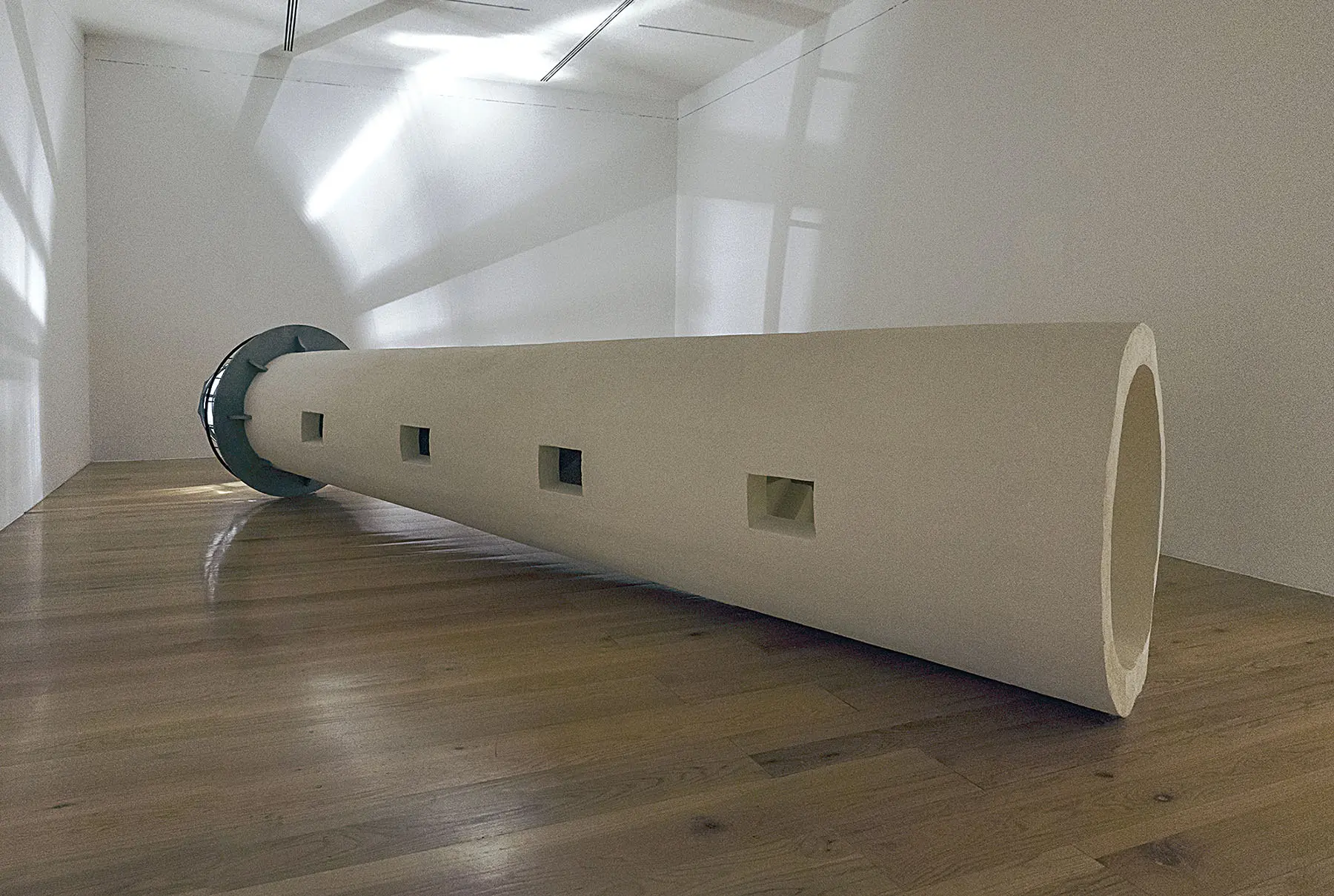
On the walls of the first gallery of the museum we encountered two-dimensional works (watercolors and drawings) such as Celosía poliédrica posada I (Polyhedric Posed Latticework I), from 2015; Cabilla, cabilla (Rebar, Rebar), a triptych from 2014, and Penumbra I (Twilight I), from 2008. Clear references to a strong influence of architecture in the generation of ideas and sketches in their artistic proposals. Faro Tumbado (Overturned Lighthouse), from 2006, is another key piece in the show’s curatorship. The light’s purpose of serving as a guide for sailors in a storm is made obsolete in the middle of a museum hall. It is a reference to Fidel Castro’s fall, in 2004, after giving a speech. Men, revolutionary or not, fall, and history does not stop.
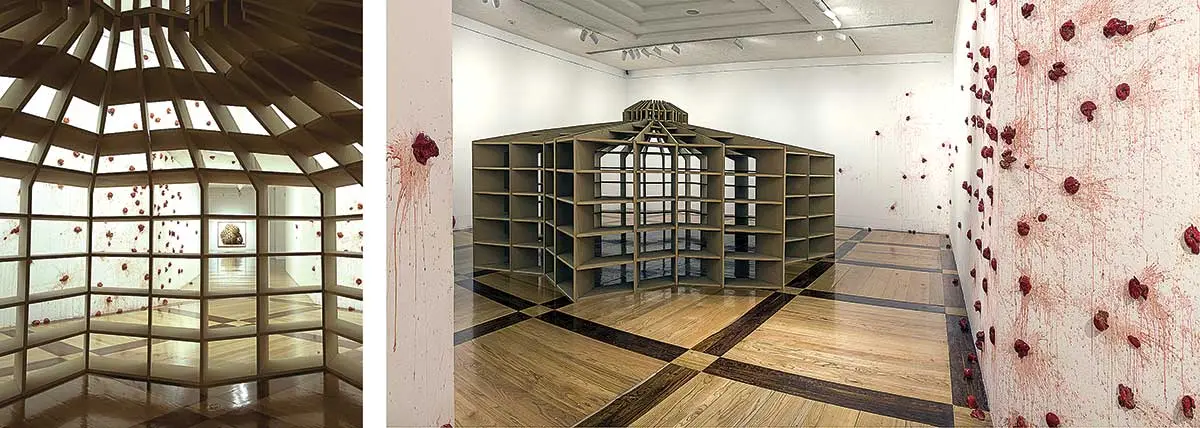
Sala de Lectura (Reading Room, 2015) is an installation in wood, in reference to the late Eighteenth Century’s panoptic prisons, adopted in Cuba in the 1920s. In 17 metros (17 Meters, 2015), made in collaboration with Ivorypress Madrid, where two hundred black suits, with a star perforated in their center, hang from a 17 meter-long metal bar. Clavos oxidados (Rusted Nails, 2013) is an installation comprised of multiple metallic sculptures strewn about the museum floor. Tomates (Tomatoes, 2013) is the exhibition’s most playful installation, built around the action of launching tomatoes against a white wall and leaving a trail of diluted juice, which becomes permanent when the artists draw the trail in watercolor and then place porcelain tomatoes on the wall.
The work of Los Carpinteros creates fascinating situations under a mystique of humor and reflection, exploring the role played by human beings immersed in the labyrinths of time and history.
ROCÍO CÁRDENAS PACHECO
Contemporary Art researcher, critic, and curator.