
In the mid-sixties, the well-remembered art critic and writer Marta Traba drove across Bogota in the French-made car—which she got by exchanging it for a work of Fernando Botero—whose doors were painted with designs invented by Rogelio Polesello (Buenos Aires, 1939- 2014) especially for her. She called him “the Magician.” The exhibition titled Young Polesello: 1958-1974 at the Museo de Arte Latinoamericano, Buenos Aires (Malba) offers new audiences the genealogy of that work and several dozens of other important works by the precocious and multi-award-winning artist. Few travelers know that Polesello authored the mural titled Eclipse (2001) that bids them farewell at the Ezeiza International Airport, or the sculpture titled Energía Olímpica (Olympic Energy, 2013), an interpretation of the Olympic rings located on Av. 9 de Julio, in Buenos Aires. In these and other works, Polesello transmuted colors in the interaction of forms without overt meaning.
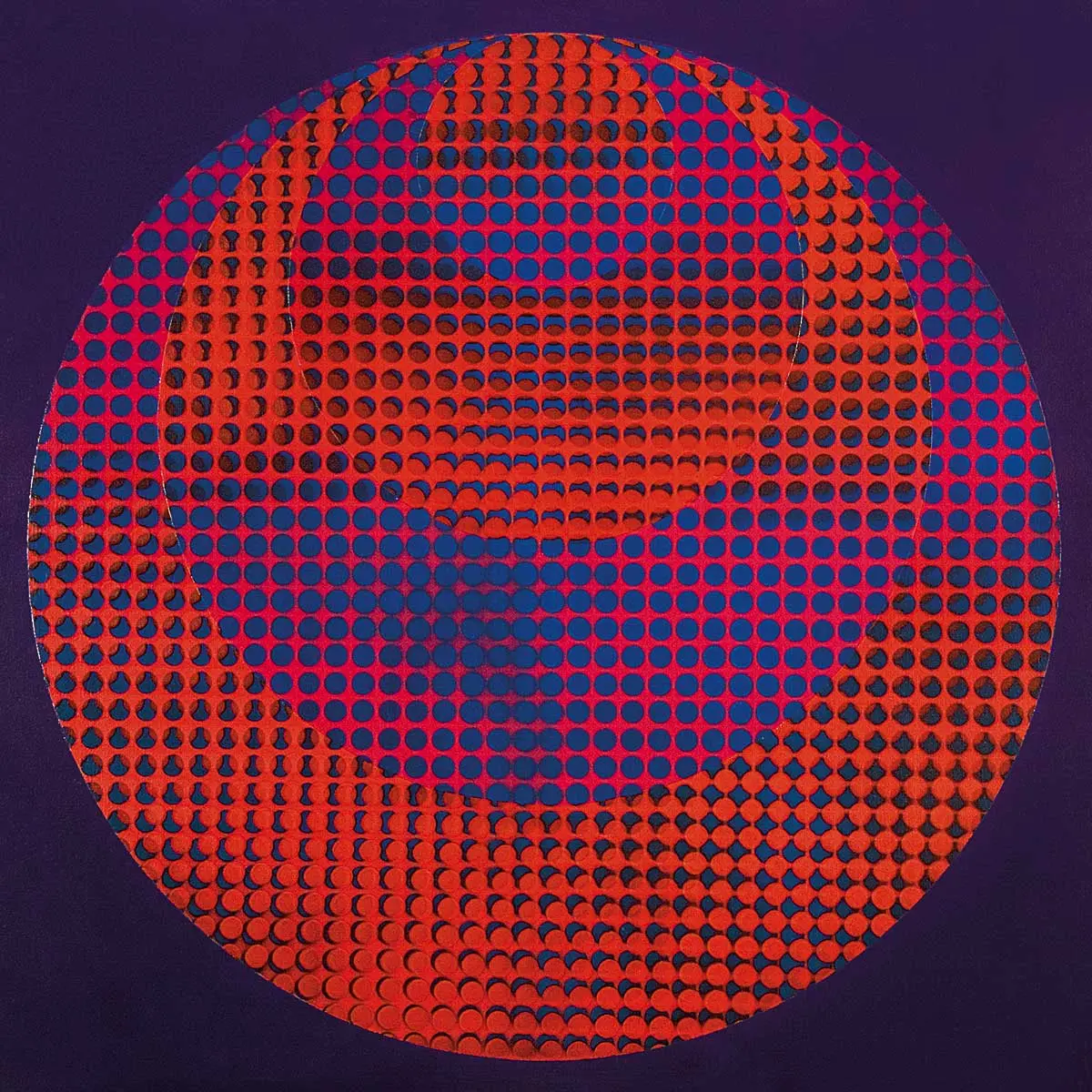
Polesello was working on this retrospective exhibition, alongside the then director of Malba, Marcelo Pacheco, when death surprised him. Today, he would be happy to know that among the 120 historical pieces—selected by a team from Malba led by Victoria Giraudo and Mercedes Casanegra—there are also works that indicate his anticipated adscription to the new design, a seldom explored facet of his career. Thus, in the context of the exhibition, several conferences were organized on Materials Ideas: Art and Design During the 1960s, which analyzed the connections established through advertising agencies, research centers, universities, and other places such as bars and nightclubs; places that introduced artists to publicists, designers, and theorists. Indeed, this multidisciplinary convergence with tinges of pop art and psychedelia occurred in the mansion that housed Polesello’s studio, which he shared with the studies of poets, photographers, and musicians.
The artist began his career in 1958, and a year later had his first solo show at the Galería Peuser. As Pacheco points out since the beginning Polesello researched “the possibilities of optical art from geometric compositions associated with constructivism.” This exhibition includes monotypes, inks, watercolors, oil paintings, graphic design, textiles projects, objects, small and large carved acrylic plates divided into five segments.
There is some illusionism in some of his optical artworks that multiply images following what appears to be a secret and symmetrical order. In his abstractions, lights and shadows unfold like sensitive imaginary landscapes and writings. His work appeals to the ludic and offers several approaches to abstraction that in some instances are reminiscent of cheerful kaleidoscopes. Splendid sculptures of carved or glued acrylic—translucent concave and convex ovals that alter perception through optical effects—filter everything that surrounds them to conjure distorted forms like the pleasant shades of a rainbow; many of which belong to private art collectors from around the world.
The exhibition also includes documentary pieces with images of exhibitions, publications, and trips that attest to a trajectory that included the projection of his work in the international art scene, including some landmark moments in Medellin, Bogota, and Caracas that coincided with the emergence of the famous optical art movement in Venezuela. In Mexico, even the legendary art critic Raquel Tibol wrote about the “optical perfectionism” of his works.
Polesello was chosen again and again by heads of international institutions—such as Thomas Messer, the director of the Guggenheim Museum in New York, and Miguel Arroyo, then director of the Museo de Bellas Artes in Caracas—to participate in traveling exhibitions, especially in the United States. Critics and curators from around the world would travel to that then a remote corner of the world, called by Jorge Romero-Brest, director of the Centro de Artes Visuales of the Instituto Di Tella (1963-1970), an institution that promoted visual art exchanges with other countries.
The exhibition succeeds in accurately reflecting important years in Polesello’s career and his development as an artist when he began to explore unknown materials such as spray paint and to experiment with geometries that increasingly became less rigid and were rendered with lines that turned looser and began to dance. This period is also examined in a lavishly illustrated 400-page bilingual catalog. In fact, the volume is also a compendium of the artistic and sociopolitical vicissitudes in Argentina and some other Latin American countries like Venezuela—writings by Venezuelan art critics María Elena Ramos and Federica Palomero are included in the catalog.
And even as, during his time in Caracas in the 1960s, for example, he maintained excellent relations with the rebellious Venezuelan intellectuals from the group Techo de la Ballena, Polesello always stayed away from politics and concentrated on the various forms of abstraction. In this sense, the text by Giraudo in Young Polesello: 1958-1974 describes “A consistent performer.” An enthusiastic participant in the art scene at the rhythm of his award-winning trajectory, during his early career he also appeared in general-interest magazines. Going against the political art current, in 1969 he had no problem referring to himself as “frivolous,” convinced that his thing was art for the sake of art.
VICTORIA VERLICHAK