
The two exhibitions previously presented in this same gallery by Sergio Vega (Buenos Aires, 1959), in 2009 and 2013, were inspired by the artist’s investigation of the notion of a Lost Paradise in the New World, which began in 1995. His new proposal, comprised exclusively of black and white photographs dated in 20151 and titled in what seems at first sight like a sibylline way—When clouds enter the forest and the art of motorcycle maintenance—is intellectually continuous with them.
The spatial configuration of Galerie Karsten Greve (for its second space, located in the same street) allows visitors to combine two different itineraries on three floors, which must be seen as a whole in order for the artist’s proposal to gain its full meaning. The concept explored by Sergio Vega is rooted in Robert Pirsig’s philosophical fiction Zen and the Art of Motorcycle Maintenance: An Inquiry into Values, first published in the United States in 1974. The text deals with issues connected to the relationship between art and everyday life, life’s pleasure, and the enjoyment of the present moment, knowledge, and wisdom.
Vega takes the ideas in the book and builds with them a sensible network to support his conceptual and artistic discourse. The fifteen photographs of the Amazon rainforest can be seen, both for the artist and for the viewer, as an experience with light, almost an initiating rite into vegetation from the beginning of time, where bewildered “travelers” are to discover a paradise. With a focus and an attitude he deems philosophical, the photographer has congealed the instant and the silence of this dark and luminous at the same time open and closed, hostile and magnetic, mysterious and suffocating jumble of plants. The forest has fallen silent, prisoner of Vega’s passing gaze, and offers itself up as a weightless, translucent dome, traversed by a light that comes from the beginning of the world (Translucency and Leaves like heavy brushstrokes), and embraces us also (or imprisons us) with the power of its branches, the organic character of its somewhat phallic trees, its roots and vines (Rough, trusty rhythm and Spiraling movement). The forest can be dark and somber (Dark canopy) or densely lightweight, cottony, and white (Misty Forest 3). Contrasts are endless in the forest. The mystical experience begins with that magic moment outside of time and even of geography, and, as the artist says, in the “profane illumination” of that dazzling instant.
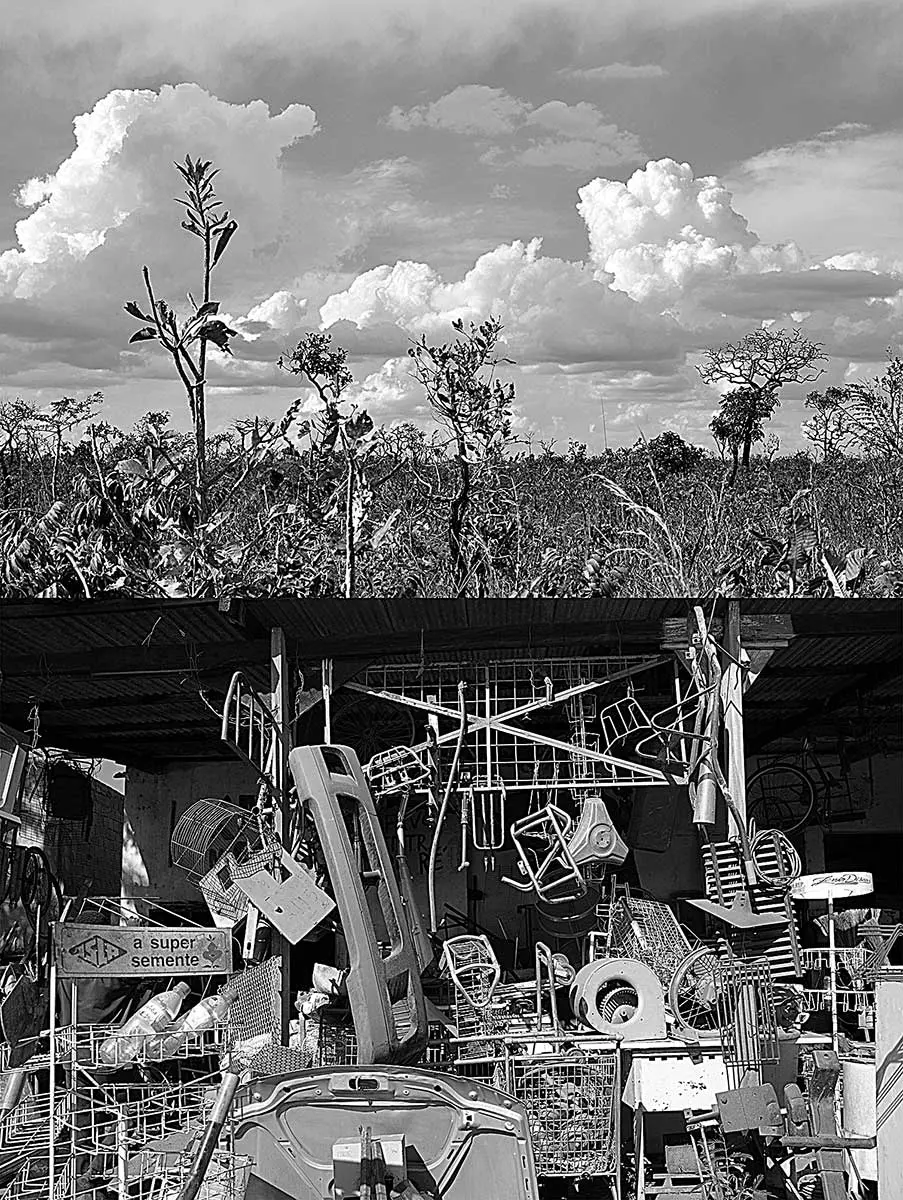
Next to this romantic contemplative attitude considered as one of two options to comprehend and experience the world, Vega proposes another existential posture, which carried him to Brazil’s Matto Gross to carry forward his investigations as in his previous exhibitions. The two galleries where twenty photographs are on display invite us to a different experience, and a different reflection. From contemplation to knowledge, from feeling to the social, from pleasure to culture. There is nothing antinomic, the author confirms, in the rational or fortuitous association, in this dialogued interplay of two images overlapping to shape a single discourse.
For an introduction to his proposal as a visual artist, Vega chose a Scott Fitzgerald quote and placed it on the wall like an epigraph: “The test of a first-rate intelligence is the ability to hold ideas in mind at the same time, and still retain the ability to function.” Simultaneity is thus necessary to apprehend our relationship with the world, and some of the photographs invite us to extend their juxtaposition. In Hello Courbet, Hello Kitty, the bucolic image of cows on a prairie (upper photograph) shares its space with a partial view of a table covered in drawings of the Japanese cartoon Hello Kitty (lower photograph). Further, into the exhibition, See Through depicts a large rock perforated at its center (upper photograph) and a partial image of a black rooster and a dog laying down as they peek from their hideaway (also black in color). Three photographs speak of a certain idea of modernity, the damage it causes, and the passage of time (Modernism and discontents, a 1950s building, above, and old rectangular container strewed about on the floor, below). Colonial/modern connects, in a more poetic vein, a rural colonial-era chapel (above) and a ceramic floor (below) illuminated in the middle by a rectangle of light. The jumble of old iron pieces in Tinguely’s Savanna (below) is a humorous wink that confronts the accumulation that is the result of consumerism with an image of virgin expanses (the savanna, above) while Balancing Acts proposes a parallel between a heron standing on its thin legs (below) with an equally thin-legged metal and plastic fiber chair. Plato’s Cave grabs our attention with the direct dialectical relationship between its “below” (a TV set against the background of a graffiti-covered wall) and its “above” (the shadow projected by a cable-TV antenna). Two images close the itinerary, dealing with motorcycle repair (The art of motorcycle maintenance). We can expand our reading of these photographs by evoking the level of a subterranean world, the infra-world of which the Aztecs spoke. However, although the two levels of Vega’s images remind us of the pre-Columbian Mictan, they do not signal a path to Hell but invite us instead to meditate on our apprehension of the world.
NOTE
1. In small and medium format: 18, 2 x 27,1 cm y 47,2 x 35,6 cm.
CHRISTINE FRÉROT