
As we walked from the parking lot to the exhibition space where Teresa presented her performance, she told me that the indigenous community—isolated from the outside world—with whom she had been developing a relationship in Mexico, had agreed—after a long period of getting to know them to gain their trust—that the money made from the sale of the work resulting from her time there would be used toward the purchase of a couple of washing machines that the town needed. But the police showed up one day and savagely beat a young man who, although drunk, had not really done anything wrong. Fear closed the doors of that interaction between the artist and the town. We started this conversation in Madrid, in February 2015; Now, in August 2015, in the state of New York, the narrative that is part of the performances by students of the SUNY campus at Purchase, once deals with the tragic referent of violence. Margolles’s works always deal with the most difficult and volatile conditions. In We Have a Common Thread, her work covers various Latin American countries, and this time incorporates the United States and an event involving the growing criminal escalation in that country.
A semi-dark room, five supports, a diagonal room divided by a series of monitors showing women embroiderers from Recife (Brazil). This town, along with the cities of Panama (Panama), Managua (Nicaragua), Ciudad Juárez (Mexico), Staten Island (US), and Santa Catarina Palopó (Sololá, Guatemala) are the places connected by “the common thread.” In Harlem, Teresa Margolles showed the video of the embroiderers in Guatemala; Upon watching it, Michelle Bishop, leader of that group, said: We have a common thread, which became the title of this exhibition.
Tracy Fitzpatrick, director of the Neuberger Museum of Art, summed the exhibition up and the importance of its content for that institution in one sentence. "Teresa Margolles: We Have a Common Thread—critical, defiant, and timely—reflects our goals as a university museum: to unravel and face those themes that are the most pressing and complex today, including violence in marginalized communities in the United States and Latin America.” This defines Margolles’s work and the work of the devoted Mayan embroiderers Masaya and Rarámuri from Recife; Kuna, from Harlem—affiliated with Harlem Arts—and members of the Asociación de Desarrollo de la Mujer K’ak’a Naoj of Santa Catalina Papoló, who collaborated in the implementation of these works in six places. Teresa Margolles also works with three assistants, and this time, with local curators. The solid catalog published by Patrice Giasson—the associate curator for Art of the Americas, founded by Alex Gordon—mentions each one of them, which we would have done here if the space permitted.
In the last ten years, Margolles has been raising a conversation in her country (Mexico) about the reason behind being named the face of contemporary art in Mexico when the media was so occupied with the unwelcoming violence that permeated her work. Since she worked with the group SEMEFO (1990-1999)—Servicio Medico Forense—that she founded with Arturo Angulo, Juan Carlos López-Orozco, and Luis García-Zavaleta, aside from integrating music, they worked with organic material from dead bodies, in an aesthetic of the counterculture. They were not addressing the popular celebrations of death in Mexico, but the corpses; in a way, they were working with remnants, with what could be recoverable from a lost life: blood and the water from washing the bodies. The counterculture, a component of the art of Postmodernism, attends to the work with concepts, objects, and the body in the visual arts. It neglects technology but embraces urban folklore, mass communication, and concerns for nature. But in the 21st century and in transmodernity, all these factors have been stereotyped, globalized; everything is provisional, unstable and rapidly loses the immeasurable value that it showed at birth before being released to the market. The work of art as legible political discourse already demonstrated its limited effect. Now, the world has several common threads that express similar human anxieties.
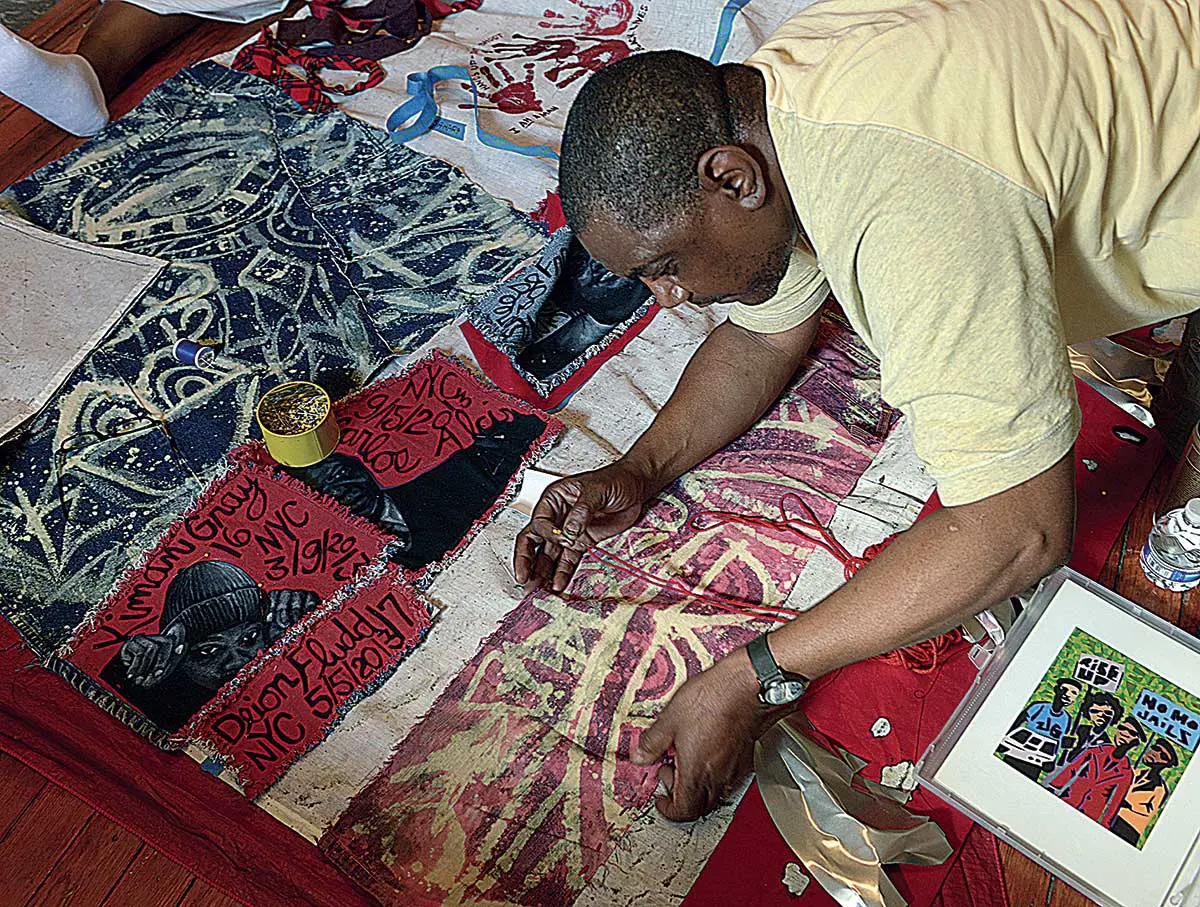
As always, Teresa Margolles offers strips of prepared fabric. To create American Juju for the Tapestry of Truth (2015), she took a large fabric to Harlem, with a strip of red cloth sewn on it with images of bullet holes and small African-style metal masks. The other strips have pieces of the quilt; a strip was fashioned from ties, another from red stamps, and others yet from stencil drawings created with spray paint. There are faces and phrases. It is a work that expresses the anguish caused by the number of African Americans who have been killed by the police. This is inserted into the larger context in which Margolles has been working, which is the tragedy of violence against women. Juju is an amulet, the embroidery is an offering, each stitch is a tear, and if counted, each stitch represents a life.
GRACIELA KARTOFEL