
Being in direct contact with confounding and sordid realities is a basic part of the job description for a photojournalist in a country like Colombia, which has endured a bloody civil war for over fifty years. Generations of photographers have borne witness to the psychological and social urgencies of Colombian history, and they have long produced powerful instruments for recording historical memory. In 1980, for instance, Roberto Rubiano wrote: “the cultural relevance of photography in Colombia has been connected, in good measure, to photo-journalism. Until well into the 1940s, the country’s most relevant photographic works were produced by photographers who were or had been active in journalism.”1
This was a traditionally male-dominated field. The first generation of female photojournalists appeared in Colombia only in 1980; among them were Patricia Rincón, Luz Elena Castro, Esperanza Beltrán, Gloria Elena Monsalve, Rosita Coronel, and Liliana Estrada, all following on a trail first blazed by Dora Franco and Viki Ospina, veritable pioneers in the profession.
One of these photographers, Zoraida Díaz, proved to have such an accurate and fierce take on the country’s pulse that it is hard to credit her work to a single individual. Díaz’s well-trained eye and her great ability to synthesize a given social context through keenly chosen characters chosen, mostly youths, must be understood in connection with her literary education and her understanding of Latin America’s reality, both rooted in her own experience as a migrant in the North: they are fragments from the diary of a young woman educated in the United States, working in a profession she learned by force of will and thanks to her colleagues’ guidance, in a violence-ridden country.
Díaz migrated to the United States at a very young age, and she studied Literature at the University of Maryland’s Spanish and Portuguese Department. There she had Tomás Eloy Martínez as one of her professors and became aware of such towering Latin American intellectual figures as Octavio Paz, Jorge Luis Borges, Eduardo Galeano, Rosario Ferré, Jorge Aguilar, Raúl Prebisch, and Ángel Rama.
Her discovery of photography began with a class on the history of the medium and darkroom practices, through which she became familiar with Kertesz, Stieglitz, Weston, and Man Ray, whose work she describes as “beautiful portraits in light and form.” Yet Díaz is most attracted to Cartier-Bresson, W. Eugene Smith, Robert Frank, Robert Capa, Tina Modotti, and Margaret Bourke-White, photographers who, as she saw it, “confronted the rigors of life head-on, while the others lived in the clouds.” *
Her true initiation as a photographer, however, came when she worked as a translator and assistant to Dr. Nancy González in a journey to Honduras and Guatemala. The purpose was to do a census of Garifuna communities, descendants of African slaves settled along the coast of Guatemala. Díaz found her deepest connection with the photographic medium while shooting portraits of Garifuna men and women: “The communion between a photographer and her subject, a perfect space where someone allowed me to see and capture something about them that had perhaps remained hidden (…) That moment of connection with the subject has shown me a range of human emotions, from innocence to helplessness, grief, terror, madness, hope. This is what obsessed me about photography: it forced me to not go through life as a tourist. I had to see and I had to feel.” *
Almost immediately afterward Díaz found work translating photo captions for Reuters’ Latin American Desk in Washington, DC, where she received images from across the continent. Being in contact with photographers active in so many different countries gave her not only an awareness of their diverse and intense production but also an understanding of the difficult conditions in which they worked, “peeling off their own cables in order to connect the drum transmitter to a phone line and send an image they had just developed in their portable darkroom.”
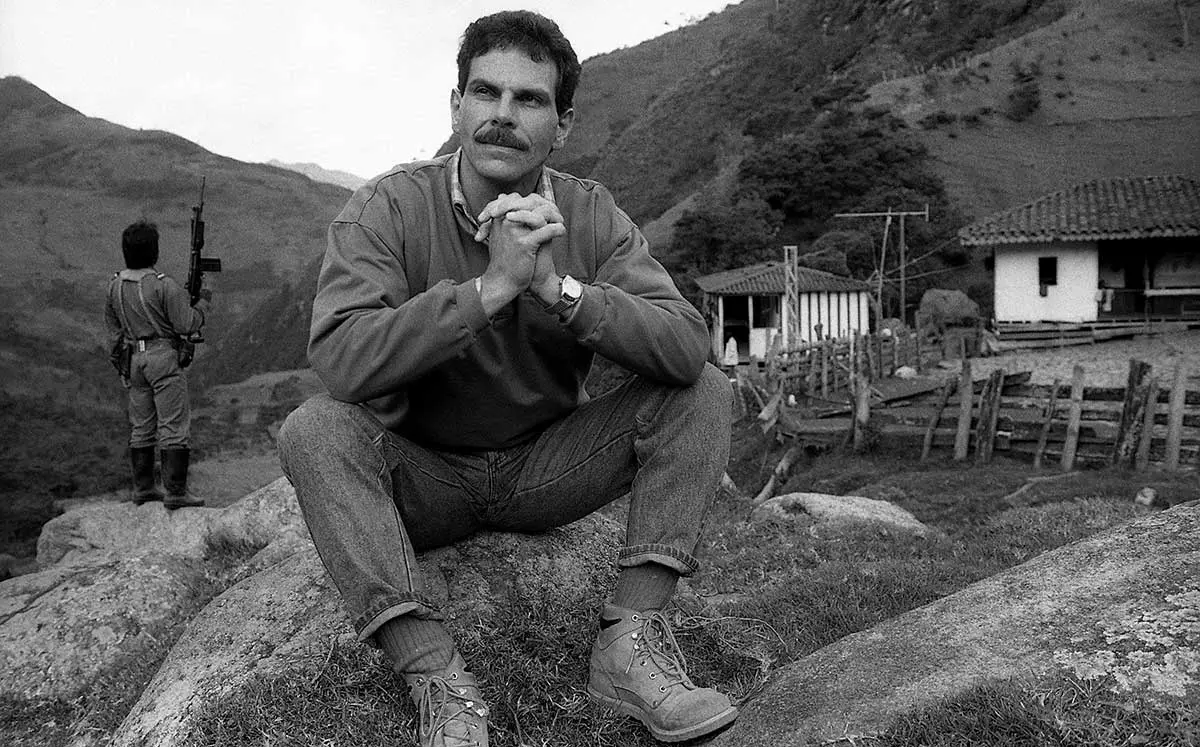
In 1987 Díaz returned to Colombia to work as a stringer for Reuters. There she met colleagues like Luz Elena Castro, Francisco Carranza, Jorge Parga, Henry Agudelo, Luis Benavides, Guillermo Torres, Patricia Rincón, and especially Fabio Serrano, whose photographs impressed her “with their stylistic elegance and their picaresque, multilayered content.” She also experienced the profession’s common employment-security and technical obstacles in a country as perilous as Colombia. Very soon Díaz found herself in the eye of the storm, covering key events during a critical period in the country’s history.
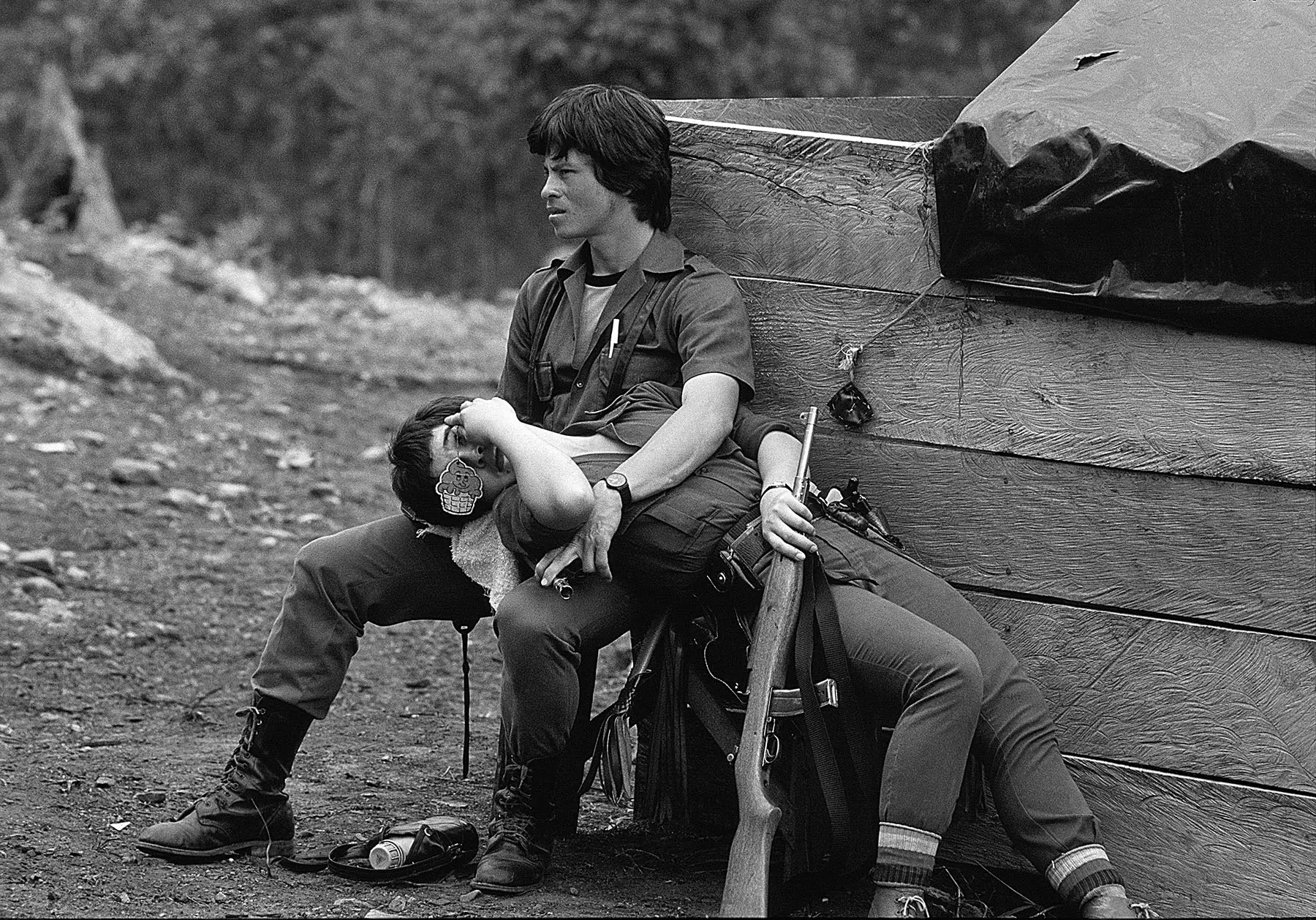
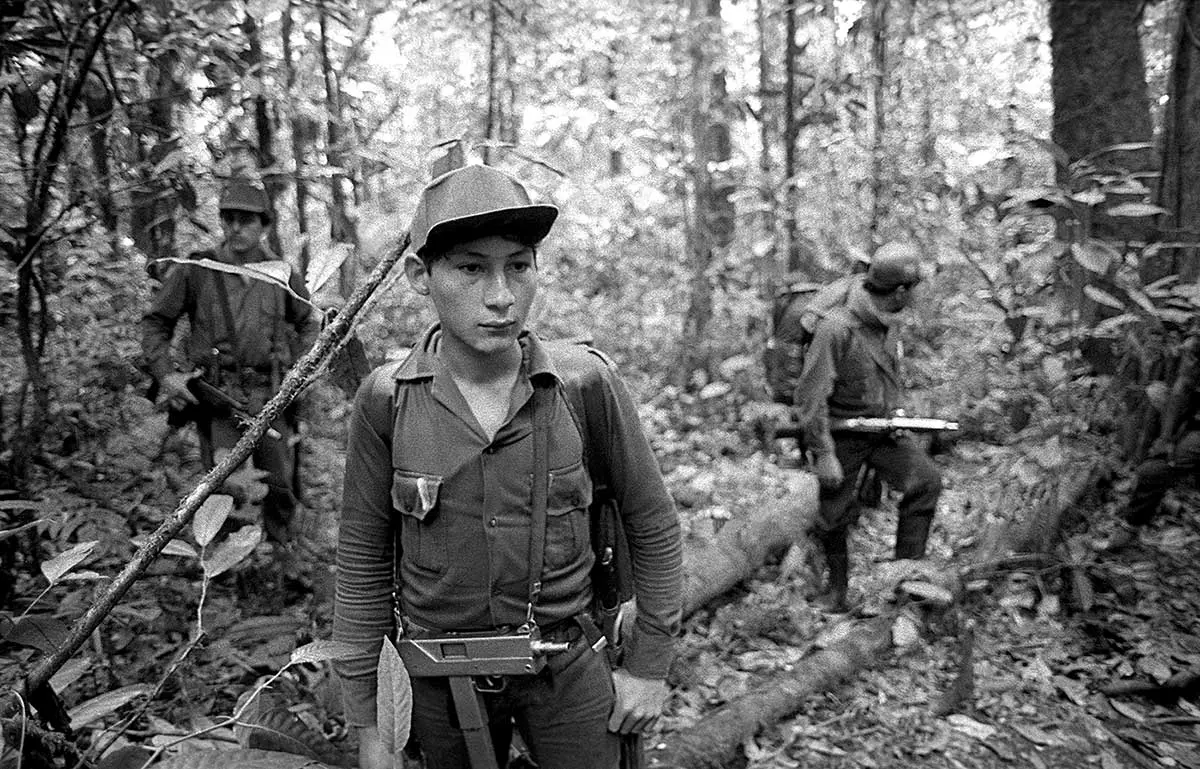
In short order, Díaz photographed the main characters in the Colombian armed conflict, contaminated by drug trafficking and a generations-old legacy of violence. In 1988, she was sent to accompany the peace negotiations between the FARC—the continent’s oldest active armed group—and the government, and at the La Uribe camp, she produced a series of notable photographs depicting everyday life in the guerilla army. The hardness of the faces and the weapons, collated with loving gestures and with the ideals of revolutionary change, are captured in Amor Rebelde (Rebel Love): “The young guerilla fighters know I am there. Unfazed, the young boy keeps sentry with a serious expression, his eyes trained on the distance, his hand on the barrel of a gun. The girl leans on him, also holding a rifle. I was impressed by the tenderness of his embrace, the way he protected her, weapon in hand. And the way in which she gave herself to it, almost like surrender, but also with her weapon by her side. (…) This image moved me because it has sexual and passionate energy I don’t think I’ve ever encountered in any war situation. And at the same time, it is an image you could see in the hallways of any Bogotá high school. These images reveal war’s true tragedy: its perversion of innocence.” *
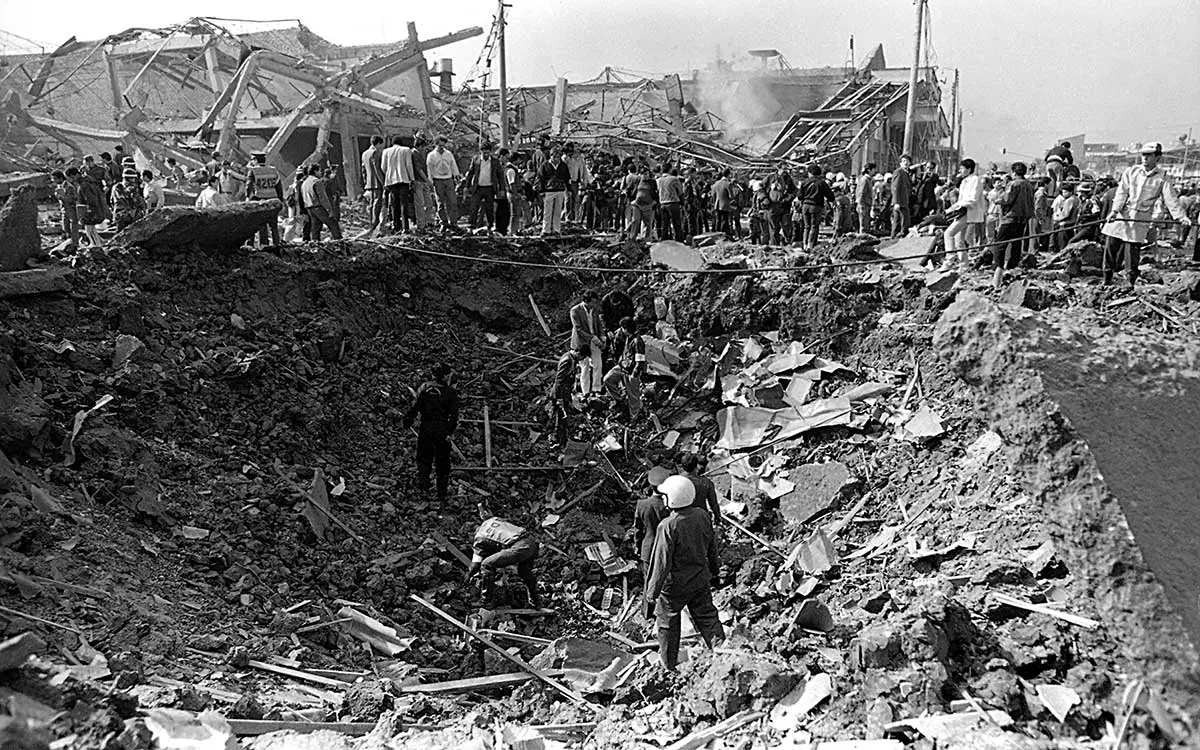
The conditions in which these photographs were taken are difficult to fathom today when photography is within reach for any smartphone-wielding person. The photographer’s own testimony gives us a clear idea of the obstacles she faced: “The Agency gave me access to events via its spot news. Let’s say that Pizarro was going to sign the Peace Agreement with Pardo Rueda in Santo Domingo. I arrive in Cali with the portable darkroom (I set it up in the bathroom of my hotel room, mixing the chemicals and leaving the tubs at the appropriate temperature), negotiate access to a phone line, and go to the site. As Pardo‘s helicopter is landing, I put a fresh 36-shot roll of film in my camera, walk around the camp, and shoot a quick series with the guerillas, some passport-type shots of Pizarro (for the archives), and a couple of vistas to set up the newsworthy event. I limit myself to those two rolls. I replace them with fresh ones and take my position to shoot Pardo’s arrival. Once he lands, I know I have two fresh rolls for my coverage. After the event, I take off running with my six rolls (one always ends up shooting like a maniac at some point!). The driver takes a couple of hours to get us to the hotel. When we get there, I run-up to the room and develop the film at once. I check the dry film with a magnifying glass to select the key moments. I know that only three of my photographs will be accepted, four at the most. They will be sent to the Latin American desk. Of those, perhaps one will go to World Service. Transmitting those four photographs will take me an hour, much longer if they are color… With such an unbearably complicated procedure, one can hardly produce transcendent images; this is why, in terms of context and style, so much of the work has that black-and-white-on-newsprint graphic harshness.” *
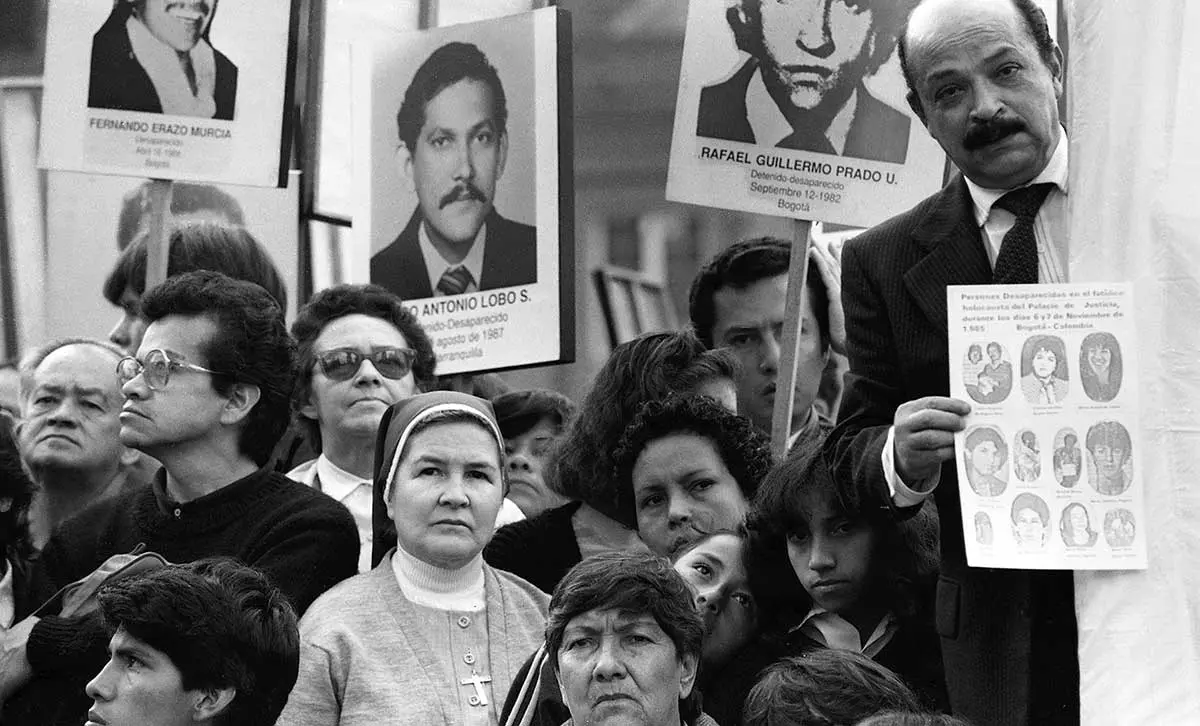
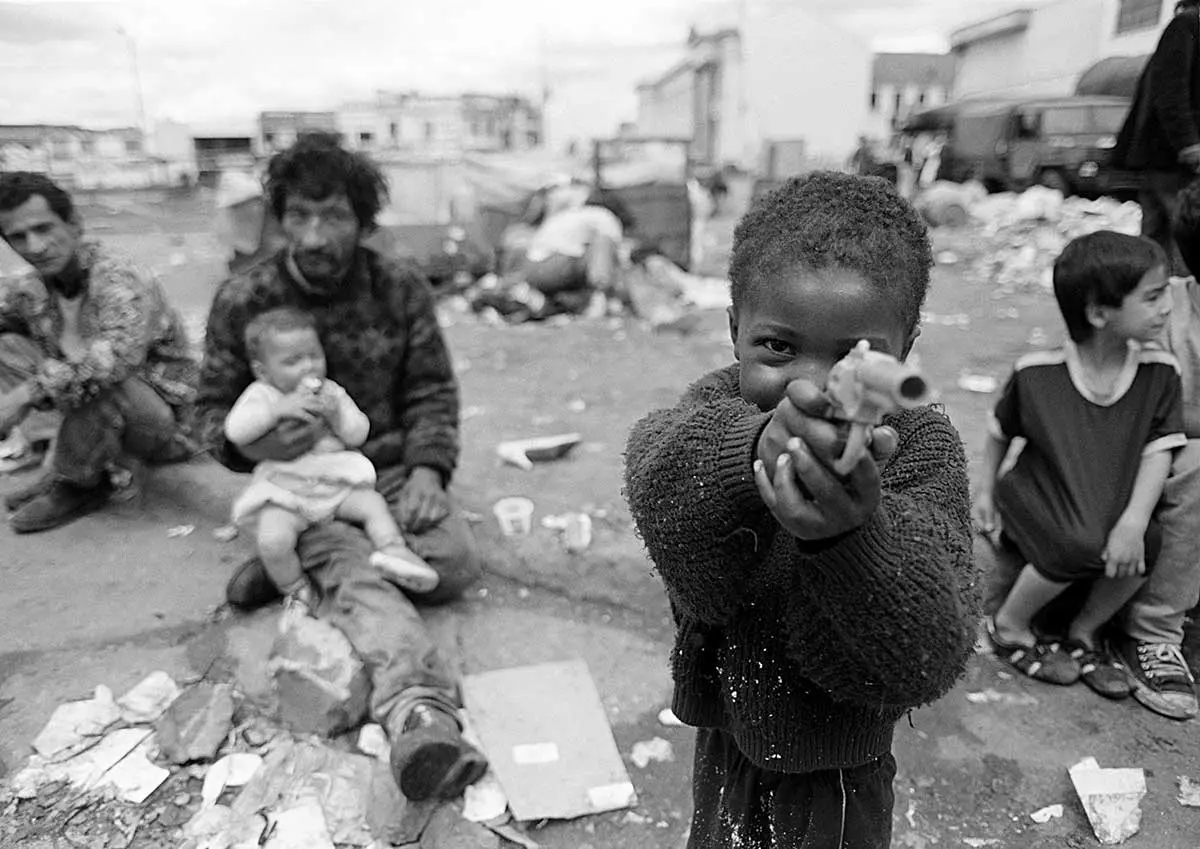
But these are not Díaz’s only images depicting the degradation of life in Colombia. The depraved hydra of drug trafficking, which fed and continues to feed the conflict, literally consumed Colombian society in a short period of time, destroying its youth and its social fabric. In one of the streets where drug commerce was most intense, known as Calle del Cartucho, Díaz took two unsettling photographs. In Policías y ladrones (Cops and Robbers), part of the Juego de niños (Child’s Play) series, a child confronts the camera with a toy gun, laughing, while in the background we see the helpless denizens of the street. “I was photographing the boy when suddenly, right as I was pointing and shooting my camera, he pointed his toy gun at me and shot me in play. I was surprised by how expertly he held the weapon. We laughed at our mock-combat game. This is one of those moments of communion I mentioned before. Moments like that make me a participant in the scene because it is impossible for me to be there as an impartial witness. The decisive instant is the climactic moment of the action in which a child raises his arms and points a toy gun at me; it is an act of extreme violence camouflaged under an angelic smile. The boy doesn’t know that, in that context, his action foreshadows a predestined tragedy.” *
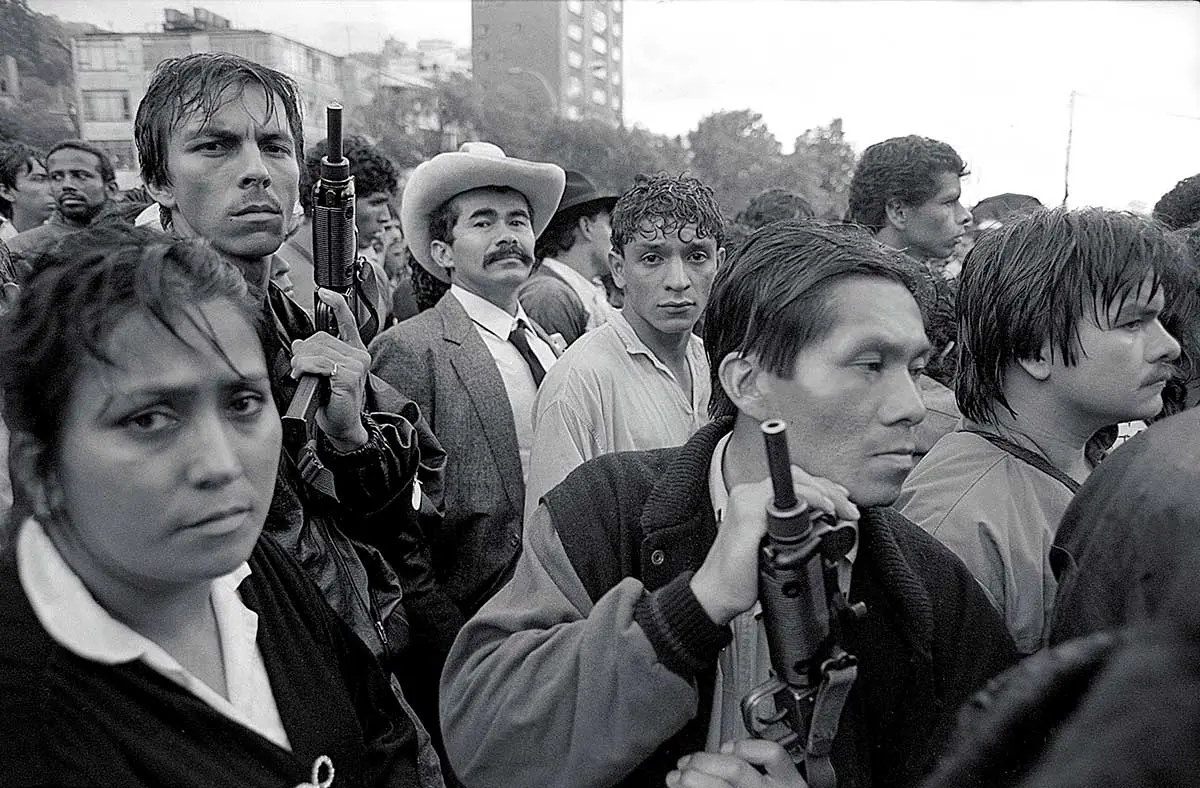
The bitter misery of Calle del Cartucho, which has not disappeared from Bogotá’s urban landscape but has relocated, with the same tragic ingredients, to what is known as Calle del Bronx, is magnetic to Díaz. According to her, “Every documentary photographer has produced images of poverty. In El Cartucho, poverty was a luxury.” And she emphasizes: “Pointing my camera to those wretched souls demanded more courage than photographing a war.” *
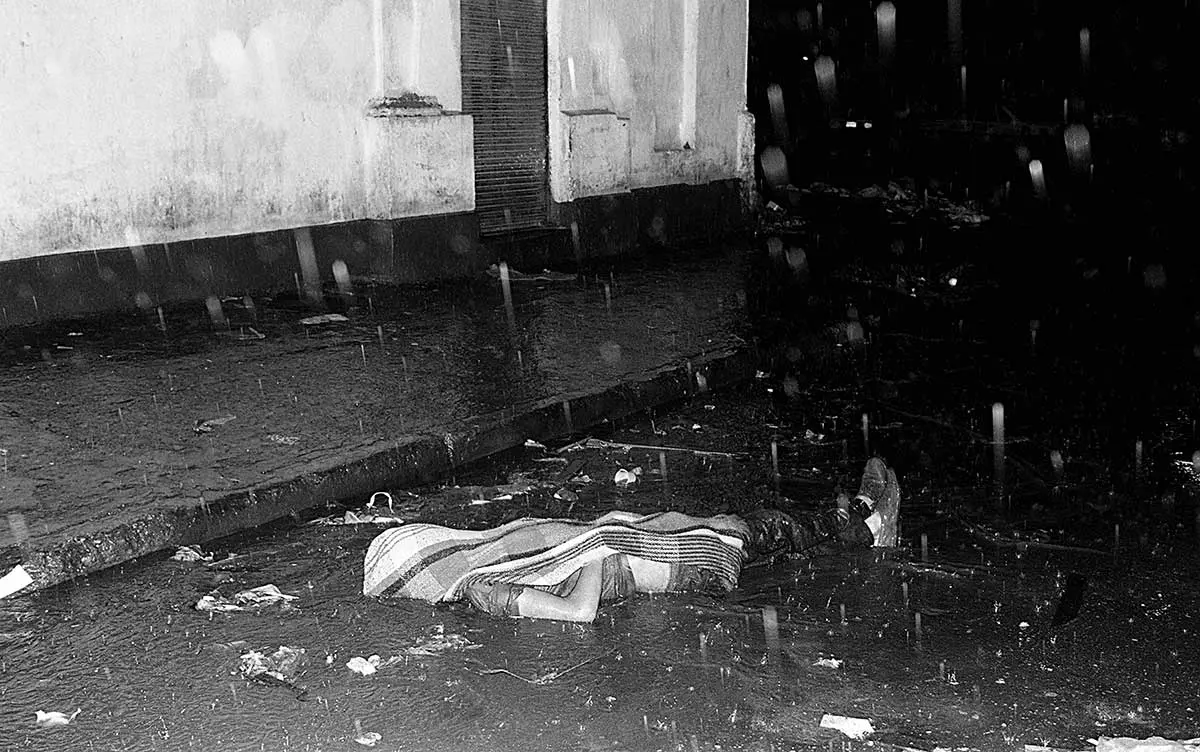
In the second image, El descanso (At Rest), which immediately brings to mind Álvarez Bravo or Enrique Metinides, a man appears to sleep under the rain in the middle of the street, covered by a blanket. The deeply surreal image makes reference to the scarcity of resources and the low value of life in such places: “I was driving around the streets of El Cartucho, looking for a panoramic shot that would describe the night as experienced by the garbage-pickers, when the rain started. I decided to go home, but then I saw a police patrol parked by the sidewalk, with its lights on. At first, I couldn’t see what was on the ground because the sewers were beginning to overflow and whirlpools of soaked garbage were accumulating. It was an adolescent boy dead in the middle of the street, his face and torso covered by a woolen poncho. He’d been stabbed in a drug-related fight. (…) I got down from the cab and, under an umbrella held by my companion, I made one or two shots using a flash, since the police patrol’s lights barely illuminated the corpse.” *
Later, Díaz covered historical events of great significance, like the terrorist bombing of Avianca 203 (1987), where 110 people were killed, or the funeral of Pablo Escobar in Medellin (1993). After Escobar’s death, Díaz was transferred to Argentina, from where she covered news of continent-wide import. Eventually, she began to garner recognition. Her work has appeared on the cover of such publications as The New York Times, The Washington Post, Libération, O Globo, Hürriyet, and The Independent, and some of her photographs are now household images, like her shot of Pope John Paul II asking Fidel Castro for the time upon his arrival in Havana. The following decade Díaz settled in Costa Rica and returned to the United States, where she devoted herself, among other things—and in her own words—“to reviewing negatives, scanning pictures, and going through a process of reflection about all those years when I shot photographs and many of them were consigned to oblivion.”
* In communication with the author.
NOTE
1. See Rubiano, Roberto, “Fotografía colombiana contemporánea,” in Fotografía colombiana contemporánea, page 12.
SANTIAGO RUEDA