
The final preparations for Allora & Calzadilla’s Puerto Rican Light (Cueva Vientos), 2015, a long-term, site-specific work commissioned by Dia Art Foundation in collaboration with Para la Naturaleza, the non-profit unit of The Conservation Trust of Puerto Rico, was like a scene from a Werner Herzog movie. Two rotating teams of eight men each carried a black metal container, suggestive of a coffin, strapped to a wooden platform, through a humid subtropical forest in southern Puerto Rico. They carefully maneuvered the 255-kilogram cargo uphill for hours through El Cedro gorge in El Convento Natural Protected Area, an extensive underground cave-spring system, millions of years old, with a unique, dynamic ecosystem.
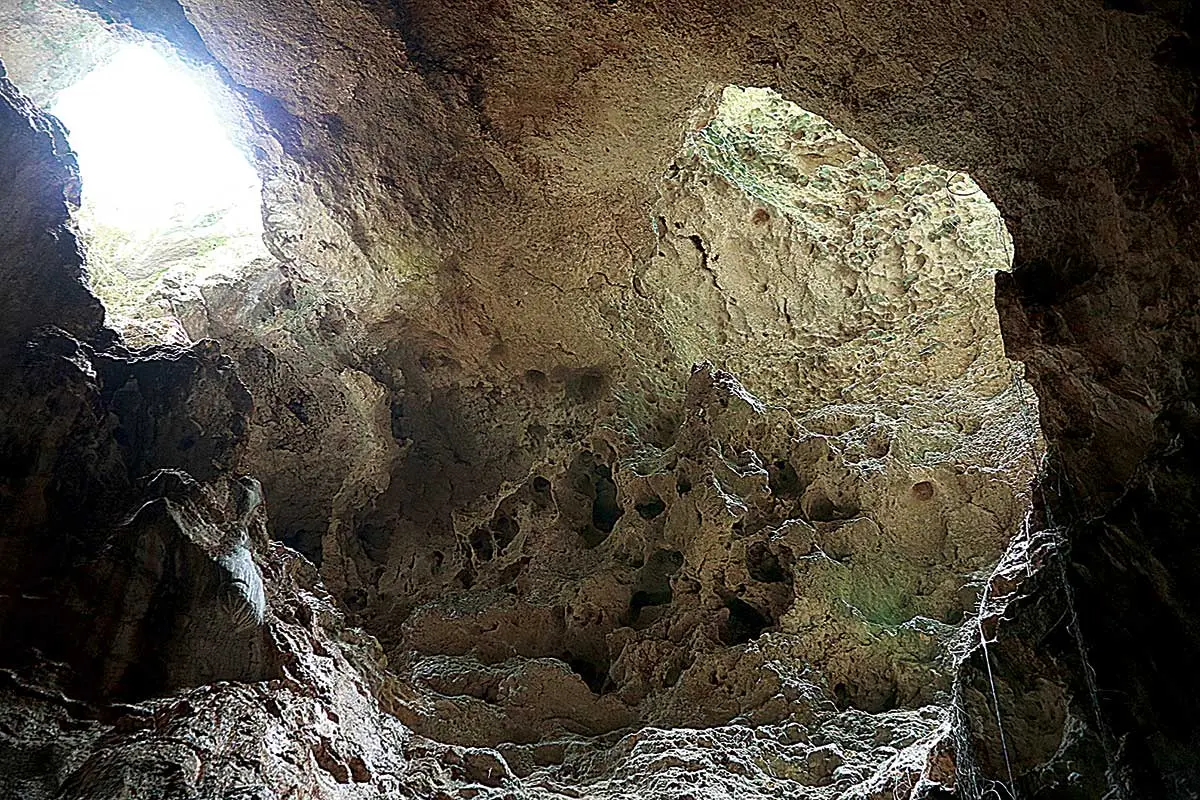
When they reached their destination, Cueva Vientos (Wind Cave), a 90-meter-long limestone cave, they climbed another 44 meters to the back of the cave, which is about 25 meters wide and 75 meters high. There, the sixteen men transformed the hardware, sealed inside the metal chamber, into Puerto Rican Light (to Jeanie Blake) 2, 1965, by artist Dan Flavin. This artwork reminded Blake of New York City’s Puerto Rican Day Parade, hence the title. As thousands of bats flew overhead, the men raised the container vertically, anchored it to its platform, folded back the metal doors of the glass-front chamber, and connected Flavin’s prefabricated red, pink, and yellow fluorescent light tubes to a solar battery bank. On a clear day around noon, shafts of natural light enter through two oculi in the back of the cave. Their mutually mutating pools of luminosity slowly approximate and recede from Flavin’s controlled system which emanates a local light of equal intensity.
In Puerto Rican Light (Cueva Vientos), co-curated by Yasmil Raymond and Manuel Cirauqui, Allora & Calzadilla give form to Puerto Rican light as a symbol, medium, and metaphor. They join divided histories and probe the possibilities of relation at the intersection of the known and unknown. In the past, the artist duo has exhibited Flavin’s Puerto Rican Light (to Jeanie Blake) at institutions, and electrified the work with solar panels charged on the island, thus posing questions about autonomy and dependency, power and dislocation. This is the first time Allora & Calzadilla have created a context for this work by Flavin in Puerto Rico. By selecting a cave (the origin of the Taínos and their deity who controlled the Sun), and this critical moment in the island’s history (mass migration to the United States, the government on the brink of bankruptcy), the circulation of ideas around Puerto Rican Light (Cueva Vientos) is richly layered and expansive. The participant’s critical consciousness has the potential to build in volume, like the sounds of the cave swallows and bats.
Puerto Rican Light (Cueva Vientos) is about what happens on the way to the maw of the cavern and what takes place when the visitor experiences an unforeseen exchange between Puerto Rican Light (to Jeanie Blake) 2 and prehistoric natural architecture that hosts over twenty species. The journey is replete with references to energy and power--the metal stalagmites of abandoned oil refineries and petrochemical plants along the highway, a marker that welcomes you to “The Land of Agüeybaná,” the most important Taíno chief at the time of European contact, whose name means “The Great Sun,” the natural world, the human body, and their interactions along the path to Cueva Vientos, the microclimate of Puerto Rican Light (to Jeanie Blake) 2, designed by Museo de Arte de Ponce’s Anton J. Konrad Conservation Center, and its daily data logger readings, and the energy of the sun which activates the entire work. As Para la Naturaleza staff spend more time at the site, they are discovering new species and knowledge.
Just as Flavin was a maker of proposals and situations, Allora & Calzadilla offer a different system of investigations into the complex relations between work, a site, and the viewer. Puerto Rican Light (Cueva Vientos) transforms one’s experience of space in unexpected ways. I have found that with the placement of Puerto Rican Light (to Jeanie Blake) 2 in a contained chamber, up high, at a distance from the spectator, in an ever-changing environment, Flavin’s work shifts between generating a comforting presence and aesthetic and critical friction. Puerto Rican Light (Cueva Vientos) holds me in the space as I experience symbiosis unfolding. It creates a synthesizing place of the relation between art, nature, history, myth, ritual, technology, and the multi-sensory body. Peter Schjeldahl referred once to Flavin’s work as a hothouse flower, dependent on an institutional setting. Puerto Rican Light (Cueva Vientos) gives visitors the chance to experience what it feels like when we replace the hothouse with a passion for the land where one lives. As Édouard Glissant reminds us, this is “...an action we must endlessly risk.”
CHERYL HARTUP