
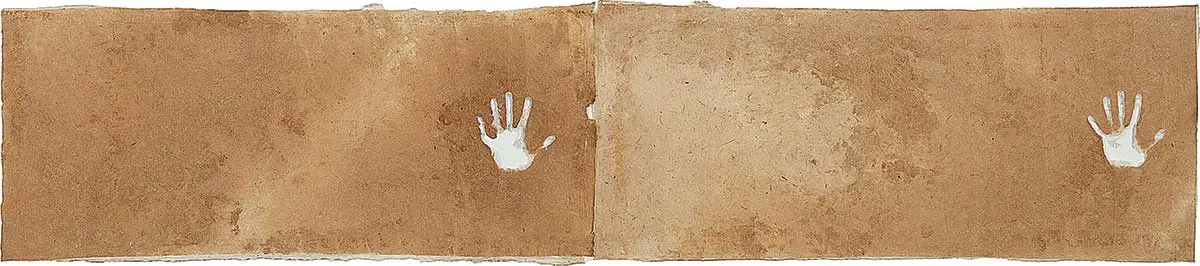
Papéis de Nepal, 1877-1986 (Nepal papers 1877-1986) a recent exhibition at Nara Roesler Gallery, in Río de Janeiro, foregrounds Antonio Dias’ break with the rationalist language that characterized his previous work. On the basis of the organic nature of the images on display, Dias presents us with what has become the essence of his poetics, strongly connected to the use of paper, a simple element whose constitution emerges from its tactile character, given by its texture, softness, and transparency.
The works on exhibit were all created during Dias "trip" to Nepal, in 1977, where he went intending to learn to manufacture artisanal paper. Interested in the conception, design, and materiality of hand-made paper, the artist obtained the support of collector João Sattamini to find a supplier in Nepal. However, after arriving in Katmandu and not finding wholesalers offering the product, he traveled to the countryside and manufactured it himself, with the help of local artisans.
Until then, Dias' trajectory had been marked by conceptualism, using such media as video and a visual lexicon that encompassed Pop Art elements and geometric planes defined by color and words. In this way, the artist interrogated the character of social conventions and of the art institution as producers of values reinforced by an international commercial system, as revealed by his English-language titles, for instance in the famed The Illustration of Art series.
In the works exhibited at Nara Roesler, colors come from the addition of natural elements, such as tea, soil, ashes, and curry, turning the process of pigment manufacture itself into a signifier. Created in collaboration with artisans from a Nepalese paper factory, these works subvert authorial unity (many of the titles were provided by the workmen). Dias put it this way in an interview: "What interests me the most is the connection between the production of the work and its producers. While laboring in its material production, some of them also imprinted a symbolic reading onto the product.”
In the gallery catalog, critic Michael Asbury writes that these works by Antonio Dias are the result of a common plot”.Although the term plot, the title of one of the series, describes both a plan or schematics and a sequential thread, it refers here to a common project applied to several works, and also to the subdivisions within a single work.
Antonio Dias was born in 1944 in Campina Grande (Paraíba), but he lives and works in Río de Janeiro and Milan. His works are featured in important international collections and are a noteworthy chapter in the history of Brazilian art. Early in his career, in the 1960s, Dias focused on neo-figurative works with strong political content. In 1966, after a military coup, he left Brazil for Europe, and in the 1970s he settled in Milan, where he developed a strong tendency towards conceptualism. In the later years of that decade, audience participation became a dominant concern, as in his installations Do it Yourself: Freedom Territory and The invented country (God-will-give days) exhibited at the 29th São Paulo Biennial.
Having already developed a unique, markedly conceptual body of work, characterized by formal elegance but also by engagement with political subjects and a forceful critique of the art system, Dias' trip to Nepal became a turning point. What began as a research project on various kinds of papers soon became a permanent interest; in the 1980s, the artist increasingly focused his attention on painting, experimenting with metallic and mineral pigments such as gold, iron oxide, and graphite, combined with a variety of agglutinating agents.
Dias reveals a tensional relationship between the properties and potentials of matter. In a sustained process of manipulation, transformation, and experimentation, Dias also became interested in chemistry. Often, what emphasizes the material characteristics of his works is not color, but the residues of matter. These can be of various kinds, including industrial products (which assert the artificiality of art) and natural elements (which underscore the work’s organic character).
Based on the diversity of supports used and the constant experimentation with materials, the ludic-lyrical aspect of Dias’ work is revealed in a dialogic relationship between apparently distant poles, such as sensuality and rationality. Dias explores this paradox with singular symbolic force.
ALESSANDRA SIMÕES