
The exhibition Zona de riesgo (Danger Zone) is a curatorial proposal by Pilar García at the Museo de Arte Moderno, reviewing the work of Carlos Aguirre (Acapulco, 1948) over more than three decades.
The show brings together works created by the artist over the course of his career in genres such as sculpture, graphic arts, photography, and installation, among others. The exhibition emphasizes works that played a pioneering role in installation art in Mexico. It presents works from the early 1990s, like Los olvidados (The Forgotten Ones, 1990), made with used industrial worker gloves. Here, the materiality of the artwork is intimately connected to the conceptual proposal behind it, since the worker gloves were collected from dumping areas, where they had been discarded after use. The title evidently refers to a condition of the working class, and the artist articulates a political position about manual labor.
Zona de riesgo proposes a dual reading of its title, connected both to the artist’s material experimentation and to his political position, the latter based on a critique of the context in which the work is produced.
The exhibition’s reading of Aguirre’s work is the result of a sustained quest for formal and material experimentation and situates him as one of today’s most innovative graphic artists. On exhibit in the gallery are works in a variety of formats, such as vinyl cuts, acrylic, and lightboxes, among others.
The show is organized around seven nodes focused on subjects engaged by the artist. Based on this organizing principle, we find works that reflect on topics like the contamination of the environment; borderline situations expressed both at a formal and a discursive level; conditions related to legal justice; history; semiotics; records of drug trafficking; child abuse; and graphic experimentation.
The installation Equilibrio ecológico (Ecological Equilibrium), from 1995, reflects on the implications of human actions that damage ecosystems and their delicate balance. Zona de riesgo also features an installation previously seen in a solo show, back in 1991, which includes human lungs afflicted with anthracosis, a condition of external pigmentation caused by the presence of contaminating agents such as cadmium, lead, carbon, and suspended particles. This work makes reference to the time when Mexico City was identified as one of the world’s most contaminated cities.
A recurring element in Aguirre’s work is the use of heavy work tools such as shovels and axes, which, with their symbolic referent set in contrast with natural elements, are able to strain and stress considerations about the social classes who use them and the implications of human-imposed changes on the natural environment.
Language and the use of words are also essential elements in Carlos Aguirre’s work; through them, he makes reference to processes of veiled violence, making explicit something that is often difficult to articulate, giving new value and power to language as a driver in the transformation of social reality.
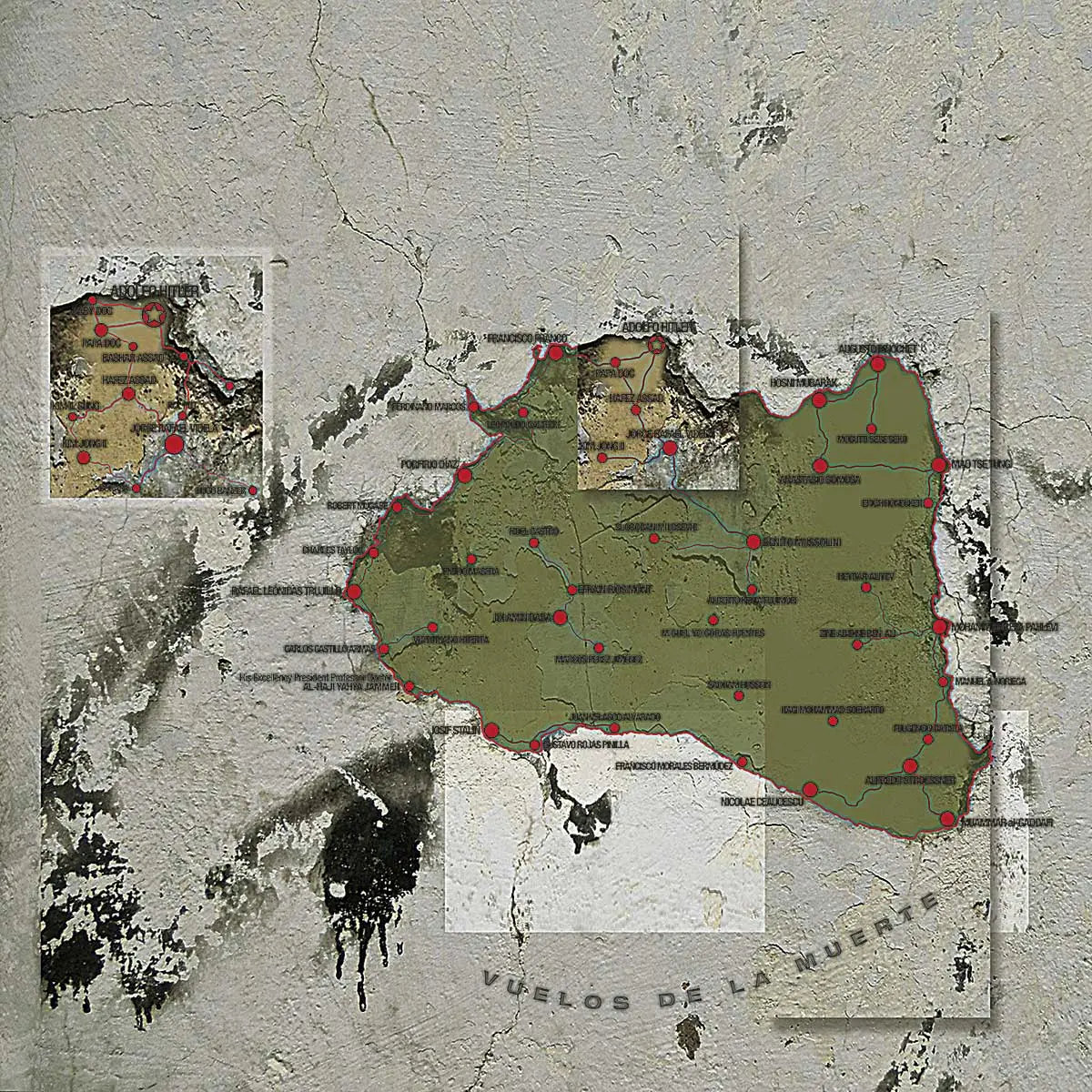
In one of his most recent series, Aguirre has presented photographs of decaying walls articulated as “islands” that recreate nonexistent geographic locations, where language reconstructs political topographies. In some cases, they recover the last words uttered by death row inmates; in others, as in La isla 28 (Island 28), from 2012, Aguirre creates geography with political names and historical characters, noting their interactions and alliances.
The overview presented in Zona de riesgo makes it possible to read Aguirre’s body of work in connection to the context of current artistic production, revealing its explicit impact, both in terms of genres and of subject matter, younger artist approaching the issue of violence in their sculptures, such as Enrique Jezik and Teresa Margolles, among others.
JOSEFA ORTEGA