
With the generic title of Wishes, artist Carlos Motta presented at the Galerie Mor-Charpentier a video of the same name along with an installation entitled La Puissance et la Juissance (Power and Enjoyment) and an artist’s book. All the works in this first exhibition by Motta in France were created in 2015. The multidisciplinary work by this Colombian artist—born in Bogota in 1978 and based in New York for many years now—subscribes to an intellectual as well as a political and iconographic reflection that is clearly present in this exhibition. With subtle reflection and analysis, with poetic sense and a touch of humor, Motta offers an inquiry into the dominant conventional discourses about sex, its imagery, practices and taboos, as he also delves into the notions of gender and the relationship of these themes with story. In fact, Motta likes to draw his themes and images from the history of culture and art as well as from the Internet (Grindr site1), to build a temporary iconographic reflection that shatters clichés and conveys the basis of his commitment as an artist who is also a thinking and social being.
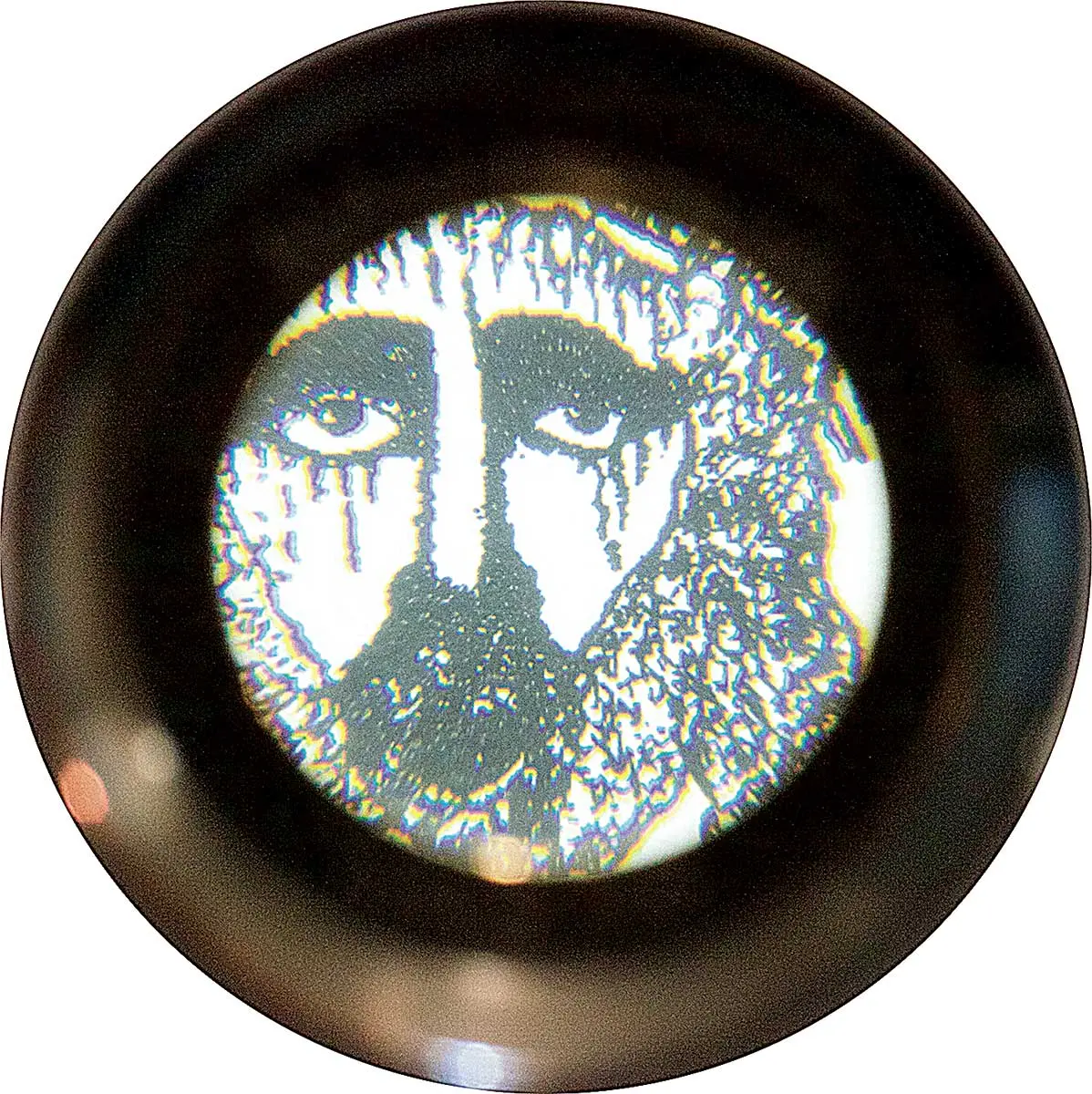
The installation, which occupies the gallery’s sole exhibition room, consists of small round openings arranged at regular intervals and at eye level, each covered with a magnifying glass. Only by looking through the magnifying glasses are viewers able to decipher the miniature letterpress drawings (black ink on white paper) hidden behind the wall, in a process that turns into a voyeuristic act that culminates with the revelation of a taboo, of something forbidden that may or may not be enjoyed. A central factor for the apprehension in these proposals, the time spent by viewers observing is necessary for the occult to be revealed and for the game between the intimate and the public to achieve the best possible enjoyment. Each miniature (2.5 cm x 3.8 cm) was inspired by an image from the history of art and then transformed and perverted to make it reprehensible.
By modifying the model that serves as a starting point, Motta constructs a different iconography. He reproduces a deviant sexual practice—bestiality—recovers religious icons like Saint Sebastian and the face of Christ, stages female sexuality, utilizes erotic figures from Roman mythology, recreates the sexual habits of the hard gay, and acts of sodomy, and so on and so forth. In this manner, artists like Goya, Peter Fendi, Robert Mapplethorpe, and Michelangelo rub shoulders with Shaykh Muhammad Ibn Mustafa Al Misri (Turkey).
Arguably, this universe that Motta reconstructs through the lens of history becomes a kind of “hell” that is now accessible to everyone. An underworld that is similar to another one in which images considered deviant or taboo for showing sexual practices labeled socially “abnormal” were often banned to the readers of the National Library of France—during periods of heavy censorship—and relegated to a forbidden and shunned section called “Hell.” Viewers are thus placed in a situation in which they must confront and challenge their own values and references as they also question the veracity of the images that Motta manipulates and gives new meaning through confrontation.
Published in five copies with the title Potencia y Goce (Power and Enjoyment), the artist’s book consists of a black box that contains twenty small plates, also black, on which the miniature drawings are mounted, as well as a magnifying glass that is inserted in a separate opening. This edition complements the installation by bringing the enjoyment into the realm of the private and intimate.
Located in the basement of the gallery, the second major piece in the exhibition is the video entitled Deseos (Wishes, 2015, 32 minutes). Co-produced by the galleries Mor-Charpentier (Paris) and Filomena Soares (Lisbon), the Museo de Arte Latinoamericano de Buenos Aires (MALBA), and the Röda Sten Konsthall (Gothenburg), the video centers on an epistolary dialogue between two women from different countries, cultures, and religions, whose exchange is done through letters that each take turns to read in their own language; Nour, from Beirut, reads in Arabic, and Martina, from Santa Fe, reads in Spanish. Victims of social morality, condemned by religious ostracism, prosecuted and charged—Nour, for having sex with the same sex, and Martina, who actually existed, for being hermaphrodite—these women from the nineteenth century were able to overcome their injunctions and live their life as they wanted.
The rhythm in the video by Motta, in which violence is mostly expressed through the situation experienced by his “heroines”, is marked by the smooth alternation of the two languages and the swinging and undulating movements of the landscape and portrait images; details of a country that the camera embraces, from one metaphor to another, with great tenderness, in an often poetic progression. The images and the two narrating voices are accompanied by music—mostly guitar arrangements—whose rhythms simultaneously evoke both cultures, confirming the convincing subtlety of the intellectual and aesthetic discourse of Carlos Motta.
NOTA
1. Grindr is a geosocial networking application geared towards gay and bisexual men that runs on iOS (Apple), BlackBerry OS, or Android.
CHRISTINE FRÉROT