
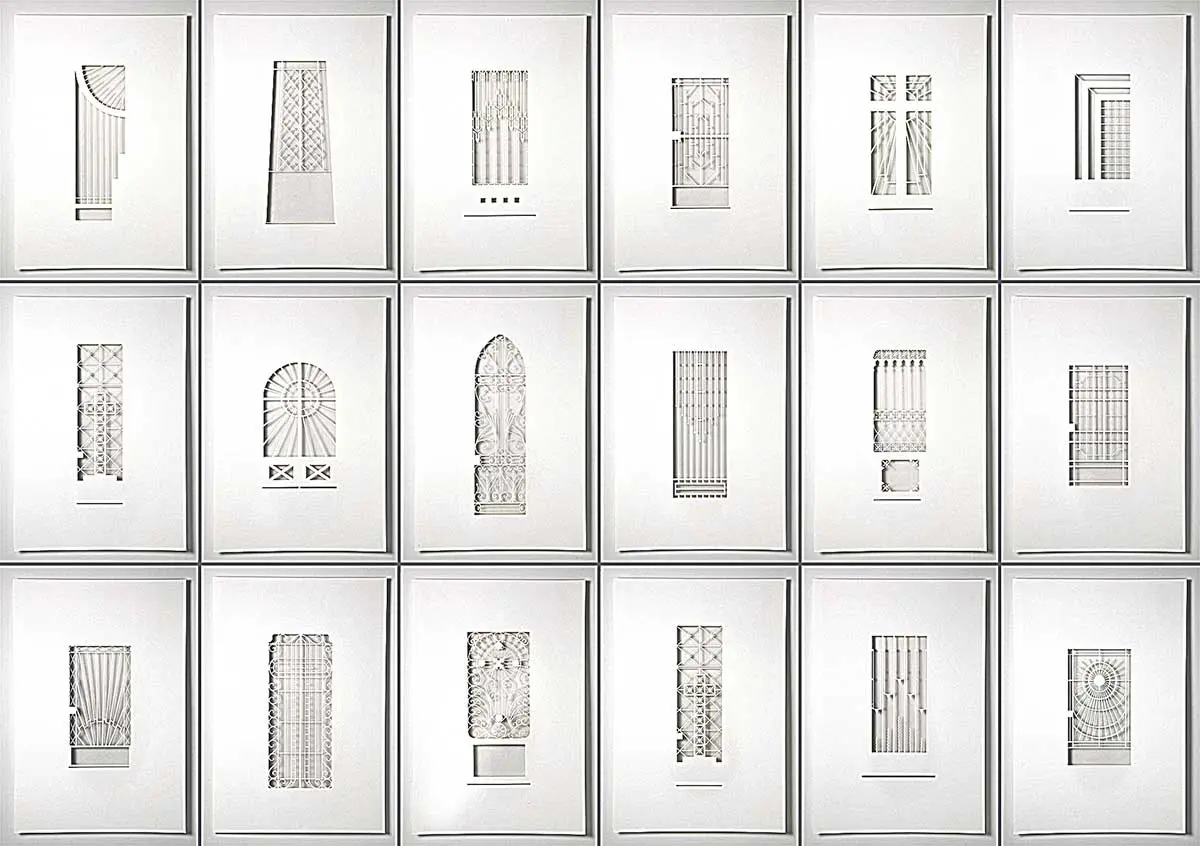
Prototipo Bungalow Nº 1-70 (Prototype Bungalow Nº 1-70) and Bungalow Nº 1 are the titles of the two works presented by Carolina Illanes in her new solo show at Patricia Ready Gallery. A series of seventy sheets of paper transformed, via laser cuts, into two-dimensional miniature versions of fences and gates found in mausoleums in Chile’s General Cemetery. The works’ delicateness and minute attention to detail, as well as their white color, produce a contrast (in this case, an absence) with the gallery space, which is vast and sober. And they also provoke surprise: what is usually outdoors is now indoors. Given the monochrome that dominates the exhibition, lighting comes to play a central role, something that has not been taken into account in all the “drawings” in the series: shadows that are as relevant as the designs themselves is created on some of them, but not in others.
Bungalow Nº 1 is an installation in foam board, made at 1:1 scale, of a bungalow-type house materialized only through its perimeter: a 60-square-meter long, 2.20-meter tall fence with no openings (viewers cannot enter the “cage”). The reference to security is clear, and it turns our attention to the surveillance mechanisms all around us: the gallery’s own cameras, guards, and metal bars. Carolina Illanes has for many years worked with paper as her prime material, intent on countering with its fragility the sturdiness of architecture and of metal guardrails and fences. She points out how, regardless of the number of walls one may build around a house, our feelings of insecurity are never resolved: it is not an issue of material structures, but a subjective perception. Many Chilean artists (Rodrigo Canala and Patrick Hamilton, among others) have reflected on issues of security and protection in Santiago, as a reflection of a larger national concern—inequality—and of class struggle in an extremely class-conscious country. As not just the wealthy, but also the middle class, internalize an exclusionary paranoia, we are all left to contemplate the ways in which public space is carved into pieces and private space rendered inaccessible. These artists, Illanes included use fences as metaphors; to one degree or another depending on the context, the operation of the material used is eminently political. In Bungalow Nº 1, a house transformed into just its perimeter fence, the impossibility of breaching the space condemns viewers to a permanent state of exclusion and immediately prompts this question: who is being protected, and against whom? Other questions arise from the collection titled Prototipo Bungalow Nº 1-70. In this case, we must not be misled by the aesthetic qualities of the die-cast shapes. These designs come from mausoleum fences in Santiago’s oldest cemetery. They come from monuments erected in memory of the deceased by wealthy immigrant families, the local oligarchy, and institutions like the armed forces or public corporations that played a significant role in national life in the Nineteenth Century.
European influences are clear in the design: Art Nouveau and Art Déco. This is a reference to Chile’s sustained relationship with Europe and the local adaptation of European forms, visible in architecture and in urban plans. At the same time, our attention focuses on the mission and purpose of these fences, made to protect tombs. Again, the question arises, here in a more ironic (and funereal) vein: who is being protected, and against whom? Or is it that the dead need to feel safer than the living?
JUAN JOSÉ SANTOS