
Elisa Bracher presents her solo exhibition Luctus Lutum, curated by Elisa Byington, at Raquel Arnaud Gallery in São Paulo. The show is a tribute to the artist’s mother, who died in March. The work explores grief, dialogs with the pain of loss, with memory, and with the mythical relationship between life and death. The emptiness caused by death inspired part of the exhibition’s construction, structured by Bracher on the basis of a triad: Labyrinth, Lung, and In the Field of Bells, photographs of the Arctic in a sound environment composed by the artist and Rodrigo Felicíssimo.
The exhibition’s intriguing title, Luctus Lutum, Mud and Mourning makes reference to the beginning and the end of life, or to the myth of Eternal Return: "you are dust and to dust you will return"; the Latin title adheres to the work as skin, according to Elisa Bracher, a sort of mooring line between form and idea, disturbed by grief, emptiness, and, at the same time, the search for meaning, for a reordering of life after loss, the effort to fill a hiatus and begin anew.
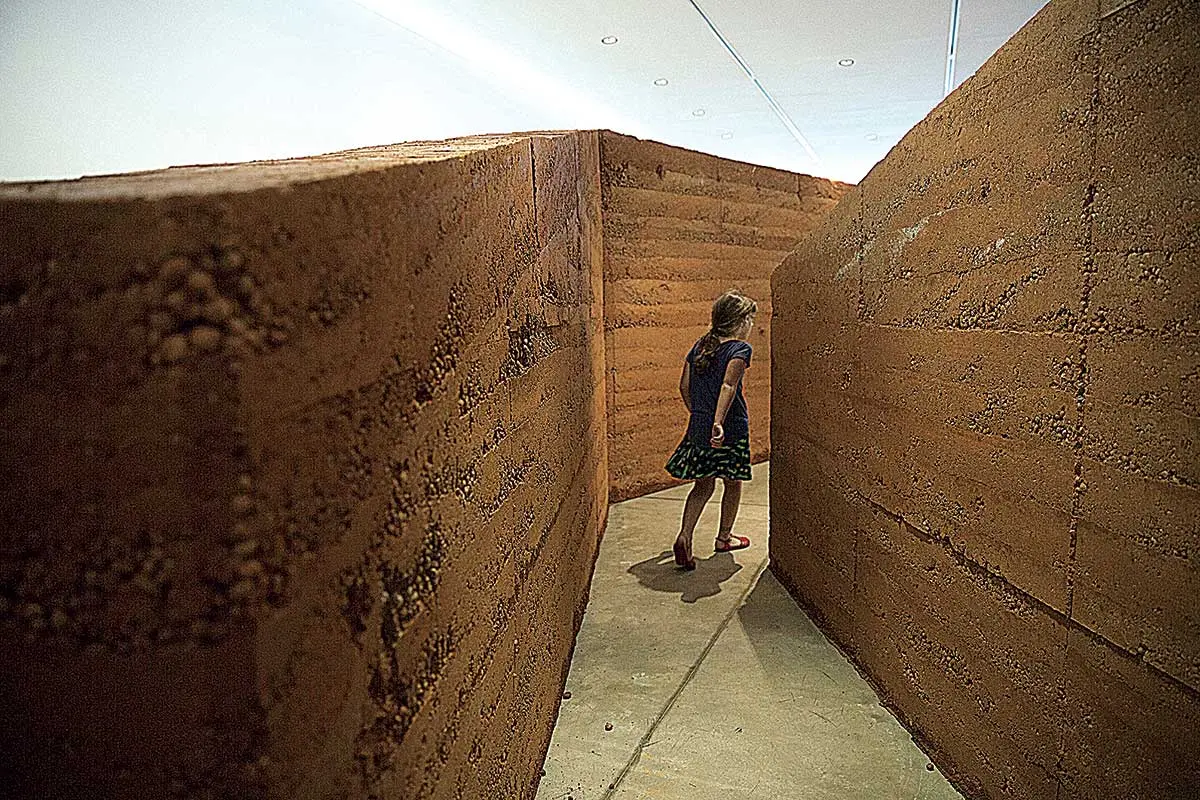
The gallery’s ground level was entirely taken over by an installation titled Labyrinth, using tamped adobe and sticks. The work weighs thirty tons and represents the path of mourning. Mud is a foundational element in this installation, structured as a series of labyrinthine passageways, cul-de-sacs, denotations of impossibility, angular cuts, walls that meet or miss each other. The subversion of order is a constant for the audience that traverses the installation, while the organic element calms our anguish for discovering the logic of the route, as the architecture prompts questions about the nature of the installation: is it in construction? Is it an exercise in demolition? Is it a representation of ruin and remainder?
With its provocations, the work unfolds at a discontinuous and disorienting pace and forces viewers to explore it through their own motion; a highly thought-centered experience through obtuse paths in contrast with the non-linear horizon. Labyrinth invites viewers to an interactive attitude, discovered with every step.
The adobe-and-sticks technique connects cultures in different chronologies, which makes possible harmony even as the temporal dimension is broken. The artisanal volumes also establish a metaphorical interplay with burial mounds and a passageway to a different place. In this way, Bracher pays homage to her mother and, through her creation, ritualizes as an offering the best she had to bring forth: her art.
Labyrinth was built on-site, which is to say, it took shape inside the gallery, without prior studies, models, or projections. It was created in its own environment. Entirely artisanal, it proceeds as rather sinuous and irregular stripes with exposed markings, veins, and furrows.
The triad is completed in the gallery’s upper level, a space divided between the Lung sculpture and the images of the Arctic, the latter in a 1m x 0,50m format, taken by the artist in 2014, when she participated in the Arctic Circle residency. This space also features a sound installation, a symphonic poem composed by Rodrigo Felicíssimo and Elisa Bracher, titled In the Field of Bells.
Lung is an innovative element in Bracher’s oeuvre, and this is her proposal: in a parody of Fernando Pessoa’s heteronyms, she found inspiration in the poem autopsychography: “The poet is a fraudster/ he fakes thoroughly as pain/ the pain he truly feels”.
In the conception of this work, the artist using materials and techniques that are not often found in her oeuvres, such as plastic and mechanical objects, so that an artificial component contrasts forcefully with the distinctive use of natural materials in her artistic formulations. This is explained by the project’s premise, based on an invitation extended by filmmaker Julia Murad for Bracher to produce the work of a fictional artist, a character in one of Murad’s films. Bracher assumed the fictional game and submerged herself in a different poetics, like that of a heteronym.
Freed from her own vocabulary and able to explore new avenues, Bracher produced this installation during her mother’s final weeks. Between her studio and the hospital, living the terminal moment and at the same time submerging herself in the creation of the work, the artist concentrated on her own biography. Lung was the name given to the final product once completed. It comprises two plastic squares connected to a machine that fills and empties them. On one of the squares is a parallelepiped, a metaphor for the struggle for breath.
Photographs of the Arctic is a series of images captured through a pinhole technique, an artisanal instrument based on the black boxes used in early 19th-century photography. The exercise forced Bracher to photograph in a rudimentary manner, akin to the use of adobe and sticks in the first section of the exhibition. The images were captured during her 2014 residency project, Arctic Circle. For this installation, the artist, along with composer Rodrigo Felicíssimo, created a sound environment, applying the latter research in the use of musical scores based on analytical readings of works and images.
HÉLCIO MAGALHÃES