
The work of Gonzalo Lebrija (Mexico City, 1972), a central figure in today’s Latin American art scene, begins with an existential meditation on being contemporary and our relationship with the era, and with an exploration of the tensions—gaps—between artwork and viewer, or of the very condition of art. Forged in the universe of the image, Lebrija’s works trace suggestive connections to the history of art and culture, linking ancient myths and contemporary narratives of power “in a multi-semantic oeuvre that transcends the clichés of advertising or the heroic impression its acts can produce.”1
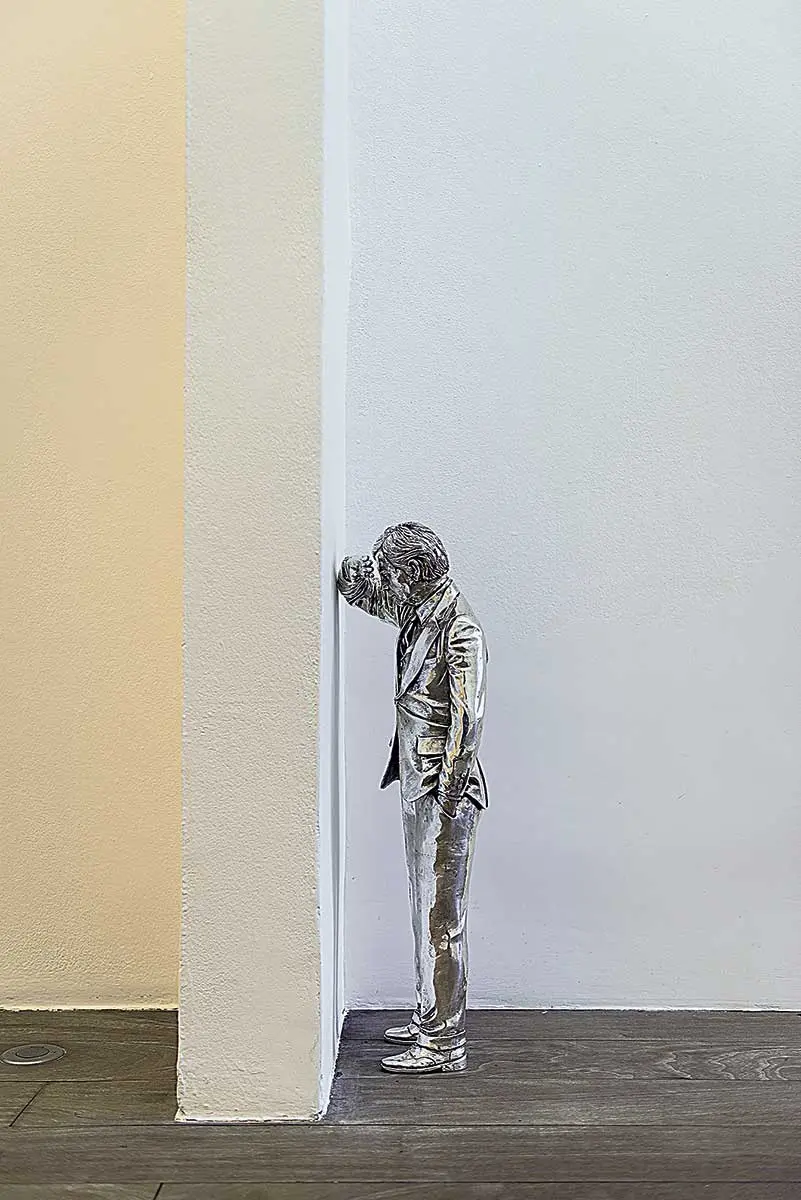
Measuring the Distance, an exhibition at La Casa Encendida in Madrid, focuses on Lebrija’s interest in suspended time, distance and displacement, and prompts a dialog between several recent works in varied formats—sculpture, photography, installation, video, and drawing—and scales ranging from the minimal to the monumental, foregrounding “the distance felt towards the world and the gap that exists between artwork and audience.”2 The show opens with Silver lamento (Silver Lament, 2015), the silver-colored figure of an elegantly dressed man facing away from the viewer, his head leaning on a wall, whose tiny scale, in the middle of the vast exhibition space and against the sharp black-and-white designs decorating the gallery, communicates sensations of frailty, loneliness, and powerlessness, a lament in the face of appearance’s dominion over reality, of imposed social and cultural constructs inherited as symbols of power, success, and well-being. The figure’s dependence on the wall—on architecture—emphasizes its image as a modern man “forced to live in a world made by others,”3 marked by his dual insertion in society: as a consumer and as an active cog in the capitalist system. Perhaps this is why a black-paint splotch, shot by a rifle nailed to the floor, barges in and expands on the gallery’s spotless whiteness (Disparo [Gunshot], 2009) or subverts the perfection of a prototypical image of the American Dream: a placid scene of comfort and domestic bliss, centered on a luxury automobile and a blonde Marilyn lookalike posited as objects of desire (Dirty Wish, 2007).
The result once again comes from an action by the artist, as is also the case with Who Knows Where the Time Goes (video, 2013). In the middle of a Mexican prairie, we see Lebrija launching a book into the air, then shooting it to smithereens. The pieces fall repeatedly in slow motion, in a kind of liberation, an act of resistance to civility and progress that is also a critique of the place of culture, with its consequent loss of values and in relation to structures of knowledge and power, and one of the exhibition’s most captivating and mesmerizing works. With his usual subtle and incisive irony, imbued with a degree of melancholy and nostalgia, Lebrija reflects on the dehumanization and commercialization of personal experience brought about by technological development, suggesting—beyond a mere feeling of loss or a repetitive (nihilistic) gesture—the need to create something new.
All of these games ultimately involve “the journey of identity in the tension of passing time, creating tiny narratives that are reactions to the environment,”4 like when the artist invited lawyers (lawyer-gangsters) who live in Guadalajara’s tallest building to participate in a paper-plane competition, generating images that are “a veritable metaphor of power tumbling down” and the seed of Unfolded Gold (2015), a series of unfolded gold leaf-covered paper planes where two of humanity’s yearnings are conjoined: flight and gold. Something similar occurred when Lebrija created a fragile wall clock using the kind of glass bristles that are a typical tool for Mexico’s street sweepers; titled La vida no vale nada (Life is Worth Nothing, 2012) in reference to a well-known ranchera song by José Alfredo Jiménez, the king of Mexico’s popular music, this work speaks of the brevity of life and the essence of time. Or when he wrote the phrase Un universo de la nada (A Universe from Nothingness, 2015) every day for a year, producing a tangle of unintelligible scrawls, a message that self-destructs even as it is being constructed. “You write the same thing so many times… that you end up breaking the message.”
In The Distance between You and Me (2009), an installation of four 16-mm films, we see the artist running breathlessly away from the camera until his minuscule figure is lost in the sublime grandness of the (distant, snowy, rocky, barren…) landscape. He disappears behind the horizon and reappears in a second screen, in an infinite loop that emphasizes and measures the same distance present in Golden Hours (2015), one of his most recent videos, seen at Travesía Cuatro gallery in Madrid, where Lebrija plays even more, if it were possible, with the viewer’s expectations (and perplexity). A crewless boat navigates the waves, seeming both in motion and in perfect stillness. Lebrija’s figure can also be seen here, amidst the back-and-forth of the waters and the gray hues of the sea and the sky. We never see him reach the horizon. We ignore his destination. And it doesn’t matter. We are captivated by the unending, tireless journey and by the uncertainty—perhaps a metaphor for his obsessions—that dominates the creative act, and life itself.
NOTES
1. Humberto Moro, “Posibilidad de desastre,” in Gonzalo Lebrija. Possibility of Disaster, Centro de las Artes, Monterrey, November 2013-February 2014, p. 29.
2. Gonzalo Lebrija. Midiendo la distancia,” http://www.juarezhoy.com.mx/
.3Adam Lerner, “Gonzalo Lebrija y el significado de ser moderno,” in Gonzalo Lebrija. Possibility of Disaster, Centro de las Artes, Monterrey, November 2013-February 2014, p. 44.
.4Adriana Herrera, “Gonzalo Lebrija o la levedad de la aventura,” Arte al Día Internacional, March 2011.
WENDY NAVARRO