
In Terra (Earth), an exhibition at Emma Thomas Gallery curated by Gabriel Bogossian, Brazilian artist Gui Mohallem proposes a specific game, which basically consists in bringing the outside, inside. Or, in other words, bringing what is exterior to the gallery into the space between its walls.
This is, in a sense, the task of the landscape painter: take the mountain to the living room. This incursion, however, is always mediated by the frame, which operates as a window. Thus, seen from a couch, a landscape painting is the fiction of a window offering us a view of something far away.
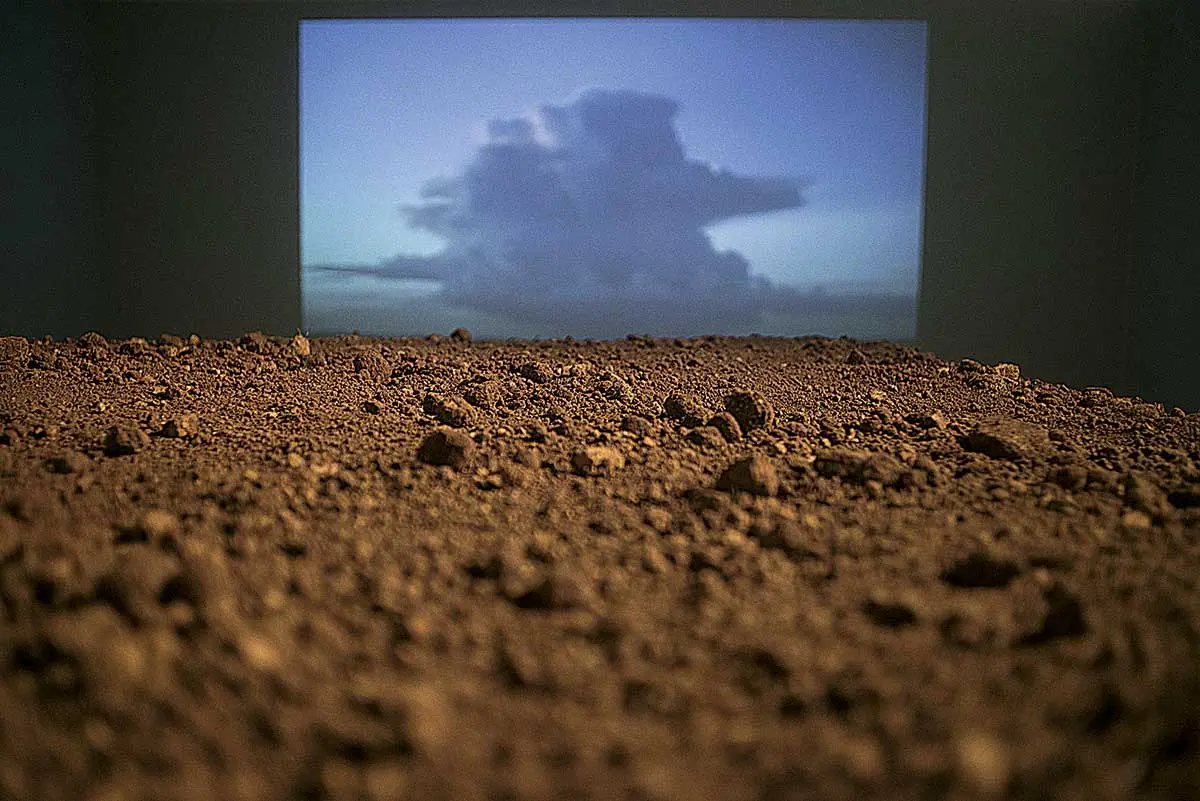
In Terra, meanwhile, the window-like function of the landscape is nullified; the frame is broken and the gallery invaded. The genre’s characteristic distancing is subverted by two key elements. First, a geometric, regular cube, unadorned and made from over a ton of dirt and paraffin, posed directly on the gallery floor. The second, a video (in a 14-minute loop) of a cloud that gradually changes as electrical charges prepare a storm inside it. The cube would undoubtedly delight Donald Judd, the minimalist, and the could fascinate Turner, the Romantic (both, let us note, extraordinary landscape painters/artists).
Immediately after entering the exhibition, visitors are confronted with the outsize cube and its rotund weight; a mere turn of the head and they find the cloud, floating in the video. The cloud is the sky; the dirt is the ground: that seems obvious enough. But those immense sky and ground are now inside the tiny space of a São Paulo gallery. The vast outside world has entered the room. The horizon is the edge of the cube, and the celestial dome has arrived in the form of the cloud.
Yet, the image of the cloud has been shot frontally, which dislocates the viewer’s position, making it as though we were atop a mountain. In sum, we see the cloud from above, but at the same time we see the dirt from below since its surface—the cube’s—begins below the viewer’s line of sight.
There is, then, a profound distortion of the location and the point of view (inside and outside; above and below). This led an employee in the gallery to exclaim: “Gui, I wish your show ended soon so that I can stand on the cube.” I am with her. We want a return of order: looking at the ground from above and the cloud from below. We want, in other words, to know where we are.
This problem of the geographic location implies a different question: we want to know how we are. And this issue, in fact, is ever-present in the exhibition, as it is in a good portion of Gui Mohallem’s work. In 2012, he traveled to Lebanon to search for his father’s family. His father had left that country in 1952, fleeing a war whose repercussions continue to be felt even today, for instance in the Syrian migrations of recent months—a process that is the mirror of so many human diasporas, so many waves of people in exile that traverse our present era. People banished from their land, people who have lost their land, and with it the documents of their identity, with all that implies.
“Nobody leaves their land because they want to,” says Mohallem, adding that it is impossible to know what is harder, the condition of those who remain there through a war—like his own uncles and aunts—or the nostalgia of those who left. Tcharafna, the exhibition he presented in 2013, after returning from Lebanon, is suffused with just that nostalgia, an inherited melancholy that belongs and at the same time doesn’t belong to the artist: the feelings of a son as he tries to treat and cure his father’s wounds. Now, in 2015, Mohallem turns his gaze to Brazil, his own land. Not by chance does the curator, Gabriel Bogossian, begin his exhibition text with a mention of Ithaca, nor is it a coincidence that the dirt used for the cube comes from Minas, the region where Mohallem’s family settled and the artist’s point of geographic provenance.
But it is landmarked by ambivalence. The pictures in the exhibition or videos like Paisaje no. 2 (Landscape # 2)—which shows the motion of the shadows of trees, and, with it, the wind that moves them—are impossible to locate geographically. What the observer sees could be taking place anywhere in the world.
Through his own history, Mohallem depicts a loss of land, identity, and origin to illustrate the condition of the contemporary individual. Confronted with such loss, the artist has two responses. First, to make the land portable, carrying it with us like Dracula in Bram Stoker’s novel (the count can only rest in his own land, so he travels from Transylvania to England with more than 30 boxes of it, weighing over 60 tons). Second, to turn towards ourselves, building an Ithaca there, within us. There resides the force of this exhibition’s attempt to bring the landscape into the gallery, fitting the vastness of the world inside four walls.
JULIA BUENAVENTURA