
An anthology exhibition of the work of Jandyra Waters was long needed, especially in São Paulo, where it has had a sustained presence in the collections of such formative institutions as the Museu de Arte Moderna de São Paulo, MAM/SP, and the Museu de Arte Contemporânea da Universidade de São Paulo, MAC/USP, as well as many private collections.
Presenting decades of her contributions to Brazilian art—be it for her important trajectory in the establishment of the abstract project, be it for the visual experimentation that resulted in an incisive and unique geometric vocabulary—the recent exhibition Jandyra Waters. Ritmo do Tempo (Jandyra Waters. The Pace of Time), at São Paulo’s Almeida e Dale gallery, confirmed the solidity of the artist’s career.
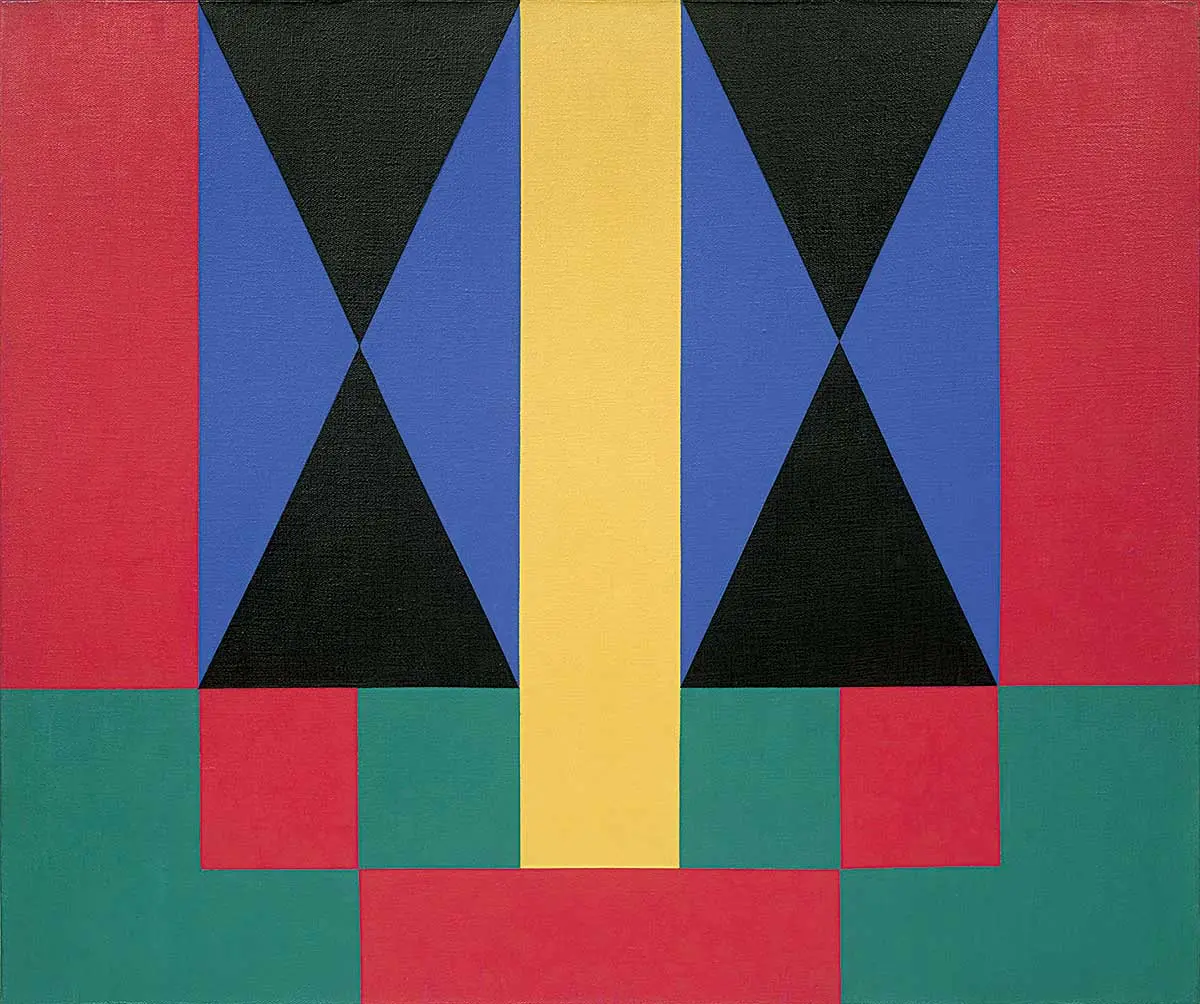
In her explorations, which moved from the initial figurative art into the pathways of sensible geometry already in the 1960s, Jandyra Waters structured a visual investigation that situates her oeuvre, widely lauded by Brazilian critics, among the foundations of the abstract-art project in the country.
Among the salient landmarks in her career, we can mention her participation in several editions of the São Paulo Modern Art Salon, in the 1950s and 60s, and her presence at the 9th São Paulo Biennial in 1967.
Her 1979 solo exhibition at the Museu de Arte Contemporânea da Universidade de São Paulo, Jandyra Waters. Paintings and objects—an important landmark as well—as reviewed by critic Theo Spanudis. In the catalog text, Spanudis’ analysis proposed an attentive reading of the geometric experiments developed by the artists: “(…) extremely subtle in her geometric compositions; lyrical or dramatic and playful at the same time, she develops illuminating delicacies and joys, and she knows how to ration out her colors with extreme care.”
Via the intuitive exercise of a flexible geometry—modulated by the color—that is her main concern when she activates the constructive vocation of sensible thought, or a thought open to sensation, Waters often reaffirmed structural relationships between compositions freed from all mistrust, fully shaped by her consistent, environment-aware investigation.
Historical in outlook and at the same time up to date with the artist’s current production, Jandyra Waters. Ritmo do Tempo proposed a consolidated trajectory while identifying the oscillations in a constructive project represented by more than 50 works in total, between oils on canvas, acrylics on canvas, acrylics on cardboard, acrylics on wood, and wood and acrylic boxes, taking over the entire gallery space.
Focusing the visitor’s attention on the vector of forces that comprised the various phases in the artist’s evolution, the curatorship established a foundational principle for the exhibition project: the rigor of a visual investigation that is aware of its own actions.
In this way, Waters’ paintings, objects, boxes, and aerial sculptures were material witnesses to her many formal insistences, constructed over six decades of active work, and supported on the unfolding of her practice.
The show’s painstakingly produced catalog, conceived by curator Denise Mattar, also deserves mention. It presents images of all the works on exhibit rather than just a selection, as it usually happens in such cases, and it includes a chronology of Waters’ life and career.
Also important to mention is the connection, made in the catalog, between Waters’ visual and written oeuvre: she is the author of three books of poetry: Naked stones (1974), Unveiler (1977), and The Pace of Time (2001), the latter the source for the exhibition’s title. Arranged on the gallery walls, placed strategically between visual works, some of Waters’ poems split the visitor’s attention with the visual dynamic between canvases and objects, and entered in a dialog with the geometric voices of the visual works exhibited.
Among the works featured in the show, Untitled (acrylic on canvas, 1978) made explicit the artist’s interest in chromatic play through symmetrical conversation between green, blue, and black tones, illuminated by the dominant yellow of a central verticalized axis around which triangular and rectangular shapes were organized. From the geometric shapes arranged in this sensible composition, the viewer moved to the angles and the ascending diagonals created by the artist.
For the curator, Waters’ visual experiments reveal a unique sense of color, modulated by an experience of the plane and the two-dimensional singularity of an intuitive work of art: “never using the original color from the tube, the artist creates uncommon luminosities in a compulsive search for color.”
In fact, Waters’ chromatic exercises can be followed in her preparatory studies, exhibited in the gallery as a welcome complement to the purposes of the main show.
Jandyra Waters. Ritmo do Tempo renewed public contact with the artist’s inexhaustible creative vein and it brought us to a new awareness of an artist who never ceased to believe in her project and registered with great precision the nuances of a significant chapter in the history of Brazilian art.
CLÁUDIA FAZZOLARI