
In her third solo exhibition in the city—Neoptiks, her previous show, was presented at MAMBO in 2010—this Colombia-based Brazilian artist surprises us with a sort of declaration of aesthetic principles, using the El Faro del Tiempo Foundation’s space as a laboratory for the display of her most recent production, which gives continuity to her longstanding concerns about nature, technology, design, habitats, and artificial life with acrylic and woodworks in small, medium, and large formats, plans, models, objects, and even carnivorous plants.
In a scene like Bogotá’s, where artists work guided by notions of crisis (ecological, economic, political, psychological), Aune’s tropical lapse surprised us with its exuberance, ambition, and bold optimism. The axis of this exhibition was an interest in the mathematical evolution of plant forms and their probable transformations, and Aune was intent on testing, through different models and scenarios, her variations on the form.
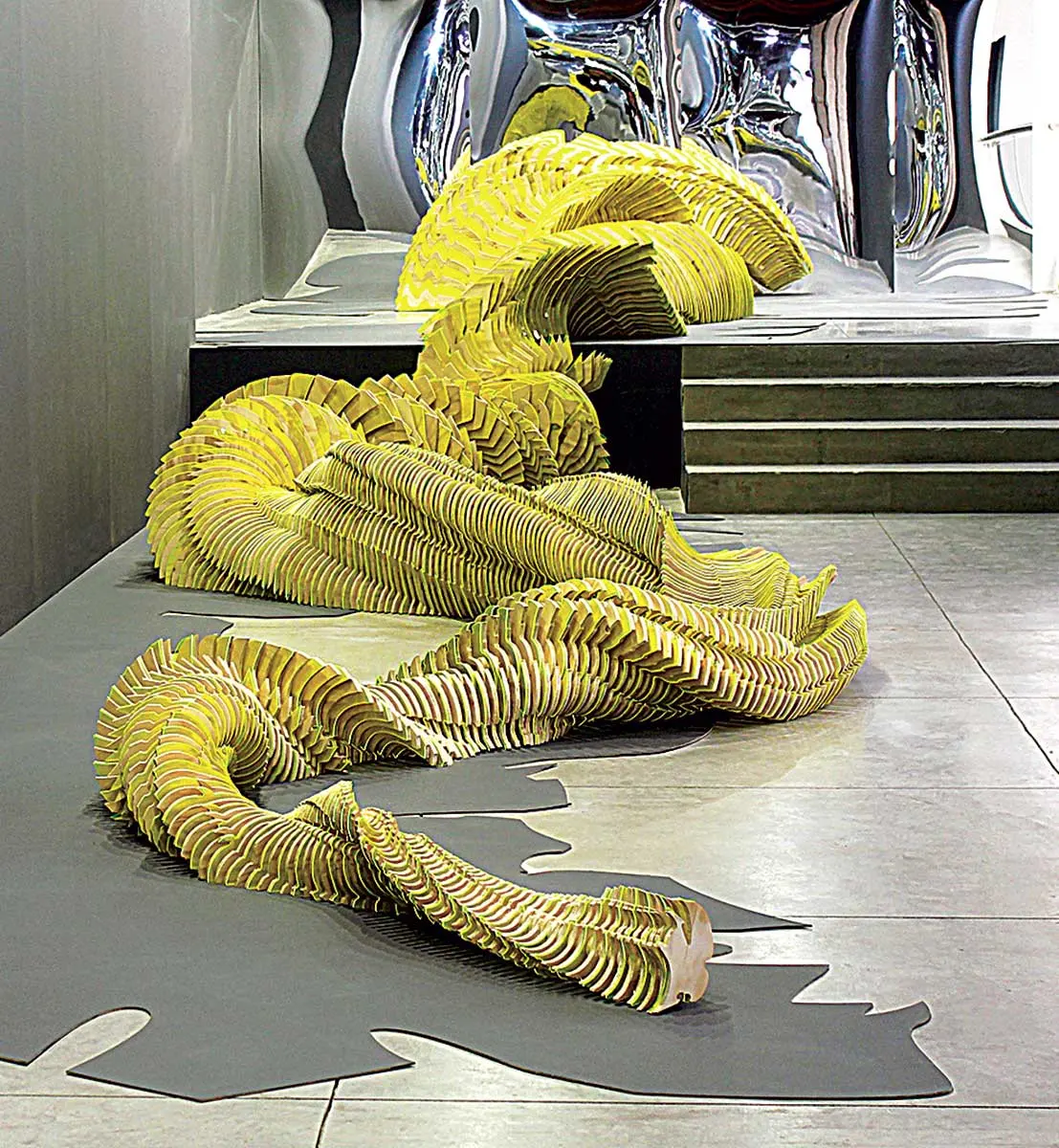
Most of the works are made on wood and acrylic, developing as physical progressions notable for their elegance and eloquence. The main work in the exhibition, 15 meters in length and arranged in a gallery with mirrors, was a demonstration of lucidity and formal daring, and it would have sufficed to justify the show. Yet Aune, an artist noted for her rigor, attention to detail, and focus on the final result, placed in space’s first level a series of models in scale, plans, and designs that not only “explained” the project, promoted by Universidad de Los Andes’ Design Department, but also allowed us to enjoy, extensively, Aune’s biotechnological botanical garden, loaded with allusions to Brazilian Modernism, science fiction, and certain forms of psychedelia that emerged not only from the exoticism of those post-vegetal forms but from the green acrylic material, which gave the exhibition, curated by Andrés García Larrota, a degree of freedom and voluptuousness.
The more than sixty architectural models on exhibit afforded us an in-depth view of the inventory of forms Aune has created over the past two years, and to penetrate, in scale, the world she is designing for the future. Aune’s versatile forms go beyond mere formal variation and came across as possible models for future constructions—towers, ducts, ships, housing units, granaries, greenhouses—; design objects; mechanical and/or medical prostheses; images of DNA chains; and even the skeletons of arthropods or crustaceans.
There is indeed something sinister and unsettling in this garden: the sensation of danger generated by these spiral-shaped structures and their sharp points, underscored by the artist with the inclusion of the carnivorous plants mentioned before alongside Ya-te-veo (I-see-you-now, 2012), a wood engraving of a story taken from a Nineteenth-Century scientific volume on flora and fauna, which asserted the existence of a giant meat-eating plant, the Ya-te-veo, that devoured people in what was then known as the United States of Colombia.
No less important, but more assuaging, was Alejandro Zuluaga’s and Pol Moreno’s sound intervention, which used the same resource of mutations of form and their temporal progression to create an acoustic curtain. What is interesting is that Zuluaga and Moreno chose for their intervention certain features, perhaps we can call them topographical, of the plants selected by Aune: Araceae, Areca, Heliconia, Bromelia, Monstera deliciosa.
As we follow the evolution of Aune’s career, we are constantly surprised by her versatility, her rigor, and her ability to change. Her most recent exhibition, Neoptiks, was comprised mainly of a hyper-realist modular painting, 12 meters long, depicting hybrid organic forms made using digital media. In Lapsus Tropicus, though, Aune brings the biomechanical creatures and the artificial constructions that previously appeared only in her canvases and screens, to a material, objectual terrain.
Signaling a way out of our often commonplace-ridden debates between nature and nurture, and of the tradition of political botany, it is to be hoped that the stimulating presence of such a bold exhibition helps the at times excessively uniform Bogotá scene bloom anew.
SANTIAGO RUEDA