
“This exhibition is like a whirlwind, it puts everything to spin and our reading of it is never linear; one can jump between works in any order and play with interpretation,” says Luis Roldán in conversation with the show’s curator, Alejandro Martín Maldonado.
Rompecabezas (Puzzle) is structured around a central axis that brings several fragments/works into its orbit. Two series set us on our journey through this exhibition: Eidola (Eidola, 2015) and Reflexiones (Reflections, 1989), as if to insist on beginnings and ends, placing them, at the start of life and death, face to face. Eidola is a series of three-dimensional paintings or painted sculptures, and it alludes directly, already from its title to the ghostly image of the dead; the sculptures are based on fragments of columns from old pieces of furniture, on which the artist has operated very precise cuts to make his paintings; here begins a visual puzzle where color zones cover portions of found wood pieces. The sculptures are arranged on a shelf that generates a line in space, which in turn is framed by the small-format paintings of the Reflexiones series, arranged on the wall. The miniatures dialog with Roldán’s more recent works, insisting on that whirlwind of creation where the beginning is inevitably connected to the end.
Roldán poses a question that is, in my view, fundamental, and which pivots for viewers an aesthetic experience coherent with the artist’s proposal: “How can the viewer fit two spaces in one?” The game is thus set, and right away as we traverse the exhibition space we are challenged to answer the question. There is a second fragment/work in this puzzle: Secreta prudencia (Secret Prudence, 2014). The pre-text is Antónov-Ovséyenko’s book The Time of Stalin, which tells the story of the persecution suffered by the artist’s father, a leader of the Russian Revolution. Inspired by his reading of the book, Roldán arranges a number of elements, such as a pair of glasses and a Soviet-style hat, on top of some books, and fills the space with a series of “writings” made with thread on the walls; he also includes a black surface on which he places cotton balls with lack stains, resembling eyes pulled from their sockets. The space is rather disquieting, and it suggests the tension characteristic of a dictatorial regime like Stalin’s, who crushed his opponents inside the Party. Forced labor, clandestine lives, persecutions, and massacres seem to dominate this subtle installation, which nevertheless avoids the pitfalls of a pamphleteering tone.
A third fragment/work is Sueños-Rotos (Broken-Dreams, 2005). Here, five paper structures arranged on the wall simulate images of crumbling buildings. The paper is breaking down into pieces as if peeling off; this surface is about to tumble to the ground. But the black thread the artist uses for his drawings has created a kind of jumble that prevents the fragments from falling. The result is truly beautiful; the highly organic lines on the white wall and the shadow projected onto the white wall, along with the pieces about to crash down, create a different vision. Dreams are broken, yes, but we nevertheless persist on patching them up and stitching them together. Perhaps this is the only way not to lose them forever.
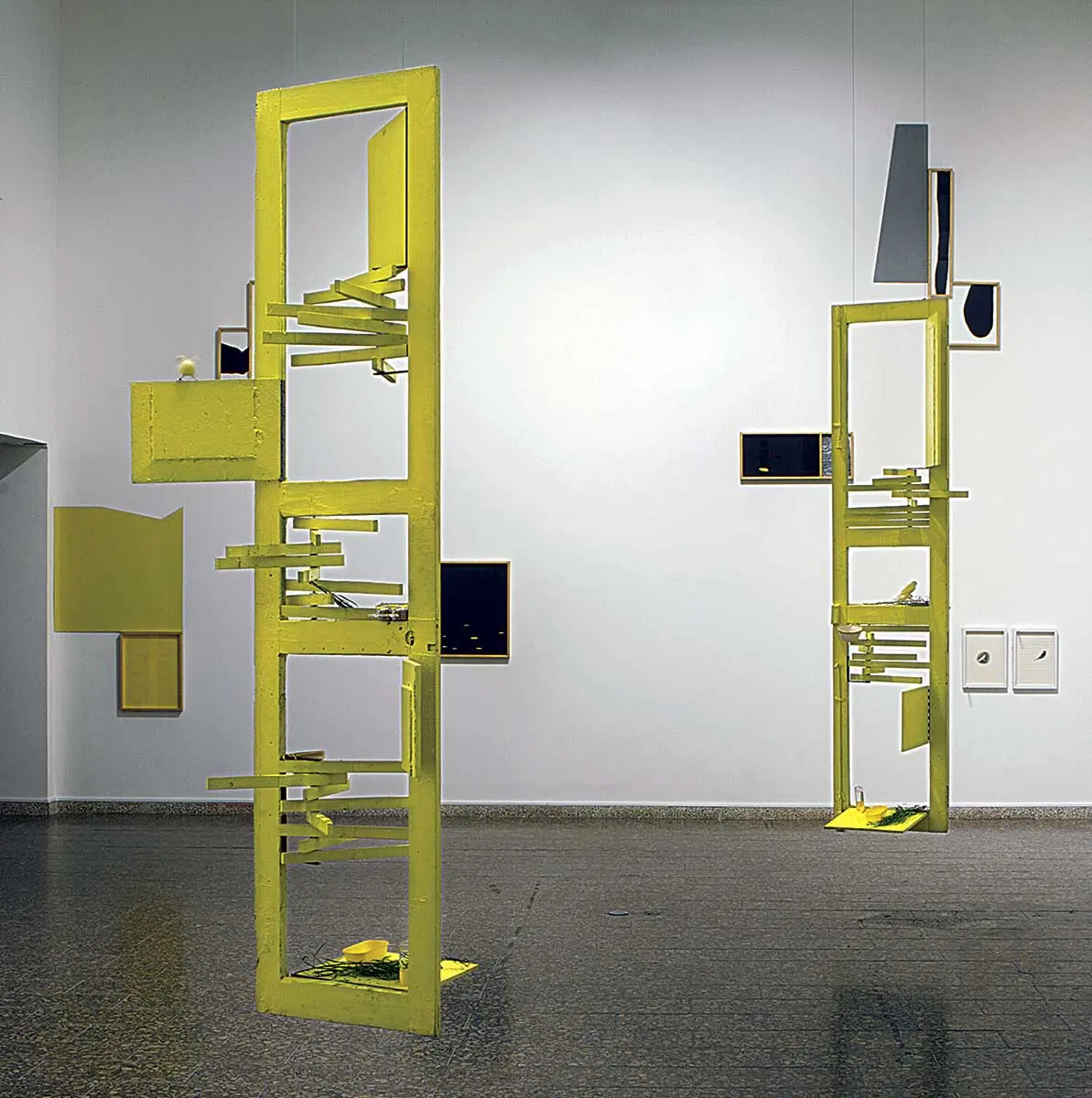
The fourth fragment/work, Circunstancias (Circumstances, 2009), is key: a series of “droplets” or pieces of paintings sticking out from the wall. The grey shadows on the wall make it possible to arrange other pieces of this large puzzle: a kind of painting-window, comprised of 25 smaller paintings that form a zoomed-in, black-and-white image of a Dutch town based on Vermeer’s A view of Delft. This series originates on yet another pretext, Marcel Proust’s In Search of Lost Time: we are reminded of Bergotte’s final moments gazing at Vermeer’s work, dominated by the yellow of a sun-drenched wall; this wall, which protects the church of Nieuwe Kerk—where William of Orange, killed in battle against the Spaniards, was buried—is what sets this fragment in motion: Bergotte says that he should have written his books in that way, with the intensity of that yellow hue, and Roldán seems to be telling us that he should have done just the same with every one of his own works. Suspended at the center of the gallery are a number of wood structures that were formerly part of old volets. These windows, now painted in yellow, retain some of their original structure but are subtly intervened to almost transform them into a tree. The sound of canaries inundating the room is broken by the flight of two of the birds, who look at us with curiosity as they fleet about. “The canary is like a thermometer to measure whether this is the art or not,” Roldán says in the end. I believe he has achieved a work of art filled with emotion and mastery.
RICARDO ARCOS-PALMA