
Entering the Museum of Contemporary Art (MOCA) Pacific Design Center in Los Angeles, the museum visitor will encounter a marvelously simple yet clever video entitled 1dm004 Eleuttherodactylus Coqui, (2004), by the artist Magdalena Fernandez. The enigmatic and formal sounding title of the work obscures its animated playfulness. The black and white video depicts a rectangle whose lines take on a life of their own as they fold in on themselves and move in response to the sound of coqui frogs, a creature commonly found in the Caribbean and in Caracas, where Fernandez lives and works. The lines of the rectangle appear to be dancing to the different frequencies emitted by the frogs. Incorporating the technology of an equalizer, the lines composing the rectangle visualize the coordinated and sometimes haphazard sound of the frog’s whistles, morphing at times into triangles and other indistinct forms in a whimsical call and response. Part of the Mobile Drawing series (Dibujos móviles), 1dm004 is captivating, inviting the viewer on a journey where the order of geometries will become temporally suspended.
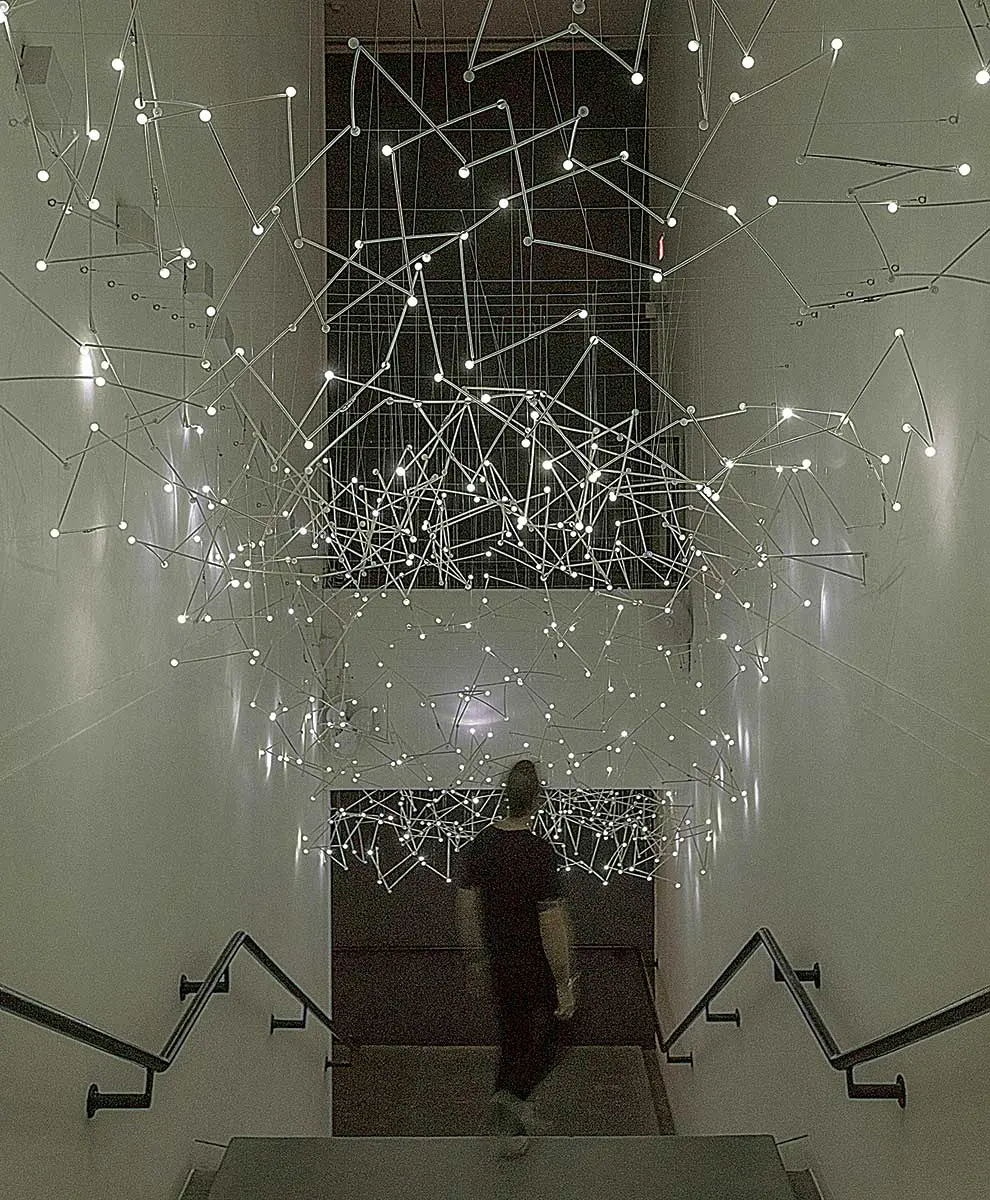
Magdalena Fernandez is not a name that an American audience might immediately recognize, but it is clear from this exhibition, that it should be, alongside her more well-known predecessors, the Venezuelan artists, Jésus Rafael Soto, Alejandro Otero, and Gego (Gertrud Louise Goldschmidt). Organized by Alma Ruiz, a former curator at MOCA Los Angeles, the exhibit is billed as the first major showing of the artist’s work in the United States. The small sample included in the show does not do justice to the depth of the artist’s material investigation during a mature career spanning more than two decades. This is unfortunate and it is obvious that the artist deserved a much more expansive exhibition in order to familiarize audiences with her unique and extensive exploration of geometry, light, sound, and perception. What is on display is limited to six projected videos and one light installation, 2i015 Luciérnaga (2015), created for this exhibit and located above the staircase leading up to the second floor. Together the works convey the main focal points of inquiry in the artist’s oeuvre. It is clear that occupying space with works whose geometry manipulates optical perception is a core concern. She is often discussed as carrying on the legacy of her Venezuelan Kinetic art forbearers. Soto (1923-2005)—whose popular Penetrable (2000) is on display at the Los Angeles County Museum just blocks away—in particular, is often invoked, as is Gego, whose exploration of the line in complex spatial installations, was no doubt an influence. Fernandez does not shy away from acknowledging the importance of her predecessors, and many of her works are in homage to those artists, whose name she signals in the title of the works. For example, in the video 1pmS011 (2011), also included in this exhibit, the S stands for Soto; the seemingly random permutations of numbers and letters of the artist’s titles belie their clarity and logical sequence; in this case, the 1 stands for the order in which this work was made during that particular year, followed by lowercase letters which stand for the series the work is part of, in this case, Pintura móvil (mobile painting), the uppercase letter, when there is one, for the artist paid tribute to, and finally the last 3 numbers which represent the year the work was made in.
On the second floor, the video, 1pm006 Ara Ararauna (2006), also from the Pintura móvil (mobile painting) series livens up the room. The projection shows a grid, divided into blue, yellow, and green quadrants, which begin to move and push against the solid black lines defining the grid. It appears at first that the movement is erratic until the realization that the movement is in response to the squawks of the blue and yellow macaw (Ara ararauna), a parrot from the tropics of South America known for its ability to speak. Like in 1dm004 Eleuttherodactylus Coqui, the solidity of geometric shapes gives way to the more entropic energy of organic beings. In both, the order of the grid is pushed at and strained by the essential disorder of natural life. In this back and forth there is a renewed harmony, which does not champion the purity and stability of geometric abstraction, but rather a constant negotiation of the organic. It is hard to tell if Fernandez is commenting on life as an artist in Venezuela and it is not a theme I have seen addressed in writing about her. What is clear is that her structures, whether in her installations or through her digital projections, address the mobility of the natural order and its destabilizing but also enlivening effect on geometric order. The result, at least in the brief glimpse of the works on view, is mesmerizing. Unfortunately, no catalog and very little explanatory text accompany the works. The artist’s website, http://www.magdalenafernandez.com, fills in some of the gaps.
ELENA SHTROMBERG