
Manuela Viera-Gallo was born in 1977 in Rome during the exile of her parents. At eight she moved to Chile, the country that she had left before birth because of the Pinochet dictatorship. In 2005, she moved to New York where she currently resides. Viera-Gallo has made her experience as a migrant and her journeys the central theme of her work, as she intelligently combines themes such as memory and authoritarian regimes, power relations, and the relationship between utopia and dystopia that operate in the geopolitical and cultural borders of modern nation-states.
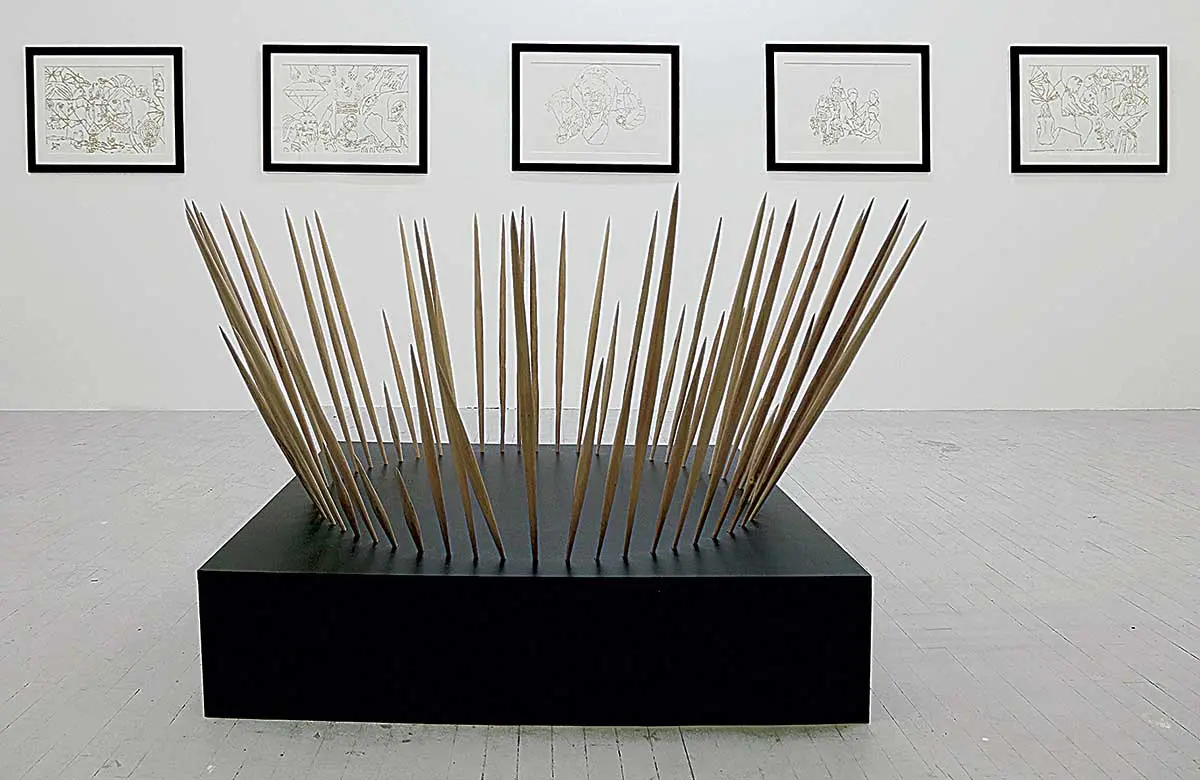
During the month of July at the new and bright space of Y Gallery located on Grand Street in New York City, Viera-Gallo exhibited Jauja, named after a mythological country in which wealth and pleasure abound. The second solo exhibition by Gallo in this gallery, Jauja consists of six medium drawings made from sawdust, a large mural installed in the back of the gallery also made from sawdust, a figurative painting, and three sculptures—a year before Viera-Gallo presented at the Biennial of the Frontiers the first version of Jauja and received the First Acquisition Prize from the jury—created with stakes and wooden bases. Viera-Gallo’s Jauja exists through multiple sensations emanating from the desire to travel and migrate.
According to the legend, Jauja was “discovered” and then “invented” in 1533 by Hernando Pizarro, when the Spanish conquistador arrived at the region of Hatun-Xauxas in the Inca Empire. Amazed by its rivers of wine and milk, by the flow that crosses its beautiful and exquisite mountains, Pizarro thought that the abundant wealth in Jauja was necessary for the Spanish people that migrated to the Americas in search of dazzling waterfalls under an always blue sky. Thus, English words like change, future, and borders are inscribed in the sawdust drawings created by Viera-Gallo. They are tattooed, like in the work La Emigrante (The Emigrant), on the face of an indigenous woman that vehemently smiles.
But it is not about impregnating the conqueror’s desire in the face of the conquered. On the contrary, the gaze in La Emigrante is very much like her exalted smile: an exacerbation that appears to be eternal when fixed in the sawdust drawing as naive representation. Is it a mask? Maybe. Perhaps the stereotypes about migrants are nothing but masks. “But those who emigrate also remember,” wrote Viera-Gallo on the large mural installed on the wall in the back of the gallery. “I have never stopped thinking about Chile.” In this manner, the mountain range drawn by the artist on the mural could be the Andes, and if it were, then multiple stories of its historical and cultural imaginary could be read: crossing the Andes, leaving Chile, thinking about a country through as the anti-poet Nicanor Parra has insisted on several occasions. But, could the mural be describing another mountain range at the same time? Jauja? A country that is no longer mythology but that has become the desire of the artist to travel but also to return?
The very eloquent visual narrative that Viera-Gallo proposes does not attempt to compare the myth of Jauja with obvious references to the American dream, as could be interpreted at first glance, nor does it fuse the desires of the conqueror with that of the conquered. By considering the face in La Emigrante as well as the faces of the subjects in Cronograma I, II y II (Chronogram I, II and III) as masks, and that the subjects of Cronograma IV (Chronogram IV) are faceless and only their outlines are rendered, the exhibition—like the concept of ambivalence proposed by Homi Bhabha—has more to do with the constant opposition between the perceptions and dimensions of culture. Because of the masks and contours, on the one hand, and because of the mountain range that alludes to other possible mountain ranges, on the other, the migrant subject resists classification, being categorized as one who only wants what the dominant culture can offer him/her. In this manner, Viera-Gallo shows the stereotypes that surveillance systems have designed for the control of customs, without ever stop remembering and reliving the uprooting.
Upon entering the gallery, visitors are met by a large sculpture that immediately interrupts the utopia of Jauja. Titled Catching Dreams, the sculpture is displayed in the center of the space. It features a black square base from which half a hundred stakes emerged, forming a circle that points outwards. Alluding through its shape to a rather heavy object that is imposed as threatening and uncomfortable, the stakes do not try to conceal its dystopian nature. Here there are no masks that hide the cruelty, and not even the title Catching Dreams can mask the intention. Thus, such an uncomfortable moment emanates from the center of the gallery towards the spectators, just as it occurred during the inauguration of the exhibition. Getting close or staying away from the sharp tips of the stakes, a dilemma that perhaps also inhabits the minds of those migrants who want to remember to then depart, once again.
FLORENCIA SAN MARTIN