
The Fundación Amalia Lacroze de Fortabat presented the exhibition titled Marcelo Pombo. An Artist of the People, a striking and moving retrospective exhibition curated by Inés Katzenstein. With an emphasis on the museography, the exhibition was divided into seven parts according to the different artistic languages that Pombo incorporated throughout his career.
The title of the exhibition already suggests the redeeming nature of the curatorial discourse to follow, which favors placing the work by Pombo (Buenos Aires, 1959) outside the box in which some art produced during the nineties in Buenos Aires was confined and deemed “light” or “rosy” to differentiate it from the politically committed art of his time. The exhibition discretely includes, almost surreptitiously, several works by other artists that shared Pombo’s interests. The place that brought this group together was the Centro Cultural Rojas, a place of reference for the art of that period.
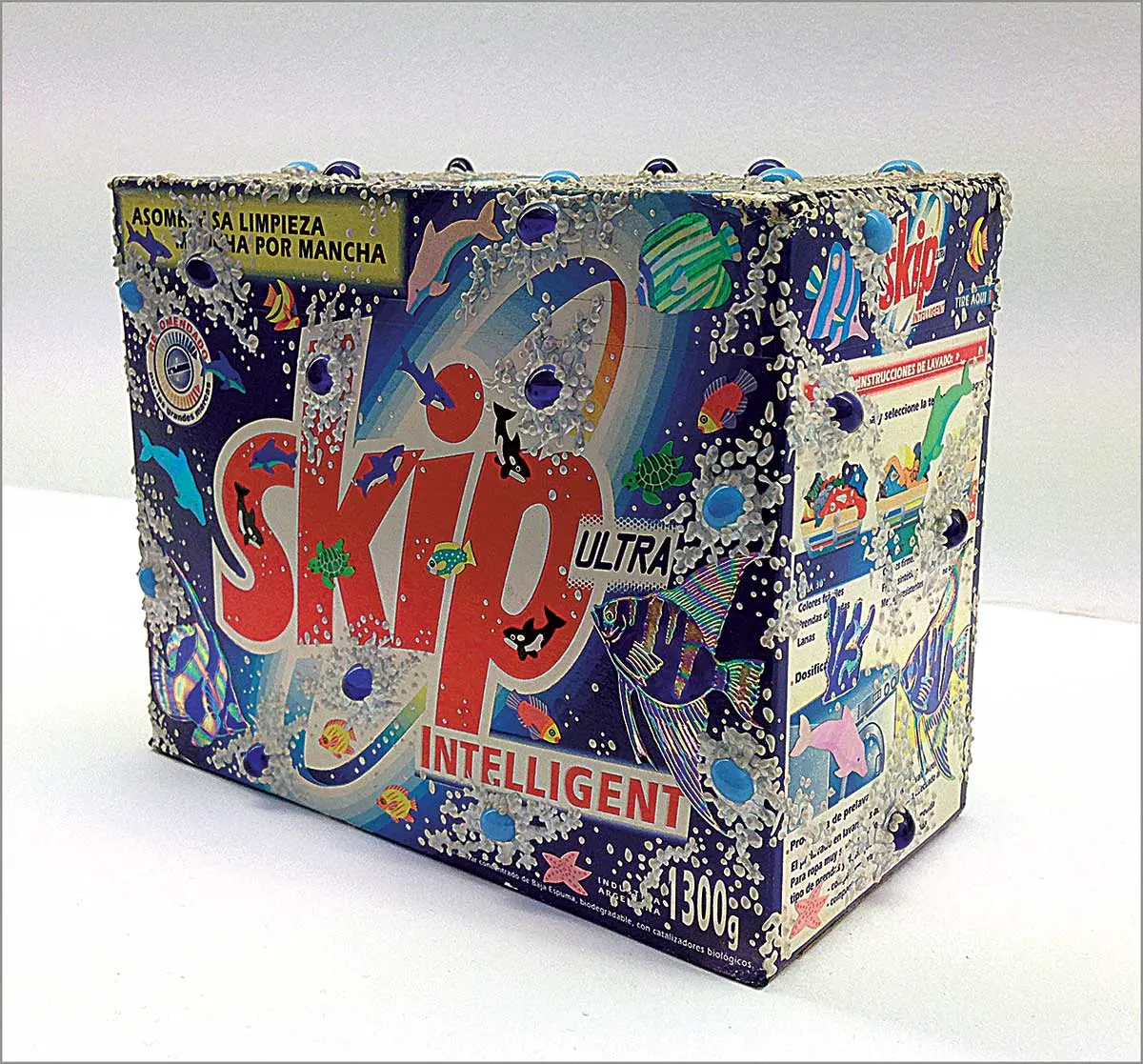
The condition of Pombo’s life has been intimately connected to the way in which he has established a relationship with creation and with art. Economic hardships and the silence that he kept for some time about being gay made need the driving force that led him to the art world. Need, that “irresistible impulse that makes causes to be molded in a certain way” became for Pombo that state which Deleuze placed above every other condition when defining the creative act.
In the text of the thorough book-catalog published for the exhibition, the critic Claudio Iglesias rescues one of the most important ideas expressed by Pombo in connection to his artistic production: namely, the motto of “the square meter”, which proposes that “everything interesting for Pombo is reduced to whatever is closest to him, within an area of one square meter in which he is the central point.” And within that square meter is the popular stamp, the poor materials in San Francisco Solano, where he worked as a special teacher, an environment with plastic mantels table covers, paper garlands, and ribbon bows.
Pombo affirms that his micropolitical practices were intended to move away from political art. In his own words, art is a luxury, an instant way of achieving luxury through the power of decoration. “The world has to be decorated,” he told the audience during a guided tour of the exhibition organized by the Foundation days before the closing of the show. Thus, he favors experience over ideas, which to him must be exercised by demonstrating devotion to the objects. Under these conditions, a special ornamentation practice emerges that does not work as aggregate or as something that has been added to make the proposal a more colorful or desirable thing. Instead, ornamentation becomes an act of veneration. And that willingness to act on the object, the energy it transmits, turns the aggregate into nourishment for the chosen object, fusses the object without diluting it, without erasing its origin, exposing it in full force to celebrate it. Beauty seems to come from a masterful use of common sense, the “ability to navigate practical life” as Henri Bergson defined it, is manifested as cause and effect of the most genuine need to create. Pombo seems to come to the realization of the spirit in matter, that just correspondence that Hegel attributed only to Greek classical art.
Special mention should be given to his project MAAR (Museo Argentino de Arte Regional), a virtual museum developed between 2012 and 2014. According to Pombo, the project focused “on the artists of the past who were excluded from the modernist canon.” What attracted him most was the way that some Argentine artists translated the canon and even showed some incompetence in the process. Cándido López and Prilidiano Pueyrredón were the most compelling artists in that regard. According to Pombo, “Ninety percent of the images I uploaded on this virtual museum were sincere tributes to artists who I always liked or photos of works that pleased me by artists who I did not know.”
In front of the audience, after ending the guided tour through the exhibition, Marcelo Pombo describes himself as “a bad provincial artist,” and the audience laughs at the comment. He remains serious, giving the impression that his reflection came from an honest place.
VIVIANA SAAVEDRA