
Matilde Marín presented her most recent works in the exhibition titled Indeterminate Landscapes at the Galería Del Infinito. It consists of a series of photographs that continue work that she began in the mid-nineties, with her famous series Horizontal Landscapes and Inverted Landscapes, in which she explored the possibilities of photographic language from shots taken in open spaces in different parts of South America.
In this new series, Marín expands her horizons to Vietnam, where she captured the rocks of Ha Long Bay, a place declared World Heritage Site by UNESCO. But this experience was quickly permeated by memories of the Argentinean countryside. The large photographs on display in the gallery show the Asiatic rocks blending with the Patagonian steppe and under the bright sky of the Salinas Grandes in Jujuy.
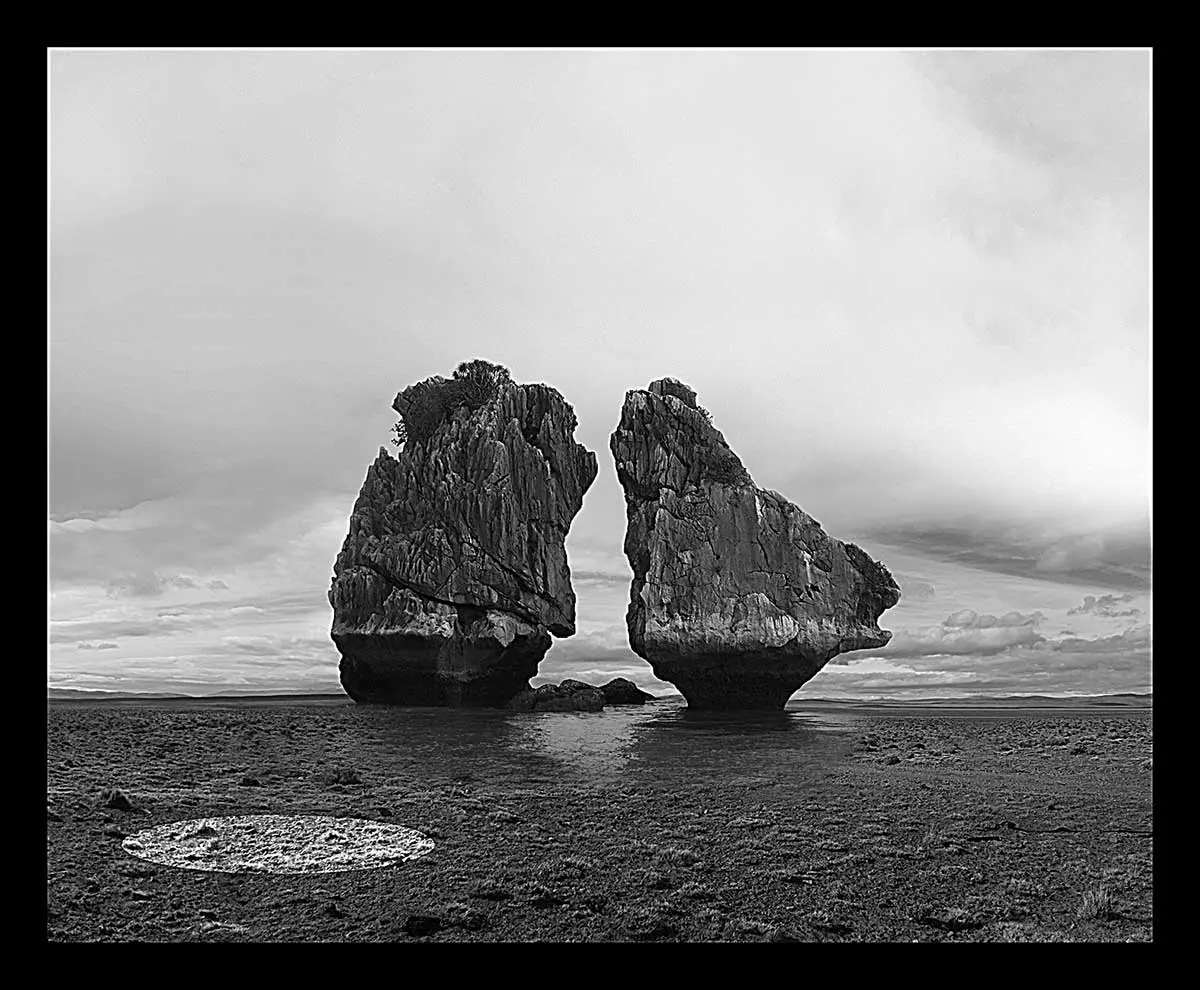
These different analog records were intervened and transformed through painstaking digital work. The high degree of skill involved in the resolution of the images and the subtle manner in which they were rendered resulted in completely new landscapes. These appear so real that viewers cannot tell that they are not and simply assume that they are looking at a place for the first time. The question of their origin, the timelessness of the images, and the limited geographical references offered, envelope these landscapes in a veil of mystery.
On the other hand, the enigma of these indeterminate landscapes is enhanced when exhibited next to small photographs of real landscapes. This contrast suggests a game between the natural and the artificial; a confrontation that is hidden because the adulterated landscape is presented as real and hides its artificial nature.
The definition of landscape allows for two windows of meaning: as an extension of terrain seen from a site and as an image that represents a certain section of land. Marín’s landscapes are unknown and known at once; created by an agglomeration of experiences and memories by the artist, they make up an image that crosses both meanings and propose a new one: an image representing different geographical areas captured at different times.
Displayed in the second exhibition room of the gallery, next to Paisajes Indeterminados (Indeterminable Landscapes), is the work titled El Viaje Imaginario de Kazimir Malevich (The Imaginary Journey of Kazimir Malevich). It consists of a series of sixteen analog photographs, taken by Marín over several trips and tours of various cities, which have been digitally altered with geometric figures. In Varsovia (Warsaw), we observe a winter scene in the Polish capital, with a group of residential buildings—built during the communist era—covered by a layer of snow that was intervened with a white ellipse. These suprematist forms in the urban landscape establish a dialogue with the rest of the composition, where five black lines create an elegant dynamism that harmoniously confronts the geometric abstraction and the photographic record.
Marín does not solely explore exterior landscapes but also approaches interior architectural spaces. In Santiago de Compostela, she reiterates the same type of intervention in the photograph of a video room inside the Centro Gallego de Arte Contemporáneo in Santiago de Compostela. Again she resorts to the circle but this time in black, which appears to be projected onto the screen of a computer. At the bottom of the composition, out of the picture, the artist enjoys the beauty of geometric compositions through three black rectangles that interact with three desks in the image.
True to her training, the composition of these works refer to Marín’s experience with engraving. She began her professional career in the graphic language but always sought to erase the boundaries of each discipline. She has been awarded important recognitions like the Grand Prize of Honour at the National Salon of Engraving (1985) and became known for works like Mitos de Creación (Myths of Creation, 1993) and Tierra Prometida (Promised Land, 1997), among others. In the late nineties, she incorporated photography and video in her explorations, as she continued to stand out for the production quality of her works.
El Viaje Imaginario de Kazimir Malevich (The Imaginary Journey of Kazimir Malevich) is also the title of the book created by Matilde Marín and José Emilio Burrucúa. The volume reproduces the complete works of that series and includes an engaging essay by Burrucúa based on Marín’s motivation behind that work: a complicated trip taken by the Russian artist through Europe and Russia before his birth; based on the exploration of suprematist forms.
AYELÉN VÁZQUEZ