
It would be reasonable to think that a person would first try to “see” when that person is in the middle of a forest. We believe that we must see everything as fast and as clearly as possible in order to be safe precisely from that which we all feel, smell, sweat, and imagine that surrounds every single millimeter of the strange beings that we are, in order to prevent that our green-permanence turns into an alien presence that walks as if without sight. Still, when the fear of blindness, of the unknown, of a noisy and saturated environment, begins to slimily become a sort of deadly, dense and enveloping respiratory infatuation that penetrates every one of our pores; then something must definitely be happening in Fordlandia (2014), the most recent video work by Melanie Smith, presented for the first time in Mexico City at the Galería Lulu.
A narrow corridor, a chair in the middle of plants, and, in the back, the beginning of a narrow and neglected metal ladder—which could be construed as the promise of a more spacious and freer-flowing visual experience—are forgotten when we go through a door to the right. We are in Lulu, a non-pretentious gallery on a budget that has managed to offer two exhibition rooms (the rooms of a small house in the Colonia Roma Sur neighborhood). It is one of the exhibition spaces in Mexico City that offers some of the more “refreshing” aesthetic and critical proposals and that, most importantly, has a lot of potentials (in every sense).
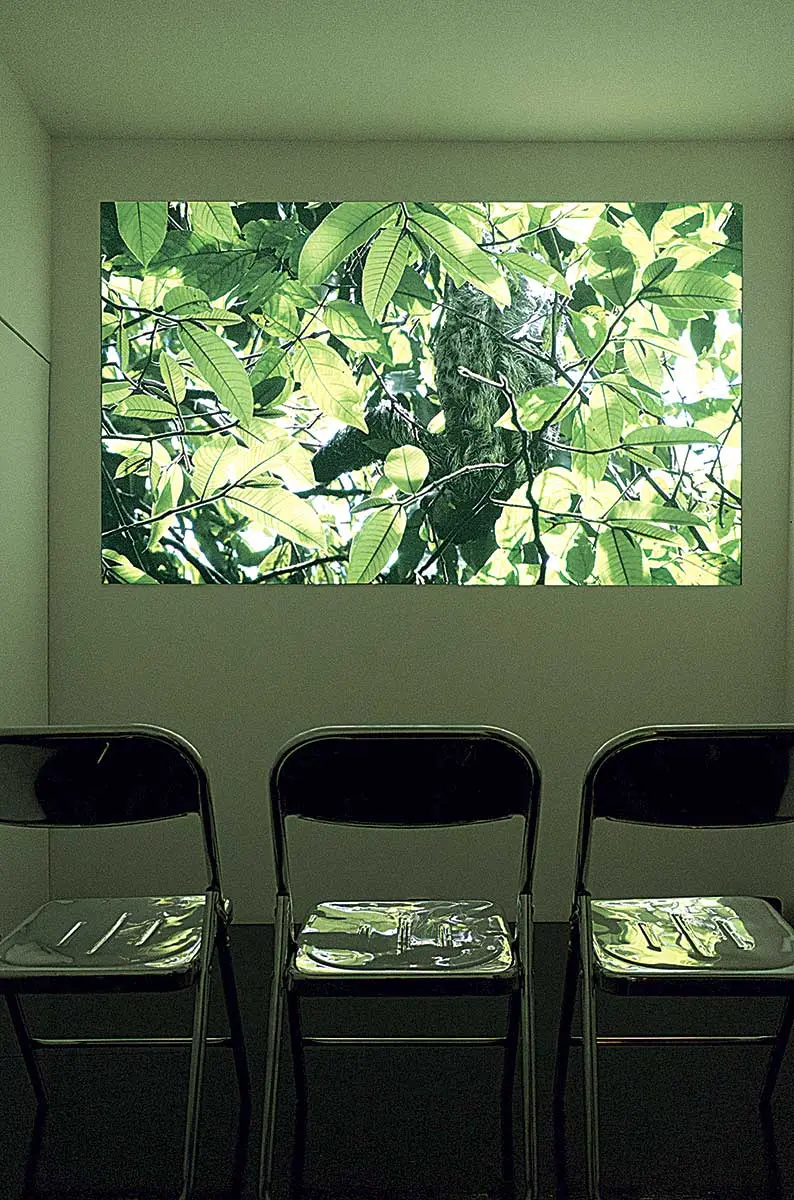
The narrowness of the gallery’s usually unpopulated hallway became saturated with the presence of visitors during a hot September morning. The wait in the corridor turned into an unexpected, and yet ideal, a preamble to the delicate observation time that Melanie Smith’s work requires. In an exhibition room that made us hesitant because we were not able to see—as we were twice blinded, first by the sun and then by the corridor-anteroom that, without being planned, placed everything and everyone within reach—our pupils gradually adjusted as our hearing sharpened to allow us to regain our visual sense.
So the images began to come into focus: the belly of a man asleep, an intensely orange fabric, and the texture of a woman’s decorated nails. Melanie Smith began to bring us really close to her work, to the point of almost touching and smelling it. The unbridled sensuality of the context in which Smith brought us this time—like, in earlier works, viewers become her passengers—appeared to be unavoidably absorbing and exuding as the video gradually began to expose it amid the bodies of persons, animals, and plants.
Suddenly, a voice in Portuguese confirmed the coordinates of the point—that we now understand we were flying over—where we had to descend to get on a boat that would take us to Fordlandia—that sort of inconvenient dream that leads nowhere and whose origins we come to find. The hungry and anxious gaze—evident in the excerpts from online missives by José Luis Barrios that are part of the book accompanying the video—reveals those most intimate motivations that elude language as Smith chases another builder of almost-possible worlds (Xilitla comes to mind) that awaits from its latitudes, trying to see his own silence.
It is impossible not to notice that the imaginary in ruins that attracted Smith—Fordlandia—opens to the gaze from the floor only so the body understands that survival in the jungle (and in the work?) depends on the sense that we instinctively tried to “clarify” from the moment we entered the exhibition room: hearing. Seeing, in this case, depending on our ability to listen.
It would seem asymptotic to describe a video from the listening body (Jean-Luc Nancy)—considering that in recent years Smith’s work has been based precisely in that visual medium, in which she navigates a fine line between damage and care—but it is essential to say that in Fordlandia hearing is the active agent; a stroke of unexpected and invisible life.
It was vitality in the wait. And I had been waiting—like Fordlandia, like the shells of dead bugs and huge machinery ill-embraced by the deaf glass—to be (re)discovered among textures, times, and shadows that Smith knows how to seek and wait for.
We began to listen to that which we saw. And that which we began to see revealed its absurdity; the sound body that the artist managed to capture for this work fully agreed with the analysis pursued. It was a type of visuality as overwhelming as it was laughable in its muted, wise, and apparently motionless condition. It was the embodiment of the futile and ancient battle against nature that to mankind is not solely possible but must be faced and overcome.
The video aptly sampled precisely and clean micro/macro replications in a perfectly tragic example of the eternal and unwinnable uphill battle of modernity: Fordlandia. That twice exposed condition that occurred before bodies-viewers allowed us to understand with serene lucidity the how and why Smith enamors planes in boundless and precise distances, seen from the sky or floated across the horizon. On a small boat on the Tapajós River at night, Smith attempted to listen-record the slightest sound coming from the jaws of an alligator: anticipating imagined dangers, she saw very little but listened to a lot. The artist traveled to see what her ears (and therefore her understanding and expressiveness) would have otherwise not been able to perceive. Smith filmed the dreadful quiet of Amazonian life.
It is life rich in naked sounds that alert, harbor, bring closer; that robust cosmos that is impossible to be guessed or at least be interesting if it does not translate into financial gains for its owner, Henry Ford, the richest person in the world for over half of the twentieth century; conqueror of the capitalist market, mass production, and massive consumption through the countless sales of his famous “ Model T.”
In 1928, Ford negotiated the control and exploitation of a substantial extension of the Amazonian forest to extract rubber, the only material involved in the construction of his cars that he did not own or control. (Ford bought the rubber to created latex from British colonialist importers, who produced it in Southeast Asia in a process that claimed the lives of many people). But Ford always wanted more and listened only to himself. The cultivation of a lucrative plantation of seringueiros (rubber trees) would be a task as easy as any of his many multimillion companies that produced each of the supplies that he required for his huge production plant on the banks of the river in Michigan.
Time and time again Ford attempted the systematic clearing of large tracts of forest to plant and produce rubber trees in large quantities and in the shortest amount of time possible, in a binary operation that he applied to his life in a comprehensive and relentless manner. He failed each time; he planted the trees too close to each other, he did not know how to overcome pests whose voracity was even greater than his own. But Ford refused to listen to scientific botanical advice from local experts. In 1945 the grandson of Henry Ford ended the catastrophic waste of one billion dollars without ever having used a single drop of rubber from the Amazon in a Ford tire.
To build the announced destruction of Fordlandia, Henry Ford refused to listen to the Amazon. To observe the dilapidated Fordlandia, Melanie Smith knew how to listen to that which is intangible and that Amazonian time devours.
MARCELA QUIROZ