
Miguel Chevalier (Born in Mexico in 1959; lives and works in Paris) has been using information technology as a means of expression and experimentation to build an imaginary virtual media since 1978. His persistence in the practice and the nature of his expressions of it gave him considerable renown in the international scene.
His studies at the École Nationale supérieur des Beaux-Arts in Paris, of decorative arts in Paris-Saint Charles, and of Art and Archaeology at the Sorbonne all speak of a pluralistic education and make it possible for him to express himself in a wide variety of techniques and to handle a broad range of subjects.
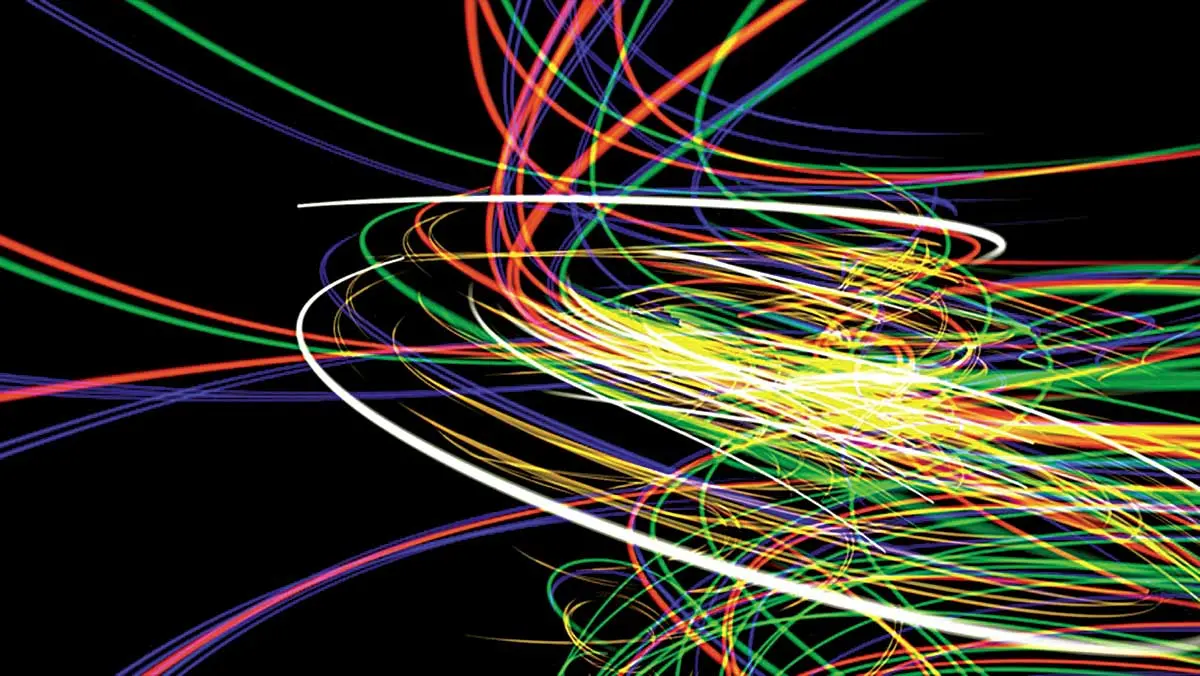
Vortex, a term understood as the rapid flow of certain elements, can be applied in this case to the unnameable spirals and their variations that comprise the selection. Never previously seen, Vortex 1 is a digital generative work presented on a vertical LCD screen. A series of fluid lines appear and intertwine following a multitude of random pathways in a kind of sea-tide. The visitor’s gaze follows the intensely colored light drawings as they branch out. Besides the video, the reproduced and printed pieces are calculated on the basis of their color distribution, shape, and variety. In the exhibition, Chevalier presents a series of objects in space and reliefs in a computer-assisted modeling technique. Most of them, conceived as unique stand-alone works, bear witness to his methodical, thoughtful persistence. How far can the subtleness of technique take us today? This is a question that observers can pose in the face of a body of work of such eclecticism in its manifestation, yet of such rigor in its production. Although the artist has always worked at the intersection of the living and the stylized, his subject matter has undergone a considerable evolution in recent years. The hybridization between the geometric and the organic is relatively new in Chevalier’s oeuvre. There is an encounter not only with the progress of technology itself and the accessibility of knowledge but also with new programming models. The profusion of styles belongs also in a global conception produced by the widespread availability of scientific knowledge and enhanced by the access to information enabled by the Internet.
Some of the works on exhibit—all made this year—are Flux (vertical), a Diasec digital print, a Tornado hologram, and others that allude to the title of the show, such as Double Vortex (red and fluorescent orange), a 3-D printed resin, 90 x 45 cm.
The selection is harmonious but it also contains a certain ambiguity in connection to the perception of the materials themselves. Unadvised viewers might not understand the aesthetic proposal in this state, given its spontaneous newness, but they will still partake in the driving force of the passage.
Be it his projections, monumental works, and murals, a large portion of Chevalier’s creations belong in the sphere of public events. His works, comprised of different, multicolor graphic frames, allude not only to the realm of numbers but also to architecture. Sur-Natures, Fractal Flowers, and Seconde Nature can be regrouped into Autres Natures (Other Natures); they all have as their starting point the observation of plant life and its transposition to the virtual world.
To the symbolic representation of the binary code of programming, related to a graphic symbol, the artist adds references to the work of kinetic-art and Op-Art artists. Viewers’ perceptions are unsettled and deformed as they move through the exhibit. Chevalier is considered a precursor of virtual art.
Miguel Chevalier produced important interactive installations such as Pixels Wave (2015, Singapore); El Origen del Mundo (The Origin of the World, 2013, Mexico City); Origin of the Curve (2014); Power Pixels, at the Carrières de Lumières (Les Baux-de-Provence, France), which occupied 7,000 square meters; Terra Incognita, (2010, Museu de Imagem e do Som, São Paulo); Oro negro (1996, Museo de Arte Alvar y Carmen T. de Carrillo Gil, Mexico), among others.
SUSANA SULIC