
Pablo Mora’s 22 de octubre (October 22, 2013) is an investigation and creation project where sets of legal documents were transformed into aesthetic objects, giving rise to many lines of interrogation and critique. The proposal emerged from personal experience: the artist’s father was killed on the date of the title; a renowned jurist and academic, he became, in his son’s words, “just another resident among the many who crowd and jumble together in the judiciary’s offices.” In basing his creative proposal on the archives left behind in his father’s office, Mora’s intention was, from the start, to reactivate the debate about a recurring event in Colombia: the abandonment before the conclusion of many judicial causes, which consigns the possibility of justice to oblivion.
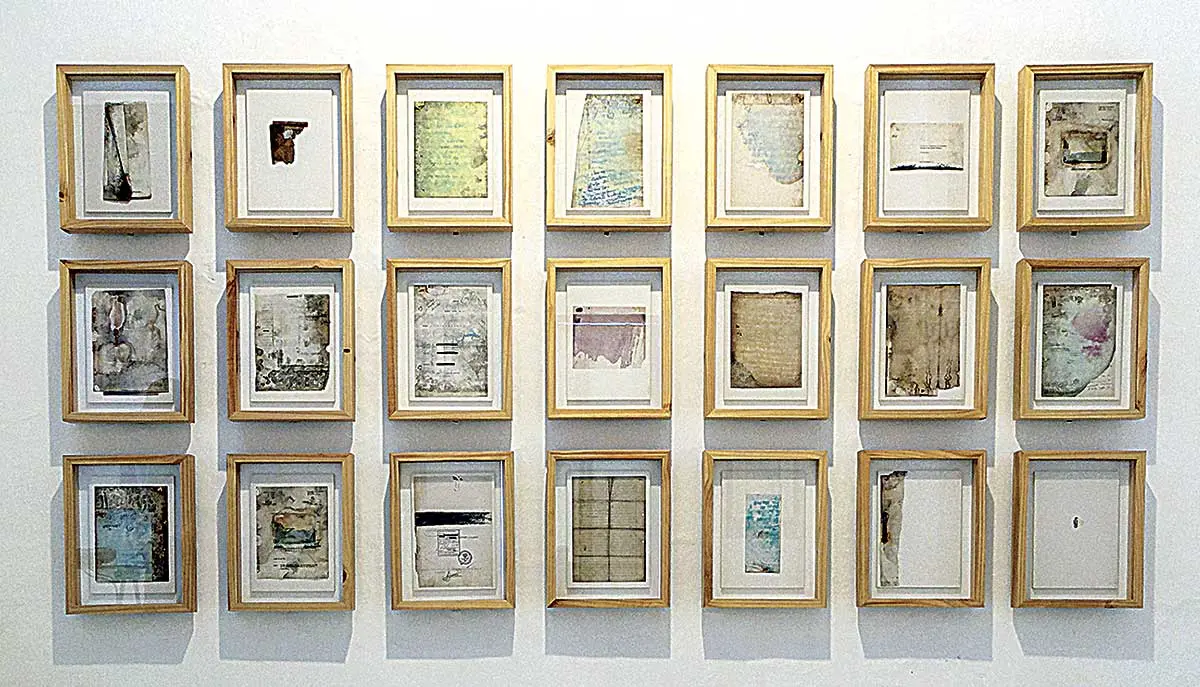
Mora’s process is founded on the painstaking observation and selection of raw materials, and it is important to remember here his fascination with the act of contemplation: as he has admitted, it was this obsessive interest that drove him to philosophy and the arts in the first place. For him, deciding which files to include in 22 de octubre was no easy task; the weight of his personal history was ever-present, and gaining any distance from it was a constant challenge. Each choice required projecting the way in which the object’s symbolic density was to become an art. After this curatorial task was completed, the artist intervened in the documents indirectly in collaboration with professional biologists and restorers. Mora defines these interventions as “an acceleration of decay.” 22 de octubre cannot be understood as a finished project; its physical and conceptual essence is pure openness, and its dramatic force cannot be brought to a closure. Once the works are arranged in a given space, their multifariousness breathes.
Mora’s installation Gabinete (Cabinet, 2013) presents us with a desk overtaken by files and documents, a strategy deployed by the artist to make the object’s use impossible and, more importantly, to give concrete shape to the complexity and incompetence of Colombia’s judicial system. It is one of the project’s most powerful images. The theatricality of the cabinet undergirds the meaning of the whole set. The aesthetic objects in 22 de octubre always act in collusion, with their final arrangement for exhibition as a deciding factor. The series presented at La Balsa, in interplay with Gabinete and Abandono (Abandonment), were titled Cubiertas (Covers), Folios (Files), and Papeles (Papers). Abandono is a video installation where a bundle of files is “reanimated” by the effect of a lamp shining directly on it. The piece condenses a certain melancholy intimacy, reinforced by the motion of the smoke registered in the video: a struggle between the living and the dead elements of materiality itself. The image that accompanies this review is from the Papeles series: pages taken from court files to illustrate the fading of their content. The way in which Mora displays them reveals their materiality—the palimpsest-like effect produced by their long consignment to the archive—in great detail. In some cases, the artist has made a few light interventions in order to emphasize shapes or to render texts (or images) legible.
Mora’s central concerns were already in evidence in his previous project, Construcciones oscuras (Dark Constructions, 2011), where the painting was the language of his discourse: a critical reflection on memory; the challenge of making an untraceable time visible; the use of veiling and erasure techniques (and the visual metaphors contained therein); and the establishment of a visual territory from where historical awareness may emerge.
“Construcciones oscuras is an escape, paintings that illustrate darkened environments, an empty space, drama clashing with a kind of calm. These are, in many ways, images of escape after the havoc wrought by my father’s death. Their pictorial materiality is a definitive precursor to the technical and conceptual ideas behind 22 de octubre”.
Pablo Mora brings an archive back to life. He does this by transforming it into something else: “This is a beautiful and harrowing process. Something that seemed legible in the original documents is corrupted. I make it blurry and situate it in a nonexistent space-time.” Mora uses the forms and discourses of an archive that contains the life histories and memories, both collective and individual, of an entire geographical space. Each work disassembles the meaning of the original documents, forcefully displaces the judicial text’s official narrative, erases forgotten contents at random, and leaves individual lives in suspension. Mora unseats these documents from their status as truth, and with his experimental techniques fosters the emergence of another memory.
ÉRIKA MARTÍNEZ CUERVO