
The intersection between art and analyzing the human mind undoubtedly brings forth a very particular kind of creator. This is the case with Pilar Moreno, the Spanish artist residing in Panama who, before working in the arts, had already developed a sharp sense of observation and completed a degree in Medicine with a specialty in psychiatry. Since her first exhibition in 2009, Moreno has created works in drawing, painting, photography, performance, and animation which, beyond documenting experiences and presenting visually rich compositions, reflect her musings on social behavior in her surroundings.
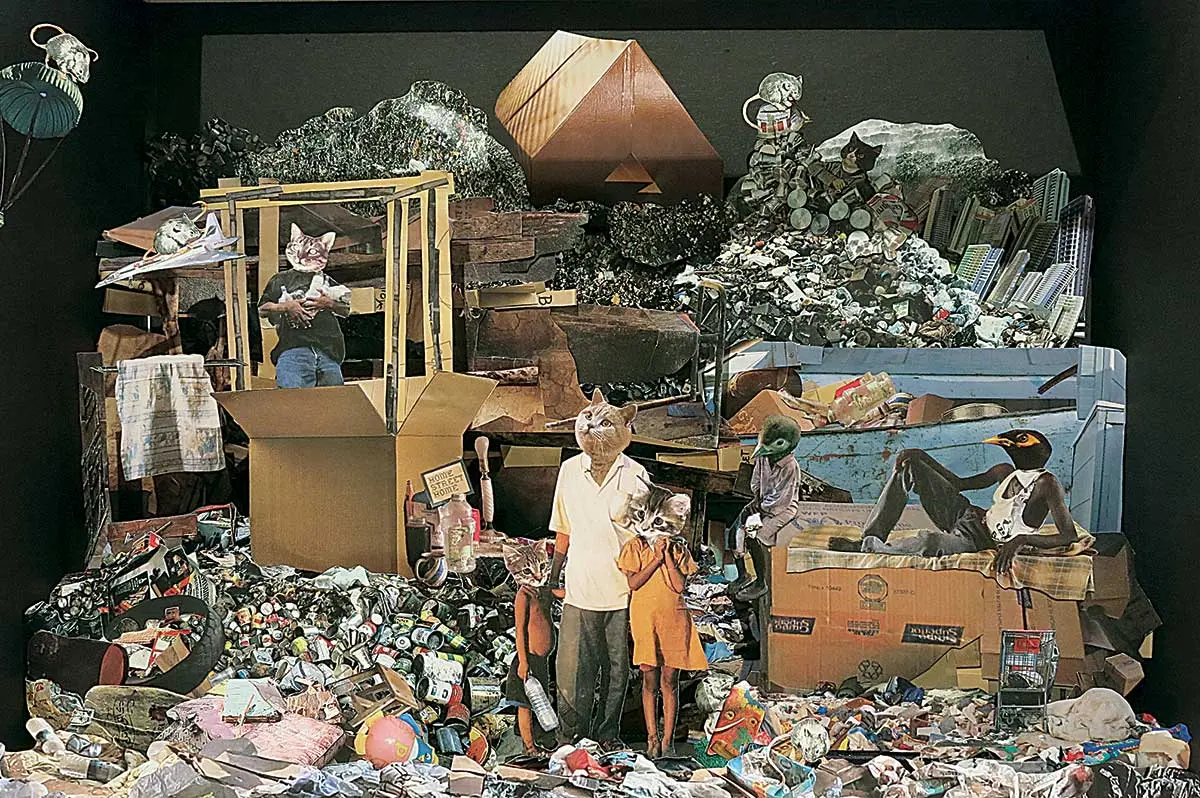
Her most recent collection, to which Moreno assigned the ambiguous title of Bestial (a word whose meaning in Spanish ranges from grandiose and extraordinary to brutal or irrational) consists of ten small dioramas that offer interpretations of her thoughts regarding Panama City. In the exhibition shown in mid-2015 at the Spanish Cultural Center in Panama’s colonial quarter, visitors were surprised by an installation of a group of wooden boxes distributed along the white walls (one of which was strangely left empty). One felt immediately drawn to approach the works in order to take a look inside them, at the contents which were subtly lit, in some cases through a small open slot that allowed light in and, in others, by a glass panel on the top of the boxes.
Each box contains a different world: domestic or social scenes, still-lifes or urban landscapes, all populated by a great number of characters and objects. In terms of the medium, they are based on clippings from illustrations and photographs in magazines that the artist collects methodically and then uses to create collages, which she later brings together to compose assemblages inside the boxes. To the observer, the boxes resemble small theatrical stages, with leading and secondary actors who interact against backdrops that transmit a sense of place.
Moreno presents an apparently playful and innocent—but also analytical and ironic—interpretation of the everyday life, material culture, and habits of Panamanians, as well as social criticism, which she emphasizes through her choice of titles. Of all the inhabitants, only four cats remain--which is made up of three dioramas of ramshackle houses with feline-headed inhabitants--makes a statement regarding the unjust eviction of low-income families from their homes due to this city’s unbridled urban development. In Invasion of the Rats, we see a city environment flooded with garbage and the consequential presence of rodents, in the middle of which a father stands tall with his two children (cat-kids) in an incongruously dignified pose. Two bird-headed figures watch the scene, one resembling a sad child, and the other with a reclining pose and a defiant gaze.
One is struck by the way Moreno uses collage to imbue her theriocephallic characters with a sense of attitude and individual character. The practice of combining human bodies with animal heads has characterized different periods in art history: it was common in Egyptian as well as medieval art but has also been present in modern and contemporary art. The surrealist Max Ernst peopled his collages with bird-men made from magazine clippings, and English artist Charlotte Cory transforms Victorian portraits by inserting zoomorphic heads. Moreno’s assemblages also remind us of U.S. artist Joseph Cornell’s surreal boxes, as well as the photomontages of Dadaist Hanna Höch and of Grete Stern, the German-born photographer who lived in Argentina. Moreno brings her own ideas, even as she participates in rich artistic tradition. Her focus on idiosyncratic details and cultural specificities imbues her work with local significance and a critical point of view, as the Dadaists did in their time. She combines the complexities of a Höch collage with the psychological impact of some of Stern’s Dreams to give life to three-dimensional scenarios that convey a sense of oppression and frustration, or even of the absurd nature of some of the sociopolitical situations in her surroundings.
Corredor Sur (South Freeway) presents an image full of cars and people trapped in a jam on the coastal highway that promised to alleviate the serious issues caused by the excessive traffic in Panama City. On the tops of the cars’ roofs and motors sit their varied and hybrid drivers (eagle-man, parakeet-woman, et al): waiting, reading, or knitting to pass the time. Beyond the street, there are mountains of piled-up cars, against a background of skyscrapers. Nothing flows along this new highway. In a parallel vein, in Flowering Guayacanes, the artist shows how these popular yellow-flowering trees bring forth golden bulldozers and trucks, in a direct reference to the city’s uncontrolled real estate boom.
Although Moreno focuses in many of her pieces on distressing themes such as failed political promises, the omnipresence of garbage, and the hard lives of low-income families, in others she considers quirky issues in a witty manner. For example, in Dim Sum, she explores the strange relationship that exists between the citizenry of this country of transit and its Chinese heritage and population; and in We Love Messi So Much, she makes reference to Panamanians’ great love for soccer. Clearly, Pilar Moreno achieves a balance between esthetics and self-analysis in her dioramas, in which most observers will inevitably discover some reflection of themselves.
MÓNICA KUPFER